BSCI331 Exam 3 - L13: Gene Expression Part 1: Regulation of mRNA Levels
 Call Kai
 Learn
 Practice Test
 Spaced Repetition
 Match
 Flashcards
 Knowt Play
1/88

There's no tags or description
Looks like no tags are added yet.
89 Terms
How can gene expression be regulated?
Gene expression can be regulated at essentially every step from transcription through protein activity/stability
Transcriptional control (DNA —> RNA transcript) - we can control how much RNA transcript is generated
RNA processing control (RNA transcript —> mRNA) - we can control the processing, particularly the splicing, of the RNA transcript to generate a mRNA
RNA transport and localization control - we can control the export of that RNA from the nucleus to the cytosol and localization control (where the RNA is found within the cytosol)
translation control (control whether the ribosome binds to the RNA, how fast it actually translates it, how many copies, is it part of a polyribosome or no)
mRNA degradation control (once the mRNA is in the cytosol, how long the RNA stays to be translated before it is destroyed and rendered inactive mRNA)
protein activity control (once the protein is synthesized, we can control its activity and its location) - aka is it an inactive protein or an active protein
Once that protein has been generated and activated, we can either inactivate it to shut it off or destroy it
At many cases, a gene is regulated at multiple of these steps, which allows for very fine control over gene expression and lots of different types of signals can regulate gene expression!

gene expression
amount of active protein in the cell
expression = is the cell function affected by the regulation of that gene? this only happens with active proteins
Transcriptional control (regulation of RNA transcription)
regulating DNA —> RNA transcript before it becomes mature RNA
For most genes, the primary regulation occurs at the level of RNA transcription
Why is transcriptional control the primary regulation that occurs for most genes?
Because synthesizing polymers is energetically expensive - we avoid the expense of synthesizing unneeded macromolecules
Therefore, matching the amount of RNA synthesis with the expression level requirements (how much protein you actually need to make), you prevent synthesizing unneeded macromolecules - so you only make RNA molecules when you need more protein molecules!
What controls RNA transcription?
Gene regulatory proteins or transcription factors play a key role in defining the level of transcription - they bind to specific sequences in DNA
What is the structure of transcription factors?
Transcription factors generally contain one or more of a small set of well-characterized DNA-binding motifs
motifs - a relatively short sequence of protein that has a common function that we see over and over in proteins
How do transcription factors regulate RNA transcription?
Transcription factors can bind to, and read the DNA sequence by binding the outside of the DNA helix, influencing EITHER the binding OR activity of RNA polymerase II
What is the structure of DNA?
DNA is a double helix that has two faces: the major groove and the minor groove
If you think of the circumference around the DNA double helix, there is one side where the sugar phosphate backbone is further away in circumference (TOP = major groove) and the other side where it’s closer together (BOTTOM = minor groove)
Hydrogen-bonding between the complementary nitrogenous bases (A-T, C-G) and other atoms that can participate in hydrogen bonding not between the nucleotides but with an external molecule like a protein

**KNOW - major groove and minor groove contain atoms that are capable of hydrogen bonding
In the major groove - for a GC-based pair, there is a hydrogen bond acceptor N and hydrogen-bond acceptor O on the G ring (in orange) and hydrogen-bond donor amine hydrogen (in blue) on the C
The minor groove also has a hydrogen bond acceptor (H in amine) on the lower part of G,
A-T pairs also contain methyl (CH3)
Regulatory proteins bind to the DNA, interacting with the major or minor groove and interact with these accessible hydrogen bond acceptor and donors and be able to detect which base pair (G-C or A-T) it is by making specific contacts in the major or minor grooves

Major vs. minor groove information
The position of these atoms is asymmetrical in the major groove but symmetrical in the minor groove - more info from the major groove
Why? There are 4 positions that can be recognized in the major group
For a G-C base pair, that is hydrogen bond acceptor (N on G), acceptor (O double bonded on G), donor (H on the amine of C), uninvolved H (on C) - (WHEN THE G IS ON THE LEFT AND IT’S G-C)
When the G is on the RIGHT, it’s the reverse (uninvolved H, donor, acceptor, acceptor)
By binding in the major groove, you can tell whether the G is on the left or on the right
The same is for the A-T base pair
If A is on the left, you have acceptor (N) donor (H), acceptor (O), uninvolved (CH3)
But flipped with T-A pairing, it’s uninvolved, acceptor, donor
There’s more info given by the major groove than the minor groove because the minor groove only presents acceptor (N), donor (H), acceptor (O) for G-C pairing with G on the left - only three positions
So when flipped with G on the right, it’s acceptor, donor, acceptor !! BOTH ARE ACCEPTOR, DONOR, ACCEPTOR
So you can tell this is a GC base pair but you can’t tell the orientation - whether the G is on the left or the right like you can with the major groove


THIS CAN BE VISUALIZED LIKE THIS - THE MAJOR GROOVE PRESENTS A UNIQUE SIGNATURE FOR EACH BASE PAIR BECAUSE IT IS ASYMMETRICAL!!!!!! BUT THE MINOR GROUP CANNOT BECAUSE IT’S SYMMETRICAL SO BINDING THE MAJOR GROOVE WE CAN TELL THE EXACT SEQUENCE (WHETHER G IS ON LEFT OR NOT), THAT IS WHY BINDING TO THE MAJOR GROOVE ALLOWS TRANSCRIPTION FACTORS TO READ IT
The major groove presents additional information than the minor groove
How can DNA-binding proteins like transcription factors recognize specific DNA sequences without separating the two DNA strands (unzipping)?
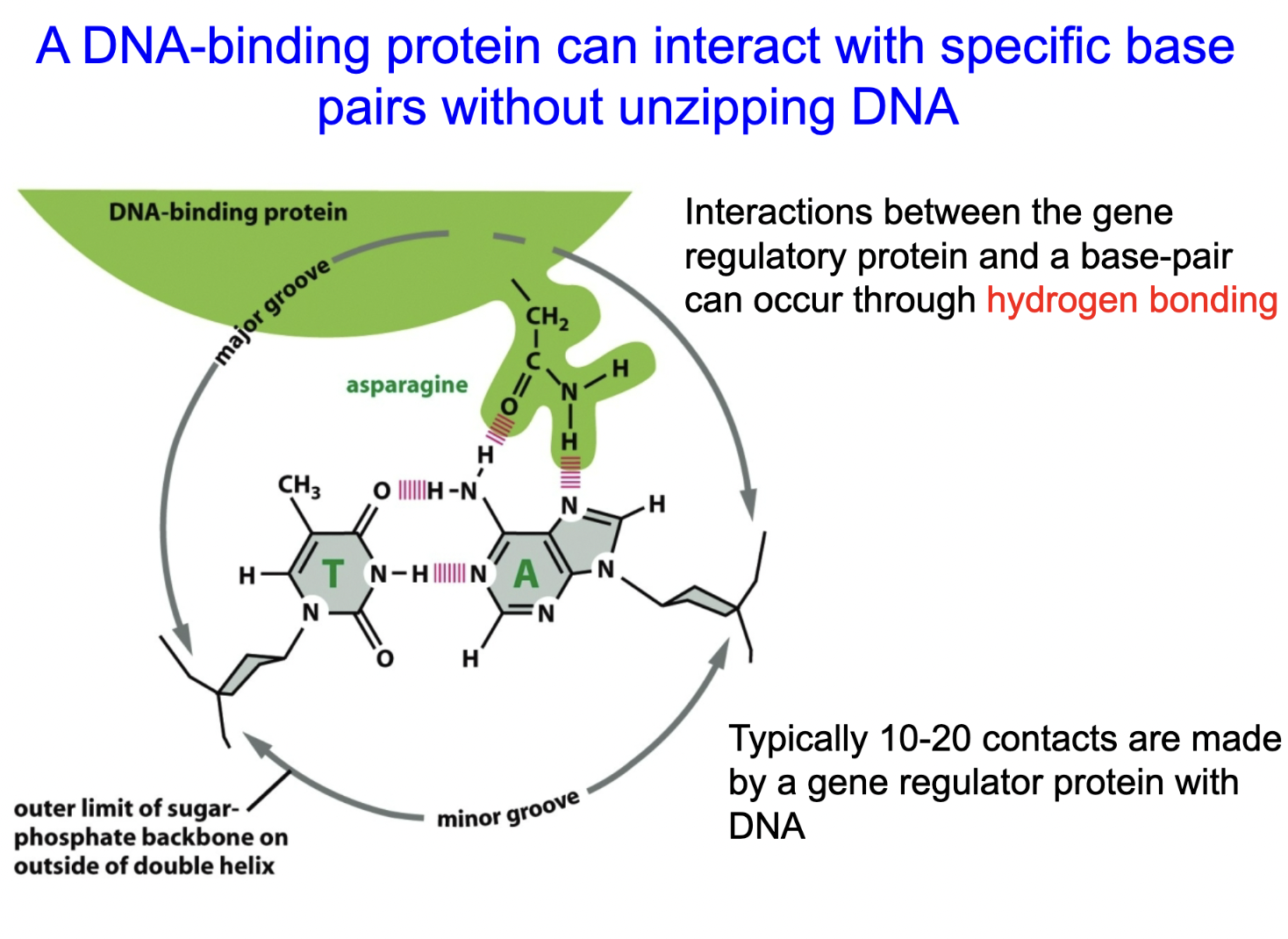
DNA-binding proteins can identify particular base pairs by hydrogen bonding with chemical groups that are exposed on the surface of the DNA double helix in the major groove
DNA is a double helix with a sugar phosphate backbone on the outside and nitrogenous base pairs (A-T and G-C) on the inside
Even though the bases are inside the double helix, some parts of the bases are exposed within the major and minor groves along the DNA surface
DNA-binding protein like transcription factors are proteins that contain residues like asparagine, whose side chain can extend into the major groove of the DNA and hydrogen bond with the chemical groups exposed on the base pairs (ex. A-T base pair)
These interactions help the transcription factor recognize and bind to a specific DNA sequence
However, one hydrogen bond is usually not enough for highly specific regulation. A transcription factor usually makes around 10-20 contacts with DNA.
To bind to DNA, transcription factors use…
DNA-binding motifs - protein (amino acid) structures that allow proteins like transcription factors to bind specific DNA sequences without breaking the base-pair hydrogen bonds between two DNA strands (unwinding)
Commonly found on many transcription factors
Secondary structures (like a-helices and b-sheets)
Types of DNA-binding motifs
Helix-turn-helix
Homeodomain
Zinc fingers
Leucine zipper
Helix-loop-helix (HLH)
Helix-turn-helix
A DNA binding motif made of two alpha helices connected by a short, unstructured stretch (“turn”) - two alpha-helices connected by a short turn (short, unstructured stretch)
The alpha helices are held at a specific angle by interactions between the helices (hold each other at a specific angle) - the specific angle of the two helices allows them to interact with DNA in a sequence-specific fashion (at a specific sequence of DNA bases)

What is the structure of the helix-turn-helix?
One alpha helix is the N-terminal alpha helix (has a terminal NH2) that stabilizes the helix-turn-helix with DNA
The other alpha helix is the C-terminal alpha helix (has a terminal COOH) that serves as the recognition helix that fits into the major groove of DNA and makes contact with the sequence, such as hydrogen bonds with exposed chemical groups on DNA bases

DNA-binding proteins like helix-turn-helix tend to act at the major grove because..
the major groove is the perfect size to fit an alpha-helix in it (alpha-helix will not fit into the minor groove)
Although not absolutely necessary, many helix-turn-helix transcription factors bind to DNA as..
symmetric dimers - two identical DNA-binding proteins bind to each other in a symmetric way with a plane of mirror symmetry - ex. tail to tail, head to head
Each of the DNA-binding protein’s (subunit’s) recognition helix binds to one “half-site” within the DNA of the major groove, separated by one turn of the DNA helix
OR heterodimers - two different but related DNA-binding proteins that bind together
Homeodomain
a special case of the helix-turn-helix motif
A larger structure that includes the helix-turn-helix region plus other highly conserved structures, including a third alpha helix
Extremely highly conserved across species, even billions of years of evolution apart

Conserved structure of the homeodomain suggests that..
All homeodomians are presented to DNA in the same fashion
conserved = protein structure that has remained relatively similar across different proteins even through billions of years of evolution
Because homeodomains have very similar 3D structures, they generally bind to DNA in a similar way
Structure of homeodomain
Helices 2 and 3 are the helix-turn-helix structure
Helix 1 is added at the N-terminus of the structure as the third alpha helix

How does the homeodomain make contact with DNA?
Helix 3 (C-terminal recognition helix) as the helix-turn-helix core make regular contact with the major groove through hydrogen bonding
Helix 1 (the third alpha helix) also makes contact with the minor groove

Zinc finger
DNA-binding motif that is made of one or more zinc ions coordinated by amino acid side groups

**ON EXAM What are the two subclasses of zinc fingers?
One subclass uses 2 cysteines and 2 histidines to coordinate ONE zinc ion
Another subclass uses 4 cysteines to coordinate TWO zinc ions
One subclass uses 2 cysteines and 2 histidines to coordinate the zinc ion - the zinc ion sits between an alpha helix and 2-strand antiparallel beta sheet (don’t need to memorize any of this) - zinc fingers can only recognize 1 or 2 nucleotide pairs in the sequence, so one is not sufficient. Therefore, specificity requires a SERIES of zinc fingers (like a zinc hand) that stick into the DNA and recognize specific nucleotides - the alpha helix of the zinc finger binds the DNA in the major groove
So a transcription factor will have a series of zinc fingers in a row, with each finger “sticking itself” into the DNA and recognizing 1 or 2 nucleotides. This drastically improves the specificity of the transcription factor
Important: there is still only ONE zinc ion despite multiple zinc fingers
Zinc finger with 1 zinc ion
One zinc ion (Zn2+) that coordinate bonds with 2 cysteines and 2 histidines (don’t need to memorize), stabilizing a structure containing an alpha helix and 2-strand antiparallel beta sheet
The alpha helix of the zinc finger can fit into the major groove of DNA and recognize specific DNA bases
How do zinc fingers contribute to specificity?
Zinc fingers can only recognize 1 or 2 nucleotide pairs in the sequence, so one is insufficient. Therefore, specificity requires a SERIES of zinc fingers (like a zinc hand) to stick into the DNA and recognize specific nucleotides. The alpha helix of the zinc finger binds the DNA in the major grove.
Multiple zinc fingers in a row can recognize a larger nucleotide sequence, drastically improving the specificity of the transcription factor
IMPORTANT - A TRANSCRIPTION FACTOR CAN CONTAIN MULTIPLE ZINC FINGERS, AND EACH ZINC FINGER HAS A SINGLE ZINC ION
Zinc finger with 2 zinc ions
Second subclass of the zinc finger motif that is made of 2 zinc ions coordinated with 4 cysteines
What are the functions of the zinc ions in the zinc finger motif with 2 zinc ions?
One zinc ion stabilizes the recognition helix (to bind to DNA)
The other zinc ion stabilizes a loop involved in dimerization - helping 2 protein subunits interact with each other to form a dimer
note: the zinc fingers do not directly connect the two protein subunits; instead, they stabilize the structures within each subunit that allow the proteins to interact
Zinc fingers with 2 zinc ions bind to DNA as…
symmetric dimers, similar to helix-turn-helix proteins (mirror symmetry)
Each half-site (one of the two DNA sequence regions recognized by a transcription that binds DNA as a dimer)
In this example:
Subunit 1 of the zinc finger with 2 zinc ions binds to one specific DNA sequence called half-site 1
Subunit 2 of the zinc finger with 2 zinc ions binds to another specific DNA sequence, called half-site 2
Together, the two subunits recognize the complete DNA-binding site
EACH HALF-SITE IS SEPARATED FROM EACH OTHER BY A FULL TURN OF DNA
By dimerization it means..
Each protein subunit contains a DNA-binding domain stabilized by 2 zinc ions.
Two protein subunits interact through their dimerization regions to form a dimer.
Each subunit's recognition helix binds to one DNA half-site.
So:
2 protein subunits × 2 zinc ions per subunit = 4 zinc ions total.
ZINC FINGER WITH TWO ZINC IONS IS NOT A SINGLE PROTEIN FOLDED UP INTO TWO ZINC FINGERS. EACH SUBUNIT IS CONSIDERED A ZINC FINGER THAT TOGETHER DIMERIZE!!!!
ZINC FINGER WITH TWO ZINC IONS IS NOT A SINGLE PROTEIN FOLDED UP INTO TWO ZINC FINGERS. EACH SUBUNIT IS CONSIDERED A ZINC FINGER THAT TOGETHER DIMERIZE!!!!
EACH SUBUNIT HAS 2 ZINC IONS! SO IT IS A TOTAL OF 4 ZINC IONS

** ON EXAM: Which transcription binding motifs are always dimers and which ones are not? Which transcription factors contain a dimerization region and which ones do not?
Zinc finger with 2 zinc ions - The first class of zinc fingers can work as monomeric proteins - the second class of zinc fingers are obligate dimers - they must act as dimers because the DNA binding region contains the dimerization region (it can’t work as a DNA binding region if it doesn’t contain this region that allows for dimerization)
Leucine zipper
Single zinc ion zinc finger does not
Homeodomain does not
The helix-turn-helix does not
They can act as dimers if there is a dimerization protein
Leucine zipper
Also an obligate dimer (the DNA-binding region contains the dimerization region) - composed of two protein subunits, binding DNA as a dimeric structure
Each subunit contains an an a-helix with a hydrophobic surface on on side
Quatenary structure

What defines the dimeric structure of a leucine zipper?
The a-helix from one subunit binds to the corresponding a-helix in the second subunit in a coiled-coil structure
The two a-helix interact together through hydrophobic interactions of their hydrophobic surface, wrapping around each other to form a coiled-coiled structure
Why is a leucine zipper called a leucine zipper?
Because it contains two subunits with two α-helices, each with its own hydrophobic surface, wrap around each other so their hydrophobic surfaces interact and are “zipped” up in the middle of the molecule, keeping the hydrophobic amino acids away from water and maximizing the entropy of the water and stabilizing the interaction face
The alpha helix serves as..
both the dimerization region and the DNA-binding region
On each alpha helix:
One end is the coiled-coil region is where dimerization occurs (with the other alpha helix)
The other end is the DNA-binding region
Because of the coiled-coil structure…
The leucine zipper interacts with DNA in a straddling fashion, almost like a pair of scissors coming down on the DNA. As a result, instead of the half-sites being separated by a full turn of DNA, the two half-sites are adjacent to each other
In the picture - at the top, the alpha helices wound around each other
At the bottom - interacting in a straddling fashion around the DNA
The two-half sites are on OPPOSITE faces of DNA
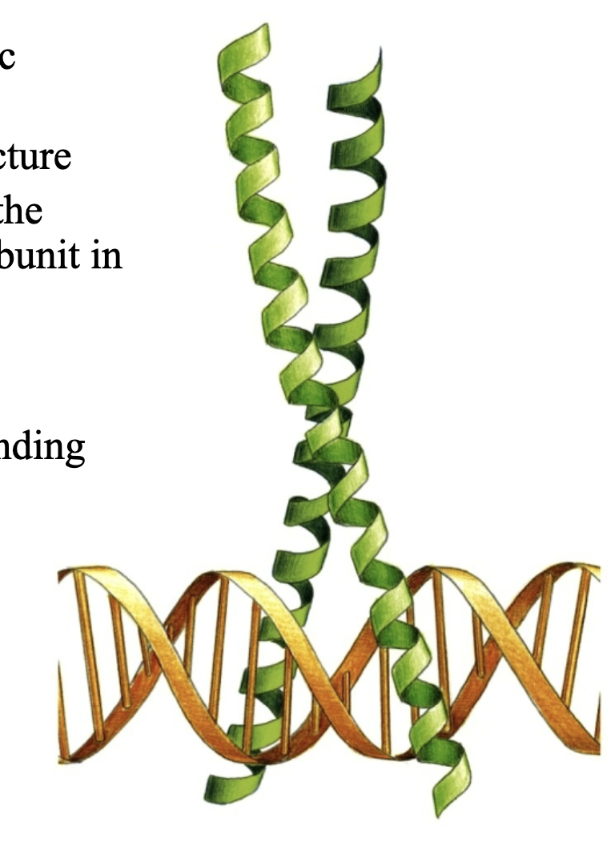
**ON EXAM- What is the difference between the way a two zinc ion finger binds to DNA vs. the way a leucine zipper binds to DNA?
The leucine zipper binds in a straddling fashion with two half sites that are adjacent to each other. The two zinc ion zinc finger dimers bind on the same face of DNA, where the half-sites are separated by one turn of DNA.
Leucine zipper transcription factors bind DNA in a straddling arrangement, with two subunits recognizing adjacent half-sites, resulting in subunits binding on opposite sides of the DNA double helix. In contrast, the two-zinc-ion zinc-finger dimers recognize half-sites separated by approximately one full turn of DNA, allowing both subunits to bind on the same face of the DNA double helix.
Helix-loop-helix (HLH)
A short alpha helix connected to a longer alpha helix by a flexible loop (two alpha helices separated by a flexible stretch of protein)
Like the leucine zipper, the HLH motif acts as both a dimerization interface and the DNA-binding region
IMPORTANT: How does the helix-turn-helix function as a dimerization interface?
Each protein subunit contains:
Helix 1: An α-helix.
Loop: A flexible region connecting the two helices.
Helix 2: Another α-helix.
The two α-helices are connected by a loop, forming the helix-loop-helix motif.
Two protein subunits, each containing an HLH motif, interact through their α-helices.
This allows them to dimerize, forming a stable protein complex.
The two short alpha helices of each subunit interact to form coiled-coil interaction that serves as the dimerization interface between the two subunit
Green = one polypeptide chain; blue = separate polypeptide chain; two subunits that are interacting together

What does this loop allow for the structure?
The loop allows one helix to fold back and pack against the other in a specific angle/orientation
What is the difference between the helix-turn-helix and the helix-loop-helix?
The loop in the helix-loop-helix is much longer than the loop in the helix-turn-helix; the helix-turn-helix has just enough amino acids to bend the protein around
Which motifs are the obligate dimers?
Two zinc ion zinc finger
Leucine zipper
Helix-loop-helix
They are OBLIGATE dimers (always act as dimers) because the dimerization region is part of the DNA-binding region (two protein subunits must come together aka dimerize to form a functional DNA-binding structure)
**ON EXAM: ow can other motifs can act as obligate dimers?
Helix-turn-helix and the homeodomain motifs can act as dimers if as part of the larger protein (the transcription factor), there’s a dimerization region - but they do not have to because the DNA binding domain does not necessarily contain a dimerization region
**ON Exam - which transcription factor motifs are obligate dimers, and which ones are not? And why?
Obligate dimers:
Two zinc ion zinc finger
Leucine zipper
Helix-loop-helix
They must be obligate dimers because the DNA binding region contains a dimerization region
Non-obligate dimers (do not necessarily have to be a dimer, but can be)
Helix-turn-helix
Homeodomain
Helix-turn-helix and the homeodomain motifs can act as dimers if as part of the larger protein (the transcription factor), there’s a dimerization region - but they do not have to because the DNA binding domain does not necessarily contain a dimerization region
What is the advantage of dimerization in DNA binding of transcription factors?
Dimerization of DNA-binding proteins can enhance binding and specificity by increasing the contact area with DNA (bind as not a single monomeric protein on DNA, but two cooperative proteins on DNA)
What is the advantage of heterodimerization in DNA binding of transcription factors?
Heterodimerization (between two different members of the same class - between 2 different subunits of the same subunit family) increases the range of sequences that can be recognized by a very small number of transcription factors - combinatorial math
Ex. 2 different subunits that can interact in a homodimer fahsion or a heterodiomer fasihion (they can interact with themselves or the other) so 1 subunit + a diff subunit = hetero, or they each could form a dimer with another of their own kind of subunit, so SA + SA, SB + SB or SA+SB
each combiniation of subunit = different dna sequence the trnascipriton factor cna reocgnize
so with 2 subunits, you can reocgnize 3 distinct sequences
anytime you can save on making genes, you can save ATP!

How many different sequences could be recognized by dimerization of a TF that has 3 different pairing partners, A, B, and C?
A - 3
B - 6
C - 9
3 different pairing partners means:
A+A, B+B, C+C; A+B, B+C, A+C
Which is a total of 6 different sequences that dimerization of subunits, so B
Ex. transcription factor families that have a dozen proteins that can homodimerize and heterodimerize with each other
homodimerize = same type of subunit dimerizes (A + A)
heterodimerize = two different types of subunits dimerize (A + B)
You can get hundreds of combinations of dna sequences without having to make nearly that many protein sequences (same subunits that are just being mixed together to dimerize and recognize new dna sequences - so cell doesn’t have to invest more ATP)
hUGE ADVANTAGE OF HETERODIMIZATION - SO EXTMREELY COMMON
You can get hundreds of combinations of dna sequences without having to make nearly that many protein sequences (same subunits that are just being mixed together to dimerize and recognize new dna sequences - so cell doesn’t have to invest more ATP)
ON EXAM - WHAT IS THE ADVANTAGE OF DIMERIZATION FOR TRANSCRIPTION FACTORS?
It increases the affinity for DNA (binding strength) - how tightly the transcription factor binds to DNA
It increases the specificity for DNA - how precisely can the transcription factor can recognize its recognition sequence outside of the randomness of the DNA sequence
By heterodimerizing, you increase the number of recognition sequences much faster than you have to increase the number of protein sequences
How does dimerization increase the affinity for DNA?
Affinity - binding strength/how tightly a transcription factor binds to DNA
When two transcription factor subunits dimerize, each subunit can interact with a different DNA half-site.
This creates more interactions between the transcription factor complex and DNA.
Together, these interactions can stabilize binding, making the transcription factor less likely to dissociate.
Two subunits can make more stabilizing contacts with DNA, increasing overall binding strength.
How does dimerization increase the specificity for DNA?
Specificity - how well a transcription factor distinguishes its target DNA sequence from other sequences
Each subunit recognizes a particular DNA half-site.
When the two subunits dimerize, they recognize a larger combined DNA sequence.
The probability of finding that complete recognition sequence randomly in DNA is generally lower than finding either individual half-site.
Each subunit recognizes a DNA half-site, allowing the dimer to recognize a longer, more distinctive DNA sequence that is less likely to occur randomly.
How does dimerization increase the diversity of recognition sequences?
Heterodimerization allows different transcription factor subunits to combine, creating new combinations of DNA-binding specificities without requiring an entirely new protein for each combination.
How do transcription factors (proteins) regulate RNA transcription?
Transcription factors bind to one of 2 types of gene regulatory regions (near the gene): promoter or enhancer
promoter
region where RNA polymerase and the general transcription factors assemble
Where is the promoter located?
ALWYS a short distance “upstream” of the 5’ end of the gene - ahead of the gene, NOT part of the RNA transcript
5’ end of the gene = the nucleotide that would be the 5’ nucleotide of the DNA strand that is sequence identical to the RNA molecule (coding strand) - DNA sequence that would be the same as the RNA transcript except for a T —> U change (complementary strand to the one being read by RNA polmerase)
5’ most nucleotide that looks like the RNA transcript
upstream = opposite direction from the way RNA polymerase moves
downstream = same direction as RNA polymerase as it transcribes (into the gene)
so on this strand of DNA, downstream means moving from 5’ to 3’
upstream = moving from 3’ to 5’
Without the promoter..
transcription cannot happen because it is where RNA polymerase binds
Although transcription cannot happen without the promoter, the promoter provides..
only a low level/basal level of transcription by itself; not sufficient for the amount of transcription the cell needs
A promoter may be..
gene-specific; only drives the transcription of its own gene (i.e., not work if you put it next to a different gene) and its orientation is important (can’t flip the promoter around 180 degrees, put it on the other strand, etc.)
Ex. Promoter —> gene A, another promoter —> gene B
If you take the promoter in front of gene A and move it in front of gene B, it may not drive transcription of that gene
enhancer
any independent gene regulatory region outside the promoter
Is the enhancer necessary for transcription?
No, enhancer is not necessary for transcription - it enhances transcription, but it doesn’t promote transcription (helpful, but not necessary)
Where is the enhancer located?
Outside of the promoter - may be very far away from the promoter (up to 10s of kb), and may be upstream of the gene, downstream, or even within the gene (even in the middle of the intron of a gene)
Can an enhancer drive transcription by itself?
NO! An enhancer cannot drive transcription by itself without a promoter
PROMOTER IS NECESSARY FOR TRANSCRIPTION.
However, the enhancer can enhance (increase) transcription thousands of fold or more - to take you from basal level transcription to transcription that is thousands as high as just with the basal promoter (dramatically increases transcription initiation from its corresponding promoter)
Are enhancers dependent on anything?
Enhancers are generally position- and orientation-independent
Position independent - No matter where the enhancer is located, it will work the same - enhancer will work the same at 1000 nucleotides upstream of a gene vs. 500 nucleotides upstream of a gene vs. in the middle of the intron)
Orientation independent - could flip it around 180 degrees, and it still works fine (because it’s not where the RNA polymerase binds - so it won’t affect the orientation of the RNA polymerase that transcribes)
Enhancers work with..
a heterologous promoter (a promoter from a different gene). You can stick the enhancer from any gene and stick it next to the promoter of any other gene, and it will work fine enhancing transcription for that gene
Enhancers are much more flexible than promoters
What do transcription factors do?
Transcription factors bind to specific sequences in the promoter or enhancer region
In eukaryotes, there may be dozens of transcription factors that bind and therefore regulate an eukaryotic gene with a much finer degree of control
Eukaryotic gene regulatory regions are typically much more complex than prokaryotic regulatory regions
How do transcription factors work together?
Multiple (sometimes dozens or hundreds) of gene regulatory proteins work together to control the rate of transcription - allowing for combinatorial control of expression
What does it mean by combinatorial control of expression?
Ex. Do I have transcription factor A bound, and not B, C, D, E, F
Can have combinatorial control - A + B bound, but not the others, A + F+ D, bound etc.
(multiple transcription factors act together in specific combinations to produce a precise outcome)
What are the ways that transcription factors can work together?
Transcription factors can work cooperatively (e.g., two activators that both increase the transcription of that gene when bound) or antagonistically (e.g. an activator vs. repressor)
This increases the possible combinations of transcription factors and their effect on transcription
Cooperative interactions can also increase transcription synergistically - more than simply additive effects (ex. transcription factor A increases transcription 5-fold, transcription factor B increases transcription 2-fold, you put them together - you don’t get 7 fold, maybe not even 10-fold, but 100-fold increase by both of these transcription factors being present)
(image represents synergy - green = 1 unit of transcription, red = 2, put them together and get 100 units)
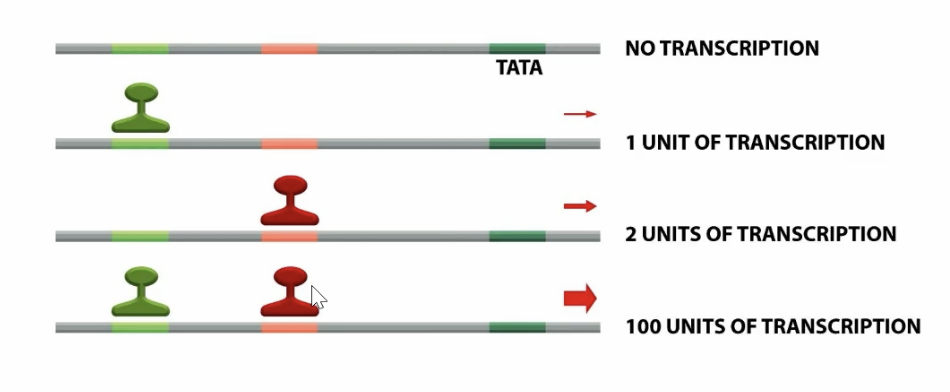
How are synergistic effects possible?
Transcription factors can bind regulatory DNA sequences located far from the promoter.
DNA can bend and loop, bringing these distant transcription factors physically close to the promoter.
The Mediator complex is a large multiprotein complex that interacts with gene regulatory proteins and RNA polymerase II transcription machinery.
Mediator helps integrate the activating or repressing influences of different transcription factors and communicate them to the transcription machinery.
By allowing multiple transcription factors to cooperate, Mediator can contribute to synergistic transcriptional activation, where the combined effect exceeds the sum of the individual effects.
DNA looping brings distant transcription factors close to the promoter, while the Mediator complex helps integrate their regulatory signals and communicate them to RNA polymerase II. This cooperation can produce synergistic effects on transcription.

**ON EXAM: What are the mechanisms that transcription factors use to regulate gene expression?
Some transcription factors help to unpack chromatin, making the gene accessible to RNA polymerase and the initiation complex (more global unravelling for RNA polymerase binding)
Some transcription factors control recruitment of RNA polymerase and/or the general transcription factors to the promoter (to help stabilize them there)
Some transcription factors may regulate the switch from initiation to elongation (once the RNA polymerase binds, it doesn’t immediately transcribe but waits - TFs help turn the RNA polymerase from initiation to transcription mode)
Some transcription factors recruit histone-modifying enzymes to change the local chromatin structure (to help open/close it more locally as the RNA polymerase transcribes, and as it’s transcribing the DNA is not running into more tightly packed chromatin - for movement through the DNA, not binding)
Some TFs bend DNA to allow long-distance interactions between gene regulatory regions (more distant transcription factors can interact with the RNA polymerase complex)
Transcription factors can serve as..
activators or repressors
Ex. transcription factors that recruit chromatin condensing or chromatin condensing machinery, shutting transcription off
Ex. inhibitors that block the switch from initiation to elongation, block the binding of RNA polymerase
Ex. histone methylase adds methyl groups, the histone demethylase will do the reverse - remove methyl groups from histone proteins
Transcription factors must be..
Transcription factors must be selectively activated - if every transcription factor was on in the cell all the time, there would be no regulation and every gene would be transcribed all the time
How are transcription factors regulated? (How do you regulate the regulators?)
Many transcription factors are regulated at the level of gene transcription (the cell controls whether the genes encoding those transcription factors are transcribed in the first place - the genes of the transcription factors are only transcribed when necessary)
What are examples of when transcription factors are regulated?
Tissue-specific expression (present in the liver, but not lymphocytes)
Different tissues produce different transcription factors; all cells in the body contain the same DNA. For example, liver cells contain genes involved in liver function; lymphocytes also contain those same genes, but not all genes are expressed in every cell type. This is because different cell types have different transcription factors that control which genes are turned on or off. Ex. A transcription factor that helps activate genes involved in liver metabolism will only be transcribed in liver cells, not lymphocyte cells.
Expressed only in response to specific environmental signals (ex. toxin in environment leads to the induction of a transcription factor that regulates a detoxifying enzyme - only see the transcription factor present in the cell when the environmental stimulus is present)
Expressed during specific phases of the cell cycle (ex. S phase is regulated only by transcription factors that are only turned on in the S phase)
What problem does this pose?
If this transcription factor is regulated by transcription, then there must be another transcription factor that regulates it, and another transcription factor that regulates that one.. this is a chicken-and-egg problem; how can the transcription of TF genes be selectively regulated? What’s the first transcription factor?
Therefore, at some point, there must be a transcription factor that is regulated by something OTHER than a transcription factor (some transcription factors must be regulated by other mechanisms)
What other mechanisms regulate transcription factors than more transcription factors?
If not regulated at the level of transcription, TFs must be regulated post-transcriptionally (after they are made)
Many transcription factors are present in the inactive state, but are activated by phosphorylation (to turn it ON)
Ex. The mitogen activated protein kinase (MAPK) family is important for phosphorylating a variety of transcription factors in response to signals from cell-surface receptors
cAMP activates protein kinase A that phosphorylates the cAMP response element binding protein, which is a transcription factor that binds to DNA and regulates genes that are responsive to cAMP
Phosphorylation converts an inactive transcription factor into an active form, or vice versa
Ex. from some TFs, phosphorylation of TF can directly regulate its activity - can allow a transcription factor to be activated to recruit chromatin remodeling proteins, allow TFs to bind to DNA, etc.
Transcription factors often have…
multiple sites for phosphorylation and other modifications - ligand binding in general can regulate transcription factors, so it’s not necessarily phosphorylation
Multiple sites for modifications results in them acting as molecular integrators - combinations of various signals can induce different cellular changes
What is another way that transcription factors are regulated?
Post-translational modification may not regulate TF activity directly, but instead acts by changing cellular localization (by moving the transcription factors from the nucleus to the cytosol or vice versa)
In many cases, the modification to TFs is mostly engaged in relocating the transcription factor from the nucleus to the cytosol or cytosol to the nucleus. How does this regulate the activity of TFs?
Because the transcription factor can only be active if it can access the DNA in the nucleus. If you keep it out of the nucleus, that is good enough to turn it off. Even if you were to provide the TF with DNA in the cytosol, it might be able to bind to it, but it can’t have access to the DNA
Aka relocation is a common way of regulating transcription factors
Ex. transcription factor NF-AT in the resting state is in the cytosol (inactive because they are in the cytosol); when it’s activated, it’s moved into the nucleus
Can you explain what it means by most transcription factors are regulated at multiple levels?
Many transcription factors are regulated at the level of gene transcription (the cell controls whether the genes encoding those transcription factors are transcribed in the first place - the genes of the transcription factors are only transcribed when necessary) - pretranslation
Post-translational: transcription factors can be regulated by changing their location within the cell, which turns them on or off (if they are moved to the nucleus, they are on, if they are in the cytosol, they are off)
Post-translational modification: Phosphorylation of TF converts an inactive transcription factor into an active form, or vice versa - or other chemical modifications like acetylation (which can occur ex. after the TF has been moved into the nucleus where it’s on - it can be further modified to increase transcriptional activity or decrease it)
Combinatorial control of transcription factors can generate complex patterns during animal development
Ex. Even-skipped (Eve) expression in fly embryo
Rainbow = a Drospholia fruit fly embryo made up of repeating segments that are set up by a repeating pattern of transcription factors
There are 14 stripes or segments of the embryo
Point mutation in a single transcription factor in the fruit fly where the even numbered segments disappear - so because the transcription factor responsible for generating those even segments are missing, those even segments are missed entirely during translation
There is also an odd-skipped mutation when a transcription factor responsible for generating the odd segments (1,3,5,7) is missing
The 1-7 in the picture shows the regions where the even-skipped gene is expressed; Darker regions between stripes: Regions where Eve expression is low or absent.
The enhancer of the even-skipped promoter enhancer region is made up of different modules that each control one of the strips (ex. DNA binding region that controls the second stripe in the embryo)
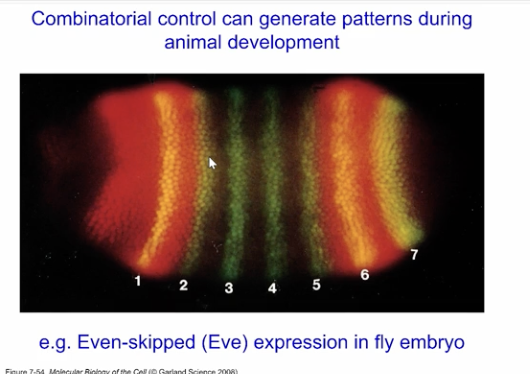
How can one stripe of the embryo be turned on and not others?
The stripe two module is controlled by a combination of four transcription factors that are expressed not from the embryo’s genome but from the mother
The four transcription factors bind to the stripped two module in an overlapping fashion
They are antagonistic transcription factors - two of them are positive acting, and two are negative acting

Image shows what the fruit fly embryo looks like - in the front of the embryo, lots of the Giant transcription factor which is an inhibitory transcription factor, and a gradient of Hunchback and Bitcoin which are positively activated transcription factors
The Giant gradient falls off steeply as you approach the location where the stripe two is
When the Giant falls below a certain threshold, its ability to inhibit the positive activity of Hunback and Bicoid goes away, and there’s a narrow region where Hunchback and Bicoid are high enough to regulate (enhance) transcription and Giant is not concentrated enough to inhibit it
Once you get further to the posterior of the embryo, the amount of this Kruppel TF protein (negative regulator) increases - so at the back end, the Kruppel levels are high enough and the Hunback and Bicoid concentrations are low enough for inhibition to occur
These four trasnscription factors specifically regulate the expression of stripe 2 (the eve gene) - other combinations of transcription factors allow even-skipped to be expressed, even if Kruppel is high
Stripe three for example binding site wouldn’t have a Kruppel binding site - it would have a different set of transcription factors that are in a different pattern in the embryo that define that stripe three
EACH STRIPE MODULE HAS ITS OWN PATTERN OF TRANSCRIPTION FACTORS (UNIQUE COMBINATION OF TRANSCRIPTION FACTORS THAT REGULATE IT) - THAT ONLY ALLOW ACTIVITY IN ONE NARROW STRIPE!

This is all great, but how do different cell types even arise to be able to express different TF patterns?
A) Cells in different places in an embryo can sense their locations and activate/express different TFs
B) During development, cells can receive different soluble signals that direct TF expression/activation
C) Both A and B are mechanisms
D) I don’t think either A or B makes much sense
C) Both A and B are mechanisms
A) Cells in different locations can sense their positions
Cells can receive positional information that tells them where they are within an embryo.
For example, a cell near the anterior (front) of an embryo may experience different regulatory signals than a cell near the posterior (back).
These differences can activate different transcription factors, causing the cells to express different genes.
B) Cells receive different soluble signals
During development, signaling molecules called morphogens can form concentration gradients across an embryo.
Cells exposed to high morphogen concentrations may activate TF-A.
Cells exposed to intermediate concentrations may activate TF-B.
Cells exposed to low concentrations may activate TF-C.
These transcription factors then regulate different sets of genes, helping cells develop into different cell types.
How are A and B connected?
Mechanism B is actually one important way mechanism A happens.
Cells can determine their positions by sensing local concentrations of morphogens.
How can we further regulate transcription factors?
RNA levels of transcription factors can be regulated at the level of initiation OR termination
Initiation - whether RNA polymerase begins transcribing a gene
Termination - whether RNA polymerase finishes transcribing the gene
Previously, we learned that transcriptions factors can regulate INITIATION by helping recruit or activate RNA polymerase
Now learning how cells can regulate gene expression AFTER TRANSCRIPTION HAS ALREADY STARTED
Transcription attenuation
the premature termination of transcription before RNA polymerase reaches the normal end of a gene (RNA polymerase does not go all the way to the end of the RNA molecule)
What is the process of transcription attenuation?
RNA polymerase begins transcription, producing a growing RNA molecule
A cellular signal, like abundance of metabolites, influences the RNA's folding.
The growing RNA chain then begins to fold into a particular 3D structure due to internal complementarity (folds up on itself as base-pairs pair with each other)
This 3D RNA structure interferes with RNA polymerase activity, causing it to pause and eventually terminate transcription
As a result, the cell produces a shortened RNA transcript instead of the complete transcript
How can attenuation be reversed?
By binding of specific proteins to the RNA structure, allowing RNA polymerase to complete transcription