econ chpt 6 quiz
 Call Kai
 Learn
 Practice Test
 Spaced Repetition
 Match
 Flashcards
 Knowt Play
1/19

There's no tags or description
Looks like no tags are added yet.
20 Terms
Price elasticity of demand is the ratio of the
absolute change in quantity demanded to the absolute change in price.
absolute change in price to the absolute change in quantity demanded.
percentage change in quantity demanded to the percentage change in price.
percentage change in price to the percentage change in quantity demanded.
percentage change in quantity demanded to the percentage change in price.
Suppose that the quantity demanded of good X rises by 8 percent when the price of good X falls by 2 percent. This information indicates that the price elasticity of demand equals
4
2.5
0.25
10
4
Suppose that when the price of a good rises from $12 to $14, the quantity demanded of that good falls from 220 units to 180 units. What is the approximate price elasticity of demand between these two prices?
1.3
0.77
1.73
0.27
1.3
Step 1: Find the quantity change
220 - 180 = 40 (change in quantity)
(220 + 180) / 2 = 200 (average quantity)
So: 40 / 200 = 0.20
Step 2: Find the price change
14 - 12 = 2 (change in price)
(14 + 12) / 2 = 13 (average price)
So: 2 / 13 = 0.1538
Step 3: Divide
0.20 / 0.1538 = 1.3
PED greater than 1 = Elastic
PED less than 1 = Inelastic
PED equal to 1 = Unit elastic
For a certain good, when the good’s price falls from $22 to $20, its quantity demanded rises from 2,000 to 2,200 units. Given this information, the price elasticity of demand for this good is approximately
2.55
0.66
0.39
1.00
1.00
Step 1: Find the quantity change
2,200 - 2,000 = 200
(2,200 + 2,000) / 2 = 2,100
200 / 2,100 = 0.0952
Step 2: Find the price change
22 - 20 = 2
(22 + 20) / 2 = 21
2 / 21 = 0.0952
Step 3: Divide
PED = 0.0952 / 0.0952 = 1.00
If the percentage change in quantity demanded is greater than the percentage change in price for good X, then the demand for good X is
inelastic.
unit elastic.
elastic.
perfectly inelastic.
elastic.
If the price of good X rises and the demand for good X is inelastic, then the percentage fall in quantity demanded is __________ the percentage rise in price, and total revenue __________.
greater than; rises
less than; falls
equal to; remains constant
less than; rises
less than; rises
Inelastic: Price ↑ → Total Revenue ↑
Elastic: Price ↑ → Total Revenue ↓
Unit elastic: Price ↑ → Total Revenue stays the same
Which of the following would result in higher price elasticity of good X?
More substitutes for good X
A shorter period of time has passed since the change in the price of good X
Lower costs of labor in the production of good X
Good X is more of a necessity than a luxury
More substitutes for good X
The longer the period of time consumers have to adjust to price changes, the __________ the __________ elasticity of demand.
lower, price
lower, income
higher, price
higher, income
higher, price
elastic
Elastic = very sensitive to price.
Inelastic = not very sensitive to price.
Cross elasticity of demand is the percentage change in the quantity __________ of a good divided by the percentage change in __________.
demanded; the price of the good
supplied; the price of the good
demanded; the price of another good
supplied; the price of another good
demanded; income
demanded; the price of another good
measures how the price of one good affects demand for a different good (like Coke and Pepsi).
If the cross elasticity of demand for two goods is negative,
one of the goods is necessarily a normal good, and the other good is necessarily an inferior good.
both goods are normal goods.
the goods are substitutes.
the goods are complements.
the goods are complements.
Positive cross elasticity = Substitutes.
Negative cross elasticity = Complements
If the price of good A decreases by 10 percent and the quantity demanded of good B decreases by 10 percent, this is evidence that goods A and B are
substitutes for one another.
complement goods to one another.
both inferior goods.
both normal goods.
substitutes for one another.
Opposite directions = Substitutes (positive cross elasticity).
Same direction = Complements (negative cross elasticity).
If Casey bought 16 cotton t-shirts last year when her income was $40,000 and she buys 14 cotton t-shirts this year when her income is $45,000, then for Casey cotton t-shirts are
an inferior good.
a normal good.
a substitute good.
a complementary good.
an inferior good.
If for good Z income elasticity is greater than 1, then demand for good Z is income __________, and good Z is a(n) __________ good.
inelastic; normal
inelastic; inferior
elastic; normal
elastic; inferior
elastic; normal
A positive income elasticity means the good is a normal good.
Price elasticity of supply is the percentage change in the quantity __________ of a good divided by the percentage change in __________.
demanded; the price of the good
supplied; the price of the good
demanded; the price of another good
supplied; the price of another good
supplied; the price of the good
producers change the amount they sell when the price changes
Suppose a producer decides that if the price of her product is $42, the quantity supplied will be 1,000 units, and if the price is $45, the quantity supplied will be 1,300. The price elasticity of supply for the good is approximately
+1.9
-0.26
+0.26
+3.8
+3.8
1. % Change in Quantity Supplied:
(1,300 - 1,000) / [(1,300 + 1,000) / 2] = 300 / 1,150 = 0.2609
2. % Change in Price:
(45 - 42) / [(45 + 42) / 2] = 3 / 43.5 = 0.0690
3. Elasticity:
0.2609 / 0.0690 = 3.8
The longer the period of time allowed for the ___________ of a good to adjust to a change in the price of the good, the ___________ the price elasticity of supply will be. This statement assumes that the quantity supplied __________ be altered with time.
producer; higher; can
consumer; higher; can
producer; lower; can
producer; lower; cannot
producer; higher; can
The quantity supplied of land is constant regardless of price. Suppose a tax is imposed on the rental price of land. Who will pay the greater share of such a tax?
The buyers will pay the entire share.
The sellers will pay the entire share.
The buyers and the sellers will pay equal shares.
The buyers will bear the greater share of the tax.
The sellers will pay the entire share.
When supply is perfectly inelastic (vertical), sellers bear 100% of the tax. inelastic because its fixed becuase you can’t just create more land

The market for good X is initially in equilibrium at $5. The government then places a per-unit tax on good X, as shown by the shift of S1 to S2. As a result, the equilibrium price
rises from $5.00 to $6.25.
falls from $5.00 to $4.00.
remains constant at $5.00.
falls from $6.25 to $5.00.
rises from $5.00 to $6.25.
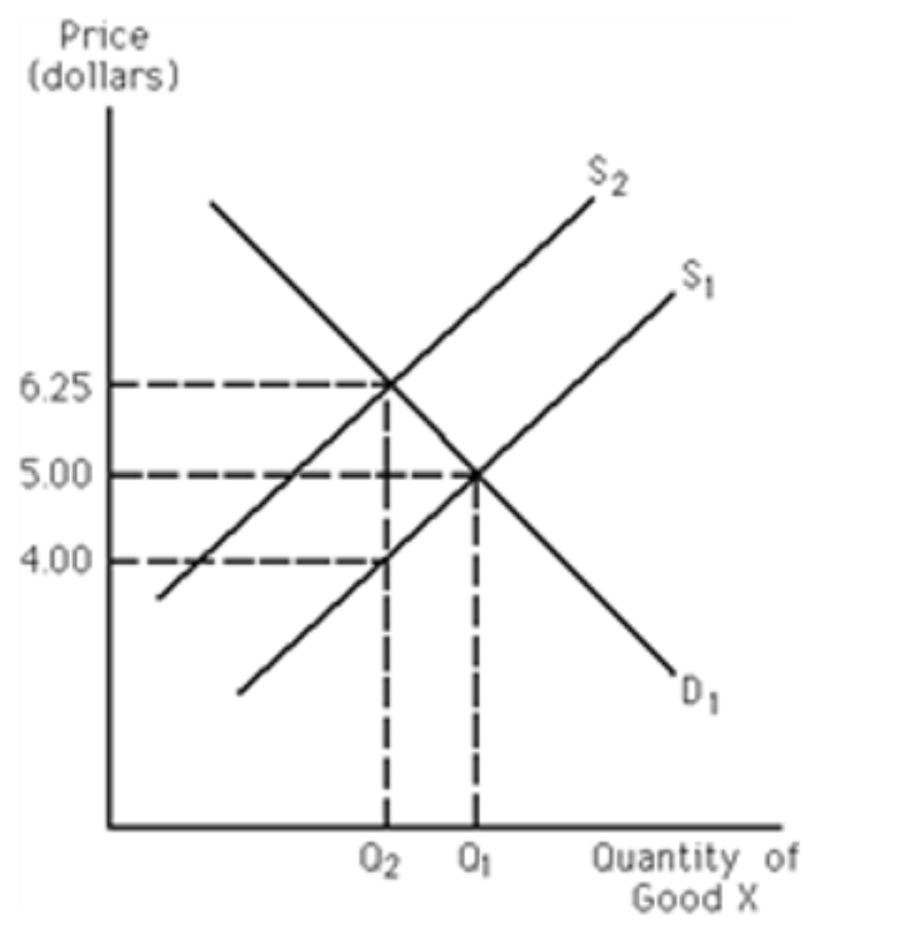
Refer to Figure 19-2. The market for good X is initially in equilibrium at $5. The government then places a per-unit tax on good X, as shown by the shift of S1 to S2. What is the per-unit tax equal to?
$1.00
$2.25
$0.25
$4.00
$2.25
you dont do it on the other equal you do it at bottom ig
Suppose someone believes that if a per-unit tax is placed on the producers of good Y, the consumers of good Y will end up paying the full tax. This person assumes that the demand curve for good Y is
elastic
perfectly inelastic.
inelastic.
perfectly elastic.
perfectly inelastic.
perfectly inelastic demand = consumers pay 100% of the tax.