Disaster Risk, Resilience and Indigenous Knowledge: Lectures 19–23
 Call Kai
 Learn
 Practice Test
 Spaced Repetition
 Match
 Flashcards
 Knowt Play
1/148

There's no tags or description
Looks like no tags are added yet.
149 Terms
What is a paradigm in the context of science?
A framework or model that guides scientific understanding and research.

What major paradigm shift occurred in science related to the theory of relativity?
The emergence of quantum physics due to observations at the subatomic level.
What does the term 'Disaster Risk Reduction' (DRR) encompass in New Zealand?
It stands for 'Disaster, Risk and Resilience' and involves research across multiple fields.
What are some major frameworks that emerged in 2015 related to global issues?
The Sendai Framework for DRR, the Sustainable Development Goals (SDGs), the Paris Climate Change Agreement, and the New Urban Agenda.
What is the significance of the 'butterfly effect' in chaos theory?
It illustrates how small differences in initial conditions can lead to vastly different outcomes.
Who is Edward Lorenz and what did he contribute to science?
He introduced chaos theory by demonstrating that small discrepancies in data can lead to significant differences in outcomes.
What did Benoit Mandelbrot's work reveal about natural phenomena?
It showed that there is infinite variation within parameters and that natural phenomena exhibit statistical self-similarity.
How does socio-ecological systems theory approach the study of hazards?
It analyzes interactions and relationships between environmental and social processes.
What is the difference between monodisciplinary and interdisciplinary research?
Monodisciplinary focuses on a single discipline, while interdisciplinary integrates multiple disciplines to address complex issues.

What is transdisciplinary research?
It involves collaboration across disciplines and includes community stakeholders in the research process.
What was a significant challenge in understanding the Christchurch earthquakes?
The lack of mapping for faults beneath the plains made it difficult to assess hazard exposure.

What is liquefaction in the context of earthquakes?
A hazard where saturated soil loses strength and behaves like a liquid during seismic activity.

What does the term 'system effects' refer to in disaster risk management?
It refers to understanding why disasters occur and how to mitigate the risks associated with hazards.
What is the relationship between environmental processes and social processes in disaster risk?
Hazard and disaster exposure results from the interaction between environmental processes and social factors.

What is the importance of interdisciplinary research in disaster risk management?
It helps to understand how various factors contribute to disaster impacts and vulnerability.
What does the term 'complex systems theory' imply?
It suggests that systems are interconnected and can exhibit unpredictable behaviors due to their complexity.
How did the Christchurch earthquake demonstrate the effects of ground acceleration?
The eastern suburbs experienced the highest vertical acceleration ever recorded for an urban area during the earthquake.
What is the implication of having different magnitudes of earthquake effects in various areas?
It indicates that earthquakes are not uniform, and their impacts can vary significantly based on location.
What role does technology play in the development of scientific paradigms?
Technological advancements enable the discovery of new phenomena and the evolution of scientific understanding.
What does 'social constructivism' refer to in the context of science?
It refers to the idea that scientific knowledge is created and constructed by scientists within a specific time period.
What is the significance of the 'Statistical Self-Similarity & Fractional Dimension' paper?
It introduced the concept that natural phenomena can exhibit infinite variation while maintaining similar statistical characteristics.
What is the focus of the new paradigm in Disaster Risk Management?
It emphasizes understanding system effects to reduce disaster risks rather than eliminating hazards.
How can the study of socio-ecological systems improve disaster resilience?
By integrating environmental and social processes, it provides a holistic view of vulnerability and capacity.
What is the impact of the divide between mathematical sciences and social sciences on complex systems research?
It highlights the conceptual versus applied nature of research in these fields, affecting collaboration and understanding.
What does it mean for a system to be unstable according to Lorenz's findings?
It means that small changes in initial conditions can lead to vastly different outcomes in the system's behavior.
What is the role of research in understanding disaster risk and resilience?
Research across multiple disciplines is essential to comprehensively address the complexities of disaster risk.
What is lateral spreading in the context of earthquakes?
Lateral spreading occurs when land slides under a river with soft banks during an earthquake.
What does the orange area on the liquefaction map represent?
The orange area represents moderate-to-severe liquefaction.
How did liquefaction affect buildings in Christchurch?
Buildings sank deeper into the swamp due to liquefaction during the earthquakes.
What policy was implemented for the eastern suburbs of Christchurch post-earthquake?
Red zoning was implemented because it was deemed too expensive to renovate the land before rebuilding.
How many homes were bought out and removed in Christchurch after the earthquakes?
7000 homes were bought out and removed.
What are the three classifications of residential areas in Christchurch post-earthquake?
TC1, TC2, and TC3, in ascending order of renovation work needed.
What does social differentiation refer to in the context of disaster impacts?
Social differentiation refers to how disaster impacts can differ according to age, gender, household formation, income, ethnicity, etc.

What is the significance of the Social Deprivation Index in Christchurch?
It visualizes the correlation between socioeconomic status and vulnerability to disaster impacts.

What was found to correlate with building damage in Christchurch?
More building damage correlated with higher heart disease admissions.
What is the focusing effect of disasters?
The focusing effect refers to how visible disasters attract more public and political attention.
What are the three forms of justice relevant to post-disaster recovery?
Legal justice, social justice, and spatial justice.
What was a major issue faced by the eastern suburbs of Christchurch post-earthquake?
They did not receive equitable support despite being the worst affected.
What is the UNDRR definition of Disaster Recovery?
Recovery involves restoring or improving livelihoods and health, as well as economic, physical, social, cultural, and environmental assets.
What are the four R's of New Zealand's disaster mitigation principles?
Readiness, Response, Recovery, Reduction.
What is a key challenge in quantifying disaster recovery?
Global databases primarily quantify immediate disaster losses, lacking data for recovery.
What distinguishes disaster recovery from non-disaster times?
Disaster recovery involves much more activity and rebuilding in a condensed time and space.
What is meant by 'disaster recovery time compression'?
Recovery processes and activities are compressed in time and space after a disaster.
What was the finding of Thomas Birkland's comparative study on disaster visibility?
Disasters that are easily seen, like earthquakes, garner more public attention than less visible disasters.

What social impacts were observed in Christchurch following the earthquakes?
Increased heart disease admissions and stress levels correlated with building damage.
Why is it difficult to measure social impacts of disasters?
Social impacts are less visible and harder to quantify compared to physical impacts like building damage.
What does the term 'overlapping social and physical systems' refer to?
It refers to how areas most harmed by disasters often lie at the intersection of vulnerable social and physical systems.
What was a significant outcome of the interdisciplinary study following the Christchurch earthquakes?
It highlighted the correlation between building damage and public health issues, such as heart disease.
How did the Christchurch earthquakes impact public health?
There was a rise in heart disease-related deaths and admissions post-earthquake.
What is the role of transdisciplinary collaboration in disaster recovery research?
It involves various experts analyzing data to understand social impacts of disasters.
What was a key finding regarding socioeconomic status and earthquake damage in Christchurch?
The poorest populations in eastern suburbs experienced the worst damage, despite some wealthy areas also being affected.
What does the term 'social vulnerability' refer to?
It refers to the varying degrees of susceptibility to disaster impacts based on social factors.
What is the relationship between building damage and stress levels in disaster recovery?
Higher building damage is associated with increased stress levels among affected individuals.
What is 'time compression' in disaster recovery?
A phenomenon of increased intensity of activities in a particular period of time, causing a spike in demand for decisions, information flows, financing, and institutional formation.
What was the impact of Hurricane Katrina on rebuilding processes?
There was no spike in the rebuilding process, but significant time compression occurred in resettlement regions unaffected by the hurricane.

What is an example of a process that is hard to compress in time after a disaster?
Bureaucratic processes, such as planning approval processes, which often fail under pressure.
What is the significance of New Zealand's high insurance rate?
It is a legacy of the Napier earthquake, leading to the implementation of the Earthquake Commission (EQC).
What is 'time poverty' in the context of disaster recovery?
An unusually large and immediate loss of capital services that triggers a compression in time for normal demand for capital replacement and expenditures.
What did Sarah's survey data reveal about post-earthquake anxiety?
The greatest source of anxiety was aftershock anxiety, with a significant drop in reported anxiety over time.
What is the difference between qualitative and quantitative data?
Qualitative data is descriptive (words/images), while quantitative data is numerical.
What does the Canterbury Wellbeing Index indicate about Christchurch after the earthquake?
The only improvement observed was in social connection.
What are the two views of defining 'successful recovery'?
The 'old normal' view focuses on returning to pre-disaster states, while the 'new normal' view emphasizes adaptation and resilience.
What did Stephanie Chang analyze to quantify recovery from the Kobe earthquake?
She analyzed cargo traffic through the Port of Kobe, population changes, and comparative trends over time.
What is 'intersectionality' in the context of social vulnerability?
The concept that individuals/groups characterized by multiple factors (e.g., ethnicity, gender, employment status) are more likely to be negatively impacted by disasters.
How does social vulnerability differ from social resilience?
Social vulnerability refers to conditions that increase susceptibility to disaster impacts, while social resilience is the ability to absorb, adapt to, and recover from those impacts.
What role do boundary objects play in disaster recovery?
They connect diverse intersecting social worlds and help facilitate understanding among different communities.
What is the relationship between social capital and disaster recovery?
Social capital refers to the connections and friendships that enable people to help each other and mobilize during disasters.
What is a common challenge in measuring recovery after a disaster?
Defining what constitutes 'successful recovery' can vary, complicating the measurement of recovery outcomes.
What are some methods of qualitative data gathering?
Focus groups, interviews, participant observation, and analysis of existing written or audio/video documents.
What is the significance of the 'spider diagram' used in the Canterbury Wellbeing Index?
It visually represents various aspects of wellbeing and recovery indicators over time.
What does the term 'capacity' refer to in disaster recovery?
The ability of a community or system to demonstrate resilience, often measured during stressors.
What is the impact of social inequalities on disaster vulnerability?
Social inequalities can increase vulnerability, making certain groups more susceptible to disaster impacts.
What is the role of theoretical frameworks in qualitative research?
They help organize key questions and guide the data collection and analysis process.
How did the planning approval processes in Christchurch fail post-disaster?
The city council lost planning accreditation due to the pressure of post-disaster recovery demands.

What does the term 'social resilience' encompass?
The social processes that enable groups to problem-solve and adapt during and after a disaster.

What is the importance of real-world findings in disaster recovery analysis?
They reveal complex, diverse trends and spatial divergences that challenge simplistic views of recovery.
What does the term 'quantitative data' include in the context of disaster recovery?
Data that is numerical and can be gathered through surveys or repurposed existing data.
What was one of the key findings from the analysis of population change after the Kobe earthquake?
There was a correlation between disaster damage and population change, with coastal suburbs decreasing in population.
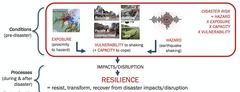
What is the definition of resilience in social systems?
Resilience refers to the ability of social relationships, networks, and organizations to increase collective problem-solving, efficiency, and adaptability during and after disruptions.
How is vulnerability defined in the context of social systems?
Vulnerability measures conditions inherent in social systems that contribute to susceptibility to hazard impacts, often linked to socio-economic and demographic factors.
What characterizes a low vulnerability, low resilience community?
An example is the Sumner area after earthquakes, where community groups felt neglected by the government.
What is a high vulnerability, high resilience trait observed in Māori communities?
Māori communities often do not expect external aid during disasters, relying on their institutional systems like marae for support.
What was the focus of the resilience case study in Lyttelton?
The study examined how community members used the resilience concept to build adaptive capacity after the Canterbury Earthquakes.
What was the population of Lyttelton around 2009?
Approximately 3,000.
What factors contributed to Lyttelton's vulnerability during the earthquake?
High exposure to severe hazards, vulnerable populations, and unreinforced masonry buildings.
What is the significance of the Project Lyttelton?
It aimed to improve community resilience and had projects in place before the earthquake to support community adaptation.

What is a 'boundary object'?
A boundary object is a concept or tool that serves different needs in intersecting social worlds while being widely recognizable.
How did the Lyttelton time bank function as a boundary object?
It provided a structure recognized by residents from various social worlds, facilitating connections and support during disaster response.
What are the four types of social capital according to Pierre Bourdieu?
Social, cultural, financial, and symbolic capital.
What is linking capital?
Connections to sources of support and resources with greater power, such as government and financial institutions.
What is bonding capital?
Connections to others with similar demographic characteristics, such as ethnicity or culture.
What is bridging capital?
Connections to others with diverse demographic characteristics, promoting inclusivity and cooperation.
What was the focus of the Bio Bio villages case study after the 2010 Chile tsunami?
It analyzed how vulnerability and resilience factors influenced recovery trajectories in small villages.
What was found to be the most important factor for community recovery in the Bio Bio villages study?
Linking capital was identified as having the greatest impact on resilience.
What challenges exist in New Zealand regarding disaster recovery?
Duties deferred to city and district councils make it difficult for communities to access government funding after disasters.
How did Project Lyttelton change local norms around collaboration?
It fostered cooperative exchanges and strengthened community connections through the resilience concept.
What are the interacting factors affecting recovery in affected communities?
Top-down decision-making, resources, connectedness vs. isolation, and community attitudes.
What is the role of scientific evidence in addressing social problems?
Scientific evidence should inform decisions, but high-stakes problems often complicate its contribution.
What is the significance of the term 'resilience' in community activism?
It can be used to organize and coordinate efforts towards sustainability and community support.
What does the OECD define social capital as?
Networks, shared norms, values, and understandings that facilitate cooperation within and between groups.