Chapter 17: Variation in chromosome number and structure
 Call Kai
 Learn
 Practice Test
 Spaced Repetition
 Match
 Flashcards
 Knowt Play
1/58

There's no tags or description
Looks like no tags are added yet.
59 Terms
Polyploidy
When a cell has more than two complete sets of chromosomes
Euploidy
A cell has a chromosome number that is an exact multiple of the haploid number (n) for the species
Animals cells are typically ____
Diploid (2n)
Monoploid (n)
Male bees, wasps, and ants
Triploid (3n)
Some fish, some amphibians
Tetraploid (4n)
Many plants (banana, coffee, potatoes, wheat), some fish, some amphibians
Ancient polyploidizations explain why vertebrates have up to ____ copies of each gene
4
Polyploidy can originate ____ or ____ closely related species
within; between
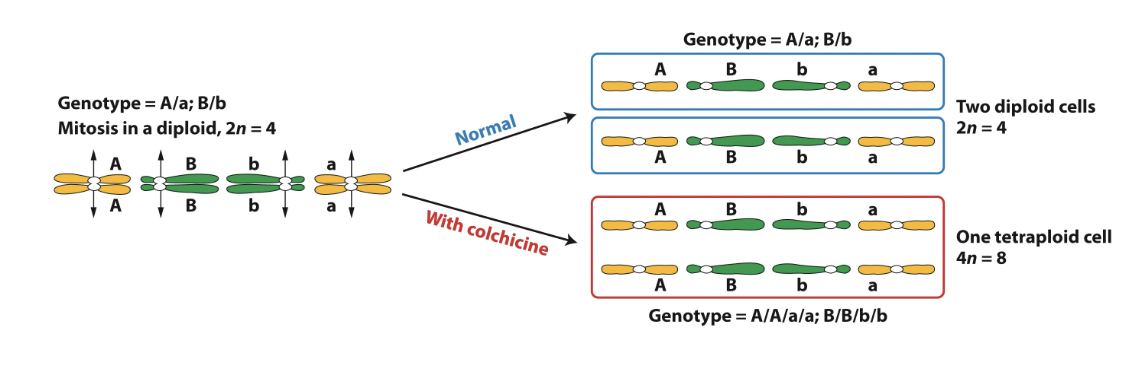
Autopolyploidy
Multiple chromosome sets originate within one species
Allopolyploidy
Multiple chromosome sets originate from two or more closely related species
Autopolyploidy arises via
Genome duplications within a species
Autoploidy possible origins
Fertilization of 1 egg by more than 1 sperm → triploids (usually)
Duplication of all chromosomes → tetraploids

Polyploids with odd numbers of chromosome sets are typically ____. Even-numbered polyploids are often ____
sterile; fertile
Autoploidy can arise ____ or be ____
spontaneously; chemically-induced
____ prevents polymerization of microtubules → no spindle formation
Colchicine
Allopolyploidy arises via
genome duplications between closely related species
Chromosome structure must be similar between species

True or false: meiosis won’t occur with odd number of chromosomes, but accidental duplication will allow meiosis again
True
____ produce both haploid and diploid gametes from meiosis
Triploids
2 possible ways for 3 homologous chromosomes to pair, but both produce haploid (n) and diploid (2n) gametes

Diploids produce gametes with ____ dosage among chromosomes
balanced
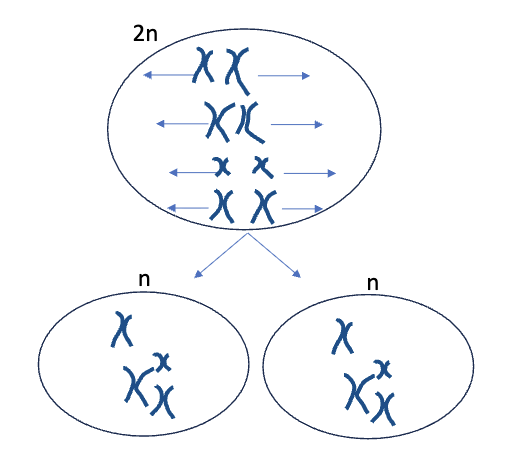
Triploids produce gametes with ____ dosage among chromosomes
unbalanced

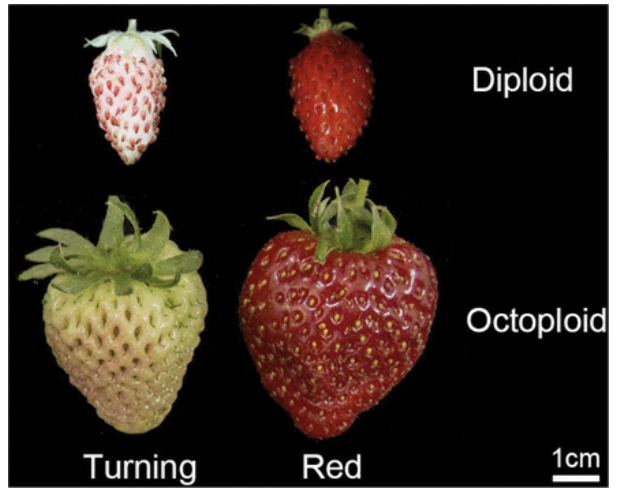
True or false: polyploid cells tend to be larger than diploid cells
True
Larger size needed to house more DNA — maintain nuclear to cytoplasm ratio
Aneuploidy
The loss or gain of individual chromosomes
Monosomy
2n-1
Trisomy
2n+1
What is aneuploidy caused by?
Non-disjunction during mitosis, meiosis I, or meiosis II
Non-disjunction at the first meiotic division produces ____% aneuploid gametes
100%

Non-disjunction at the second meiotic division produces ____% aneuploid gametes
50%

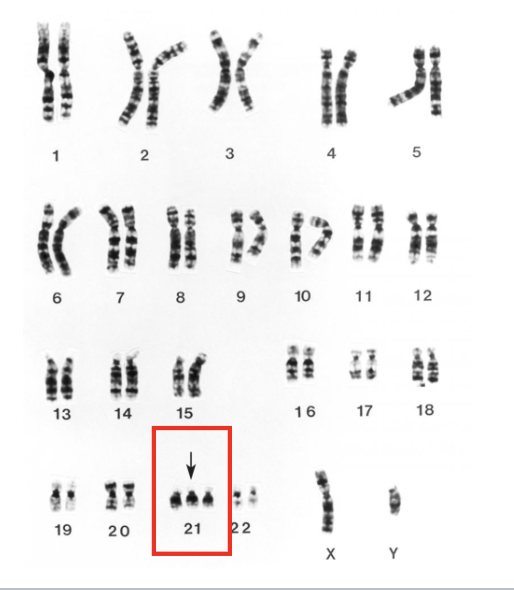
Trisomy 21 (Down syndrome)
Rare autosomal aneuploidy
Can be sporadic or inherited
0.15% of live births
Mostly due to nondisjunction
More rarely due to translocations
Which type of chromosome aneuploidies are more likely to be viable?
Sex chromosomes
Turner’s syndrome
XO
Phenotypically female
1/5000 births
Sterile, physical and cognitive issues
Escapers are not expressed, leading to symptoms
Triple X syndrome
XXX
Phenotypically female
1/1000 births
Fertile
Klinefelter’s sydrome
XXY
Phenotypically male, but with some intersex traits
1/1000 births
Sterile, mildly impaired IQ
Escapers are expressed at 2x normal dose, leading to symptoms
Jacob’s syndrome
XYY
Phenotypically male
1/1000 births
Fertile
~____% of genes on the X chromosomes are not inactivated (escapers)
15%
What are the four types of chromosomal rearrangements?
Deletion
Duplication
Inversion
Translocation
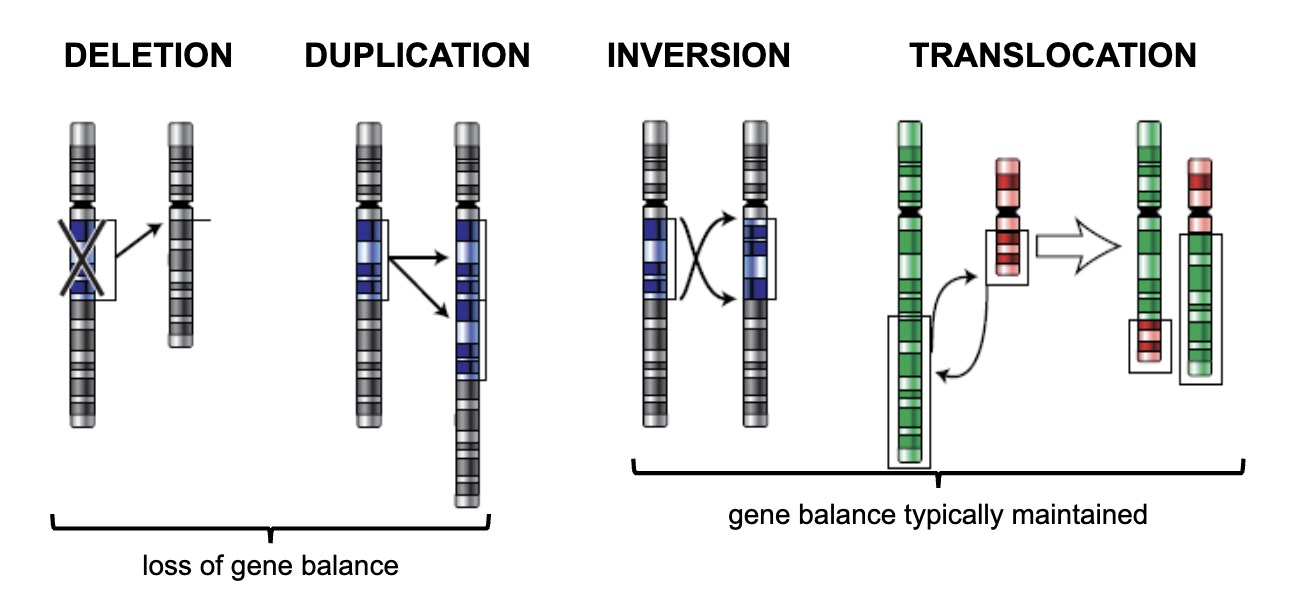
What are the two origins on chromosomal rearrangements?
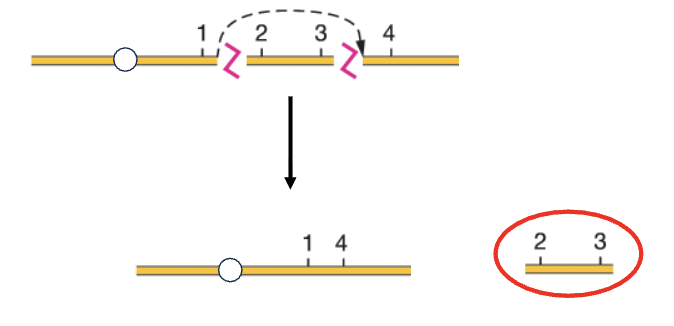
Non-homologous end joining
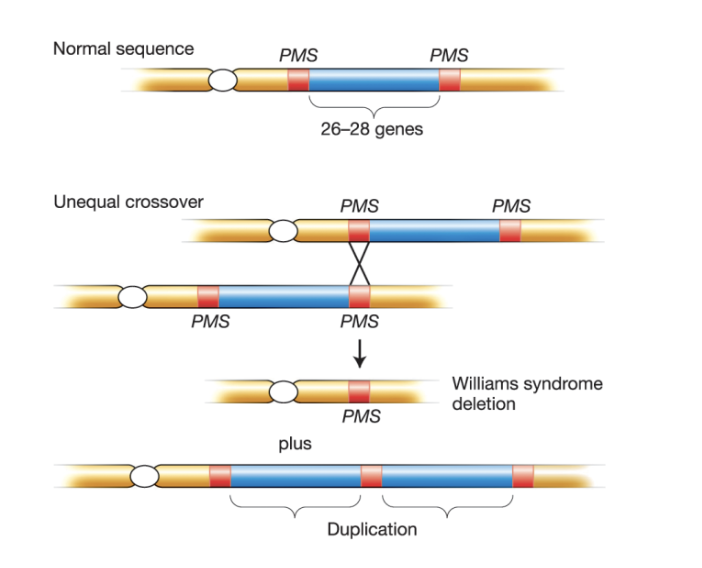
crossing over between repetitive DNA
Non-homologous end joining
Generation of a deletion via non-homologous end joining of double-strand breaks
Fragments without centromeres will not be incorporated into daughter nuclei during meiosis
Crossing over between repetitive DNA
Generation of a deletion and duplication via crossing over between repetitive DNA segments
Multi-copy PMS gene encodes for a DNA repair protein
Only chromosomes with ____ centromere and ____ telomeres will survive long-term
1; 2
Acentric chromosomes
No centromere
Will fail to segregate to pole during mitosis or meiosis and will not be incorporated into daughter nuclei
Dicentric chromosomes
Two centromeres
Often are pulled to opposite poles during anaphase and will. not be incorporated into either daughter nuclei
Chromosomes without telomeres
DNA is lost from ends of chromosomes with each cycle of replication
Deletions
Loss of a fragment of one chromosome arm

Chromosomal rearrangements can be visible on ____ chromosomes
Polytene

Recessive phenotypes can be expressed if
homologous segment is deleted
*answer to screenshot is hemizygosity
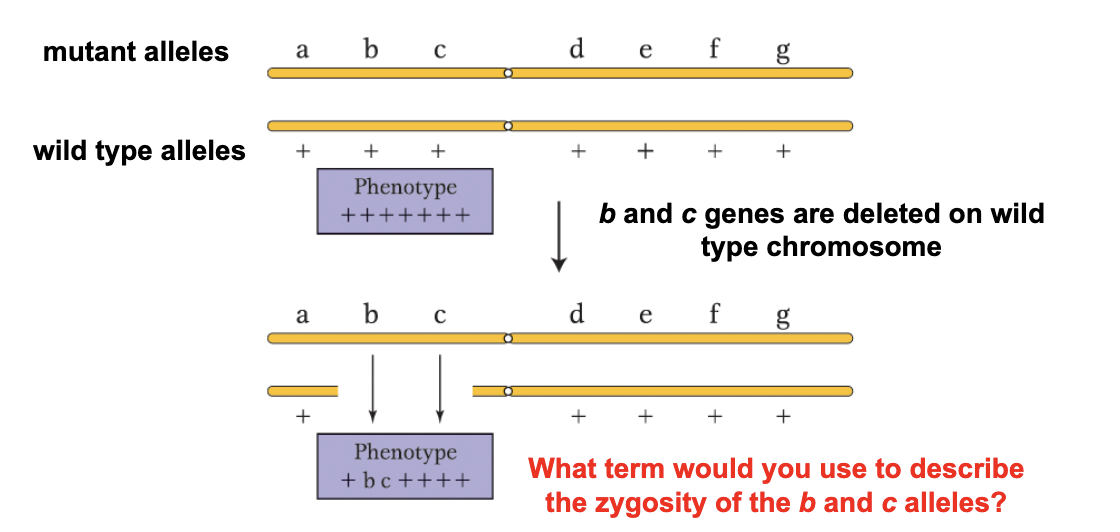
Chromosomes with deletions are called ____
Deficiency chromosomes (Df)
If a/Df = mutant phenotype →
Fail to complement (deletion includes the a gene)
If a/Df = wild type phenotype →
Complement (deletion does not include the a gene)
Duplications
Gain of a fragment of one chromosome arm

Duplicated regions can be (2):
Tandem - duplicated segment is adjacent to original segment
Insertional - duplicated segment is inserted elsewhere in the genome
Inversions
Fragment of one chromosome arms is flipped and reinserted

True or false: inversions may or may not include the centromere
True
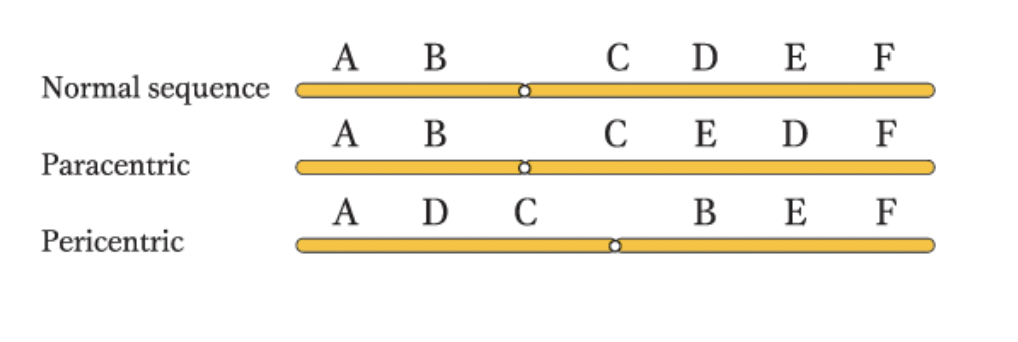
True or false: inversions may or may not disrupt genes
True

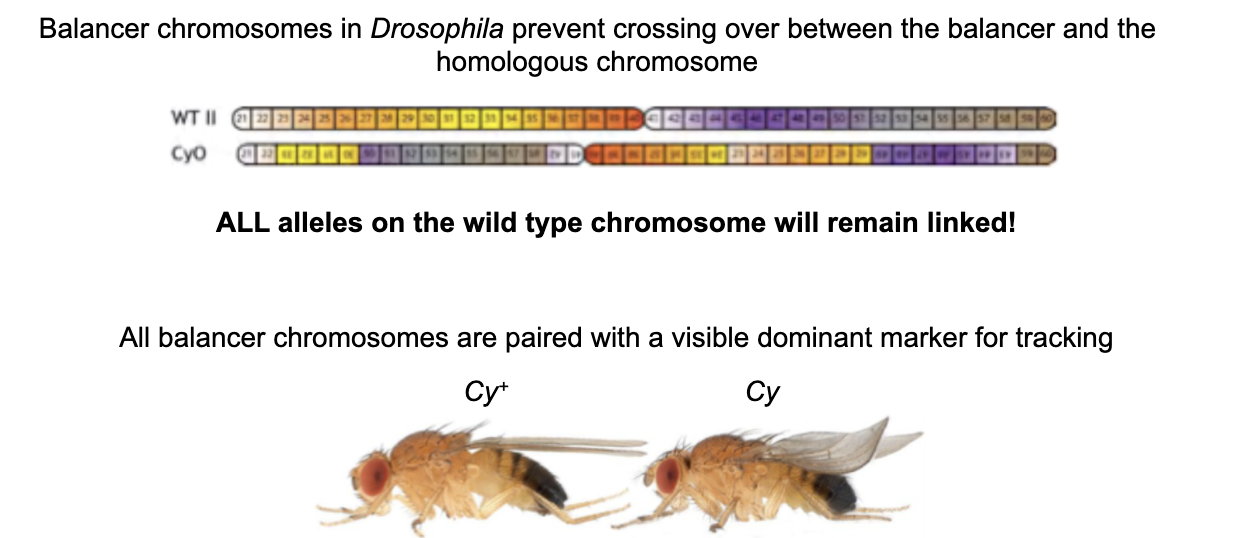
Inversions often block recombination via
crossing over

Inversions are used to make ____ which prevent crossing over
balancer chromosomes
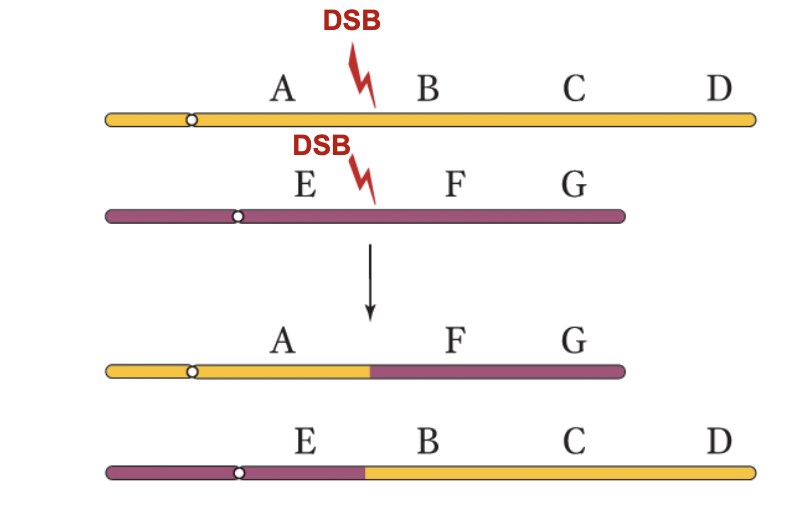
Translocations
Fragments from two chromosome arms are traded
Ewing’s sarcoma is caused by a
translocation

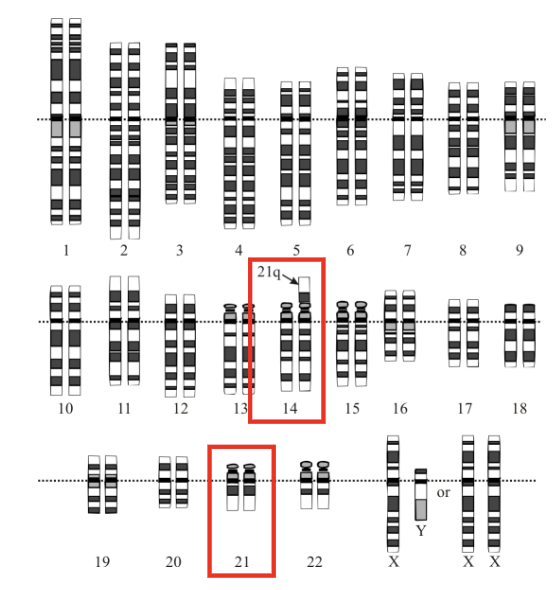
____ translocation of chromosome 21 to another chromosome is an alternative source of Down syndrome
Robertsonian
The long arm of chromosome 21 can be translocated to chromosome 14
Chromosome abnormalities are detected in ~____% of non-viable pregnancies
50%
