Ch 1. Behavior & The Brain
 Call Kai
 Learn
Learn Practice Test
 Spaced Repetition
 Match
Match Flashcards
 Knowt Play
1/104

There's no tags or description
Looks like no tags are added yet.
Name | Mastery | Learn | Test | Matching | Spaced | Call with Kai | Chat |
|---|
No analytics yet
Send a link to your students to track their progress
105 Terms
What type of cells make up all brain cells, and what do they contain?
Eukaryotic cells make up all brain cells. They contain a nucleus and specialized organelles.
What is DNA?
A molecule that winds around histones and is packed into chromosomes inside the nucleus.
Why is DNA copied?
For two reasons: replication, to make DNA for a new cell, and transcription, to make RNA used in making a new protein.
What is RNA?
A molecule that carries genetic instructions from DNA and helps make proteins.
What is a protein?
A molecule made of amino acids that performs specific functions in the body and cells.
What is the phospholipid bilayer?
The structure that makes up the cell membrane. The heads are hydrophilic and the tails are hydrophobic.
What is the fluid mosaic membrane model?
The cell membrane is a flexible, fluid structure in which phospholipids and many proteins can move laterally within the membrane.
What is gene expression?
The process of using information in DNA to make proteins through transcription and translation.
What happens during transcription and translation?
Transcription: DNA → RNA. Translation: RNA → proteins.
What is a neuron?
A specialized nerve cell that receives, processes, and transmits information through electrical and chemical signals.
Where are electrical and chemical signals used in neuronal communication?
Within the neuron, including the dendrites and down the axon, signals are electrical. Between neurons, at the axon terminals/buttons, signals are chemical.
What is an afferent neuron?
A sensory neuron that carries information from the body/sensory receptors toward the CNS (brain and spinal cord) to be interpreted.
What is an efferent neuron?
A motor neuron that carries information away from the CNS to muscles and glands.
What is an interneuron?
A neuron located throughout the CNS that connects and allows information to pass between afferent and efferent neurons.
What is a synapse?
The junction or communication point between two neurons, usually involving the release of neurotransmitters.
What are dendrites?
Branch-like structures of a neuron that receive signals from other neurons and carry information toward the cell body.
What is an axon?
The long part of a neuron that carries electrical signals (action potentials) away from the cell body toward the axon terminals.
What is the axon hillock?
The place where the axon begins. The action potential initiates here if the neuron reaches threshold.
What are axon collaterals?
Branches off the main axon that allow a neuron to send signals to multiple cells or locations.
What is an axon terminal?
The end of the axon, or little "buttons," where neurotransmitters are released to communicate with the next cell.
What is myelin?
A fatty insulating material produced by glial cells that helps electrical signals travel faster along axons.
What happens to an action potential if an axon has no myelin sheath?
It travels slower because myelin allows the electrical signal to travel rapidly between the Nodes of Ranvier, where the action potential is regenerated.
What is the myelin sheath?
The layer or covering formed when myelin wraps around the axon.
How do Schwann cells and oligodendrocytes differ?
Schwann cells produce myelin around neurons in the PNS and cover one segment of one axon. Oligodendrocytes produce myelin around neurons in the CNS and can cover segments of multiple axons.
What are Nodes of Ranvier?
Gaps between sections of the myelin sheath along an axon where the action potential is regenerated, allowing the signal to travel faster.
What is the synaptic cleft?
The small gap between the presynaptic neuron and postsynaptic cell where neurotransmitters travel to communicate a signal.
What are neurotransmitters?
Chemical messengers released by neurons that carry signals across the synaptic cleft and bind to receptors on the postsynaptic cell.
What are glial cells (glia)?
Cells in the nervous system that support, protect, nourish, and maintain neurons. Types in your notes include Schwann cells (myelin of PNS), oligodendrocytes (Myelin of CNS), astrocytes (BBB) AND microglia (immune system).
What is the hierarchy of biological organization from molecule to community?
Molecule → Organelle → Cell → Tissue → Organ → Organ System → Organism → Population → Community. Mnemonic: My Old Cat Took One Orange Off Papa's Counter.
What four biological molecules make up all cells?
Carbohydrates: energy. Proteins: structure/function. Lipids: membranes and energy storage. Nucleic acids: what DNA is made from, which forms chromosomes.
What is the function of the nucleus?
Control center; contains DNA.
What is the function of mitochondria?
Produces energy (ATP).
What is the function of ribosomes?
Make proteins.
What is the function of the cell/plasma membrane?
Controls what enters and leaves the cell.
What is the function of lysosomes?
Break down waste/cell cleanup.
What is the function of the cytoskeleton?
Structure and support.
What is the function of DNA?
Genetic instructions.
How does the cell membrane control what enters and leaves the cell, and why are protein channels important?
The cell membrane is selectively permeable, meaning it controls what enters and leaves. Protein channels allow specific substances/ions that cannot easily cross the membrane to move through it.
How do the outcomes of DNA replication and transcription differ?
DNA replication copies the entire DNA molecule and produces DNA. Transcription copies a specific section/gene of DNA into RNA and produces RNA.
What are the major features of a multipolar neuron?
Dendrite, cell body, axon hillock, axon, and axon terminals.
How do dendrites and axons function differently?
Dendrites receive signals and carry information toward the cell body. Axons carry electrical signals/action potentials away from the cell body toward the axon terminals.
What makes up the central nervous system (CNS)?
The brain and spinal cord.
What is the general function of the brain?
Processes and integrates information and controls the body's responses and functions.
b
c
What is the peripheral nervous system (PNS)?
All nerves outside the brain and spinal cord that connect the CNS to the rest of the body.
What are peripheral nerves?
Nerves that extend outside the brain and spinal cord throughout the body.
What do afferent nerves do?
Carry sensory information toward/into the CNS.
What do efferent nerves do?
Carry motor information away from/exiting the CNS.
a
b
What are the meninges?
Three protective layers of tissue surrounding the brain and spinal cord: dura mater, arachnoid mater, and pia mater.
What is the dura mater?
The tough outer layer of the meninges.
What is the arachnoid mater?
The web-like middle layer of the meninges.
What is the pia mater?
The thin inner layer that closely covers the brain and spinal cord.
Neural nets are diffuse networks of interconnected neurons with little or no central control. Ganglia are clusters of neuron cell bodies that provide more centralized processing. In centralized brain systems, neurons are highly concentrated in a brain that serves as the main processing/control center.
How do neural nets, ganglia, and centralized brain systems differ?
What does gray matter mainly contain?
Neuron cell bodies, dendrites, and synapses.
What does white matter mainly contain?
Myelinated axons.
How are gray and white matter arranged in the brain?
Gray matter is outside and white matter is inside.
How are gray and white matter arranged in the spinal cord?
Gray matter is inside and white matter is outside.
What are the functions of cerebrospinal fluid?
Cushioning/protection, buoyancy, chemical stability, and waste removal.
Describe the three meninges and their functional role.
Dura mater is the tough outer layer. Arachnoid mater is the web-like middle layer. Pia mater is the thin inner layer that closely covers the brain and spinal cord. Together, they are protective layers surrounding the brain and spinal cord.
What is the forebrain and what does it do?
The largest and most complex division of the brain; it is involved in higher-level functions, emotion, sensory processing, and movement. It includes the cerebral cortex, thalamus, hypothalamus, and limbic structures. Think: thinking, sensing, emotion, and movement.
What is the midbrain and what does it do?
A part of the brain involved in movement and processing/responding to visual and auditory information. Think: movement + sight + sound.
What is the hindbrain and what does it do?
A part of the brain involved in basic survival functions, movement/coordination, and sleep/arousal. It includes the medulla, pons, and cerebellum. Think: survival + coordination + sleep.
What does the spinal cord do?
It carries information between the brain and the rest of the body and controls basic reflexes.
What does anterior mean?
Toward the front.
What does posterior mean?
Toward the back. Memory cue: butt.
What does dorsal mean?
Toward the top/back. Memory cue: fin.
What does ventral mean?
Toward the bottom/belly. Memory cue: belly button.
What does medial mean?
Toward the middle/midline.
What does lateral mean?
Toward the side/away from the midline.
What are the four primary regions of the spinal cord?
Cervical, Thoracic, Lumbar, and Sacral (C.T.L.S.).
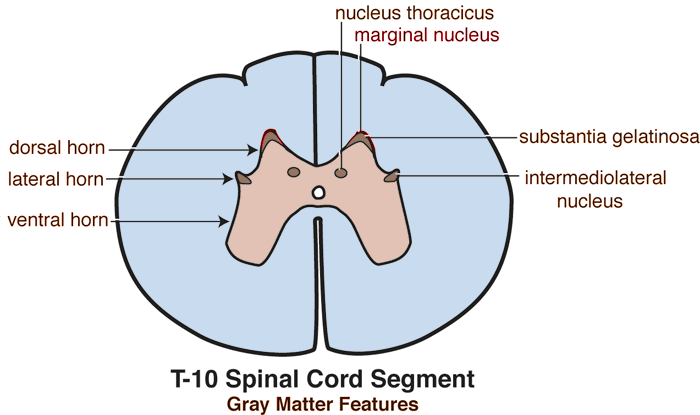
How do the dorsal and ventral horns of the spinal cord differ functionally?
The dorsal horn receives sensory (afferent) information, while the ventral horn carries motor (efferent) information. Remember: Dorsal = Afferent = Arrives; Ventral = Efferent = Exits
How does the direction of sensory and motor tracts differ within the spinal cord?
Sensory (afferent) tracts ascend UP the spinal cord toward the brain. Motor (efferent) tracts descend DOWN the spinal cord from the brain toward the body.
What are gyri?
The raised ridges/folds on the surface of the cerebral cortex.
What are sulci?
The grooves/indentations between the gyri on the surface of the cerebral cortex.
What are the cerebral hemispheres?
The left and right halves of the cerebrum, which communicate with each other primarily through the corpus callosum.
What are the five major divisions of the human brain listed in your notes?
T, D, Mes, Met, Mye.
What are the four brain lobes?
Frontal, parietal, temporal, and occipital.
What are the major functions of the frontal lobe?
Personality, language/speech, and planning/decision-making. Memory cue: THINK + MOVE + personality.
What are the major functions of the parietal lobe?
Touch/body sensation and spatial processing. Memory cue: TOUCH + SPACE.
What are the major functions of the temporal lobe?
Hearing, language comprehension, and memory. Memory cue: HEAR + MEMORY.
What is the major function of the occipital lobe?
Eyesight/vision. Memory cue: SEE.
What are the main structures of the brainstem and their general functions?
Midbrain = movement/senses. Pons = sleep + bridge/relay. Medulla = survival.
What is the function of the limbic system?
Emotion, motivation, and memory.
What is the function of the basal ganglia?
Movement and habits.
What is the function of the corpus callosum?
Connects the cerebral hemispheres.
What is the function of the thalamus?
Sensory relay to the cerebral cortex. Memory cue: the brain's mail person.
What is the function of the hypothalamus?
Homeostasis; regulates hunger, thirst, temperature, hormones, and motivated behaviors.
What is the function of the pituitary?
An endocrine gland that releases hormones.
What is the function of the tectum?
A midbrain region involved in orienting/responding to visual and auditory stimuli.
What is the function of the tegmentum?
A midbrain region involved in movement, arousal, and reward.
What is the function of the cerebellum?
Coordination, balance, and motor learning.
What is the function of the pons?
Sleep/arousal.
What is the function of the medulla?
Automatic functions involving the heart, lungs, and blood. Memory cue: survival.
What are cranial nerves?
PNS nerves that connect directly to the brain and carry sensory and/or motor information, mainly for the head and neck. The optic nerve is technically CNS.
What are spinal nerves?
Nerves that connect the spinal cord to the rest of the body and carry sensory and motor information.
What are ganglia?
Clusters of neuron cell bodies located outside the central nervous system (CNS).
What is the somatic nervous system?
Controls voluntary movement of skeletal muscles and carries sensory information to the CNS. Think: voluntary.
What is the autonomic nervous system?
Controls involuntary functions of internal organs and glands. Think: automatic.
What is the sympathetic nervous system?
Fight/flight, or the stress system.