Lect 2 The Hip and Pelvic Regions
 Call Kai
 Learn
 Practice Test
 Spaced Repetition
 Match
 Flashcards
 Knowt Play
1/78

There's no tags or description
Looks like no tags are added yet.
79 Terms
The lower limbs sacrifice ______ for _______________.
mobility; stability
What is stability enhanced by?
atm press
Gravity in erect
Acetab labrum
Capsule/ligaments
What is a common result of weight-bearing activities?
degenerative disorders (arthritis)
When people talk about the hip region, what are the most likely referring to?
both the hip and the pelvis
What region has the articulation between the ilium and the sacrum?
pelvis region
What region has the articulation of the femoral head with the acetabulum?
hip region
What kind of functional joint is the hip joint?
ball and socket joint
How many degrees of freedom does the hip joint have?
three degrees of movement
Flex (forward) / ext
Abd/ add
Int / ext rot
Circumduction
What is circumduction?
combination of flexion, extension, abduction, adduction, and rotation
Where is the intertrochanteric line? (femur)
ant side between greater/lesser trochanters
Where is the intertrochanteric crest? (femur)
post between greater/lesser trochanter
crest of the wave is on the back
Where is the intercondylar fossa/notch? (femur)
posterior

What is the orientation of the Acetabulum?
Lat / Ant / Inf
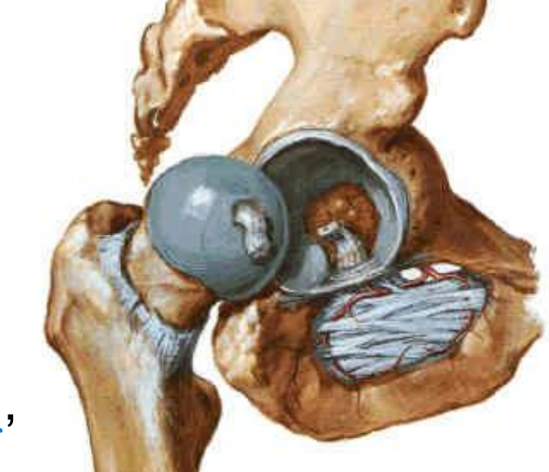
What does the acetabulum's orientation enable?
freedom of movement
What ligament is housed in the acetabular notch?
transverse acetabular ligament
What is the deepest portion of the acetabulum that contains a fat pad?
acetabular fossa
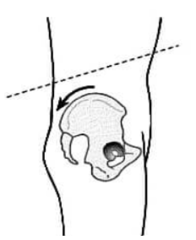
What is the orientation of the pelvis in respect to the femurs and to the rest of the body?
pelvic tilt
What kind of pelvic tilt is when the pelvis rotates forward?
anterior pelvic tilt
PSIS > ASIS

What kind of pelvic tilt is when the pelvis rotates backward?
posterior pelvic tilt
ASIS > PSIS
Normal femoral head inclination
125 degrees
What are the 2 atypical inclinations of the femoral head
coxa vara (smaller angle closer to 90 = farther apart)
coxa valga (greater angle closer to 180 = closer together)

If the acetabulum is oriented ___, _____, ____, how is the femoral head oriented?
acetab: ant, inf, lat
fem: post, sup, med
Acetabular labrum
fibrocartilaginous ring in the acetabulum
attached to periphery of acetabulum
What does the acetabular labrum do?
deepens the hip socket = inc congruity = inc STABILITY
What are the characteristics of the hip joint capsule?
thick + reinforced by strong ligaments
dense, fibrous, minimally elastic
Where the hip joint capsule thickest/strongest vs thinnest/ weakest?
thickest: anterosuperiorly
thinnest: inf post (*percaution: don’t flex past 90)
What is the intracapsular ligament of the hip joint?
ligamentum teres
What conducts blood vessels to the head of the femur?
ligamentum teres
supply blood
NO significant role in stability
What is the primary source of blood supply to the femoral head?
ligamentum teres
When a person is in a neutral position (standing) the ligaments of the hip joint are _________________________.
under moderate tension
When are the hip capsule tendons taut vs lax?
lax in flexion (untwist)
taut in extension (twist further) - force femur into acetab
moderate tension in neutral
When a person is in hip extension the ligaments of the capsular ligaments are __________________________.
twisting, forcing the femur into the acetabulum
When a person is in hip flexion the ligaments of the capsular ligaments are __________________________.
relaxed
When is the acetabulofemoral joint most vulnerable?
flexion (unwinding of ligaments decreases stability)
What are the three pelvic ligaments?
iliolumbar
sacrospinous
sacrotuberous
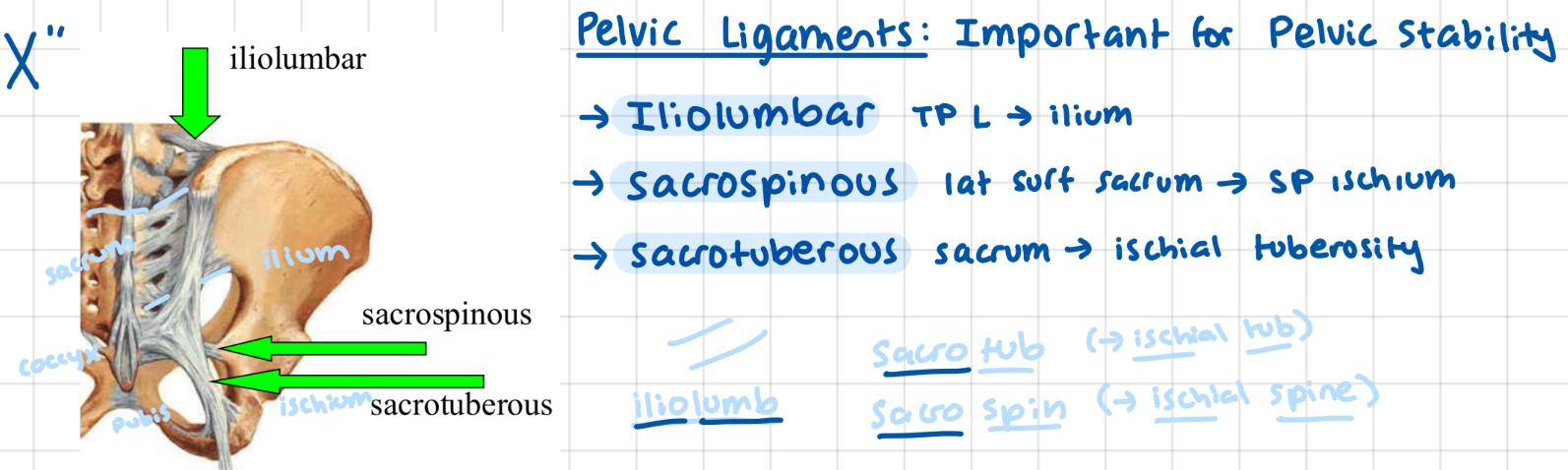
What are the three pelvic ligaments important for?
pelvic stability
What muscles are the FLEXORS of the hip?
iliopsoas
sartorius
quadriceps
What two muscles make up the iliopsoas?
iliacus and psoas major
What is the origin, insertion, action, and innervation of the iliacus?
O: iliac fossa, iliac crest, and ala of the sacrum
I: lesser trochanter
A: hip flexion
N: femoral nerve

What is the origin, insertion, action, and innervation of the psoas major?
O: transverse processes of T12-L5
I: lesser trochanter
A:
primary: hip flexion
secondary: lateral rotation
N: anterior rami of lumbar nerves L1, L2, L3

What is the origin, insertion, action, and innervation of the sartorius?
O: ASIS
I: pes anserine
A:
primary: hip flexion
secondary: abduction and external rotation
N: femoral nerve

What muscle is responsible for the "tailor sit" position AKA criss-cross apple sauce?
sartorius
What four muscles make up the quadriceps?
rectus femoris
vastus lateralis
vastus medialis
vastus intermedius
What is the origin, insertion, action, and innervation of the rectus femoris?
O: AIIS
I: common tendon to tibial tuberosity
A: assist illiopsoas in hip flexion and extends the knee with the quads
N: femoral nerve

What is a powerful hip flexor?
Rectus femoris
What is the origin, insertion, action, and innervation of the vastus lateralis?
O: greater trochanter, lateral lip of the linea aspera
I: common tendon to tibial tuberosity
A: knee extension
N: femoral nerve

What is the origin, insertion, action, and innervation of the vastus medialis?
O: medial lip of the linea aspera, intertrochanteric line
I: common tendon to tibial tuberosity
A: knee extension
N: femoral nerve

What is the origin, insertion, action, and innervation of the vastus intermedius?
O: anterolateral femoral shaft
I: common tendon to tibial tuberosity
A: knee extension
N: femoral nerve

The vastus intermedius is ______________ the rectus femoris?
deep to
What are the primary EXTENSORS of the hip?
gluteus maximus and hamstrings
What are the secondary EXTENSORS of the hip?
gluteus medius
piriformis
adductor magnus
What is the origin, insertion, action, and innervation of the gluteus maximus?
O: posterior ilium and sacrum and sacrotuberous ligament
I: superior fibers insert to iliotibial band, inferior fibers insert to gluteal tuberosity on the femur
A: hip extension and external rotation, some abduction
N: inferior gluteal nerve

The gluteus maximus is the _____________________________?
most powerful hip extensor
What is the origin, insertion, action, and innervation of the tensor fascia latae?
O: ant ext lip iliac crest + ASIS
I: IT band which attaches to Gerdy's tubercle
A: assists in abduction and internal rotation
N: superior gluteal nerve
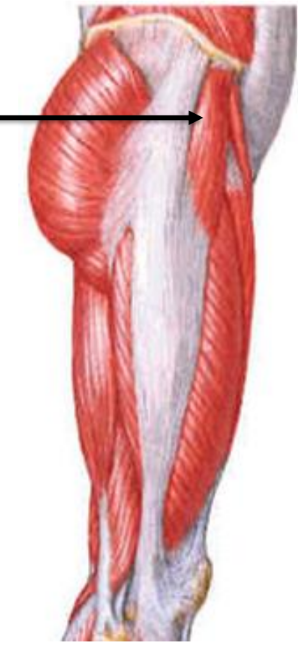
What attatchment point is on the anterolateral tibia?
Gerdy's tubercle
What is the origin, insertion, action, and innervation of the gluteus medius?
O: ext surf ilium
I: greater trochanter femur
A: hip abduction (secondary extensor)
N: superior gluteal nerve

The gluteus medius is the _________________________?
most powerful abductor
What is the origin, insertion, action, and innervation of the gluteus minimus?
O: ext surf of the ilium
I: greater trochanter of femur
A: hip abd
A: superior gluteal nerve

The gluteus minimus is _______________ the gluteus medium?
deep to
You drop something on the floor and bend at the hips to pick it up. When standing back up, which muscle is most active?
a- Gluteus maximus
b- Vastus lateralis
c- Sartorius
d- Psoas major
gluteus maximus
What muscles make up the hamstrings?
biceps femoris (two heads)
semitendinosus
semimembranosus
As a whole, the hamstrings are _____________ as powerful as the gluteus maximus?
2/3
What is the origin, insertion, action, and innervation of the long head of the biceps femoris?
O: ischial tuberosity
I: fibular head
A: hip extension and knee flexion
N: tibial portion of the sciatic nerve
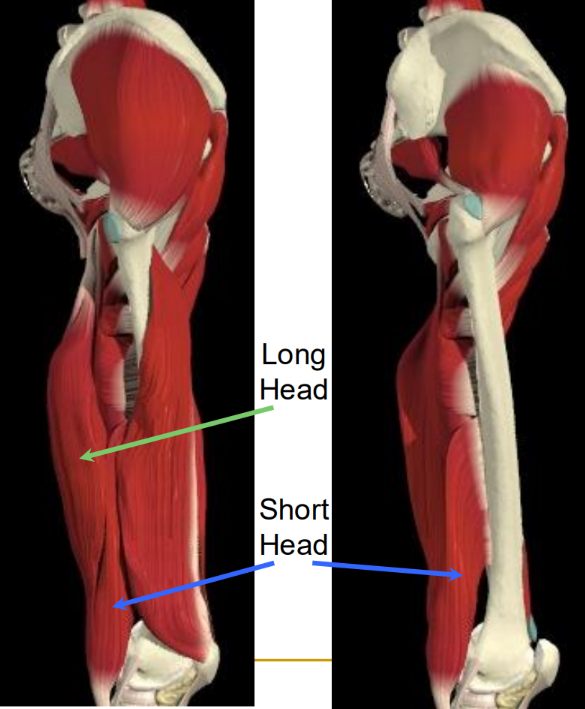
What is the origin, insertion, action, and innervation of the short head of the biceps femoris?
O: lat linea aspera
I: fibular head
A: hip extension and knee flexion
N: common peroneal portion of the sciatic nerve
common peroneal is uncommon in hamstrings- only there “briefly/short time”

What is the origin, insertion, action, and innervation of the semimembranosus?
O: ischial tuberosity
I: medial condyle of the tibia
A: hip extension, knee flexion
N: tibial portion of the sciatic nerve

The semimembranosus is __________________ the semitendinosus?
deep to
What is the origin, insertion, action, and innervation of the semitendinosus?
O: ischial tuberosity
I: pes anserine
A: hip extension, knee flexion
N: tibial portion of the sciatic nerve

What muscles make up the hip adductors?
adductor magnus
adductor nrevis
adductor longus
gracilis
What muscles are secondary adductors?
gluteus maximus and pectineus
What is the origin, insertion, action, and innervation of the hip adductor muscles?
O: inferior ramus of the pubis
I: medial side of the femur along the linea aspera (except gracilis)
A: adduct the thigh
N: obturator nerve (except pectineus)

What is the insertion point of the gracilis?
pes anserine
What nerve innervates the pectineus?
femoral nerve
True or False: no muscle has internal rotation as a primary function.
TRUE, overall power of internal rotation is /1/3 of external rotation
What muscles contribute to internal rotation of the hip?
tensor fascia latae
anterior fibers of gluteus medius and minimus
3 adductors
pectineus
what adds together 4 internal rot?
TFL
adds
pectin
ant fib glut med/min
What are the external rotators of the hip?
piriformis (N to)
quadratus femoris (N to)
gemellus sup / inf
obturator int / ext
my external rotation performance on the rectangular stage was great the obturator thought i was a gem
What nerve innervates the external rotators of the hip EXCEPT the piriformis and quadratus femoris?
sciatic nerve
What makes up the borders of the femoral triangle?
superior border: inguinal ligament
medial border: adductor longus
lateral border: sartorius
What are the contents of the femoral triangle?
femoral VAN (runs out)
Following injury to the obturator nerve, which actions would be impacted? (select multiple)
a- hip extension
b- hip internal rotation
c- hip abduction
d- knee extension
c) hip abduction & b) hip internal rotation