Objectives and Bold Terms Animal Form and Functions
 Call Kai
 Learn
 Practice Test
 Spaced Repetition
 Match
 Flashcards
 Knowt Play
1/24

There's no tags or description
Looks like no tags are added yet.
25 Terms
How does metabolic rate per kilogram of body mass change as an animal's body size increases?
It decreases significantly; smaller animals have much higher metabolic rates per unit of body mass than larger animals.
What are the four main types of animal tissues?
Epithelial, connective, muscle, and nervous tissues.
Where is simple squamous epithelium located, and what primary function does its single layer of flattened cells perform?
It is found in areas like lung air sacs and blood capillaries to facilitate rapid simple diffusion.
Why is stratified squamous epithelium suited for body surfaces such as the skin and mouth lining?
Its multiple cell layers regenerate rapidly, protecting underlying structures from mechanical abrasion.
What structural feature defines connective tissue?
It consists of sparse, scattered cells embedded within an extracellular matrix.
Loose Connective Tissue
A widespread tissue containing protein fibers that binds organs together and provides space for water, nutrient, and material exchange.
Adipose Tissue
A connective tissue composed of cells specialized for storing fat (triglycerides), providing energy storage, thermal insulation, and organ cushioning.
Which type of muscle tissue features striated, multinucleated cells and is under voluntary control?
Skeletal muscle.
How do smooth muscle and cardiac muscle differ in cellular structure and coordination?
Smooth muscle consists of unstriated, spindle-shaped single-nucleus cells; cardiac muscle consists of branched, faintly striated cells connected by intercalated discs for synchronized contraction.
What is the primary difference in function between neurons and glial cells in nervous tissue?
Neurons transmit electrical and chemical signals, whereas glial cells support, nourish, insulate, and modulate neurons.
How does signal transmission in the endocrine system differ from signaling in the nervous system?
Endocrine signaling secretes chemical hormones into the bloodstream that travel throughout the body to specific target receptors; nervous signaling sends high-speed electrical impulses along dedicated pathways to specific effector cells.
What determines whether a cell acts as a target cell for a specific hormone?
The presence of a specific protein receptor for that hormone on its plasma membrane or inside the cell.
Define homeostasis.
The maintenance of stable internal conditions necessary for cellular metabolism despite fluctuations in the external environment.
In physiological homeostasis, how do regulators differ from conformers?
Regulators maintain a relatively constant internal state regardless of external changes, whereas conformers allow internal conditions to vary alongside environmental changes.

What is the defining mechanism of a negative feedback loop in animal homeostasis?
The physiological response reduces or dampens the initial stimulus, bringing the internal variable back toward its optimal set point.
How does a positive feedback mechanism differ from a negative feedback mechanism?
A positive feedback mechanism amplifies or accelerates the change/stimulus further in the same direction rather than restoring the system to a set point.
Which brain structure serves as the main integrator (control center) for human thermoregulation?
The hypothalamus.

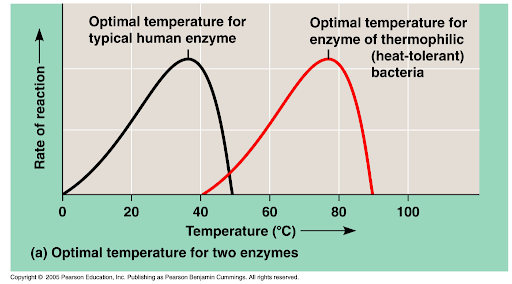
Why is thermoregulation critical for enzyme function?
Enzymes operate at an optimal temperature; lower temperatures reduce kinetic energy and reaction rates, while excessively high temperatures denature enzymes and destroy catalytic activity.
What is the primary distinction between endotherms and ectotherms?
Endotherms generate most of their body heat internally through metabolism, whereas ectotherms absorb most of their body heat from the external environment.
How does homeothermy differ from heterothermy?
Homeotherms maintain a relatively constant internal body temperature regardless of ambient temperatures, whereas heterotherms allow their body temperature to fluctuate with environmental conditions.
How do integumentary structures like down feathers, blubber, or dense fur aid in thermoregulation?
They provide thermal insulation, trapping air or fat layers that reduce the rate of conductive heat exchange with the surrounding environment.
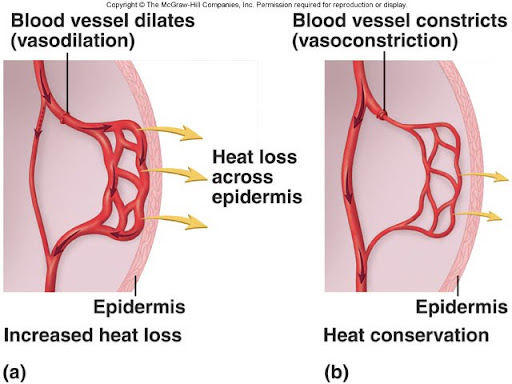
How does cutaneous vasodilation assist in thermoregulation when an endotherm experiences elevated body temperatures?
Dilating superficial blood vessels increases blood flow to the skin epidermis, elevating heat loss to the environment.
What is the mechanism of countercurrent heat exchange in animal extremities?
Warm blood in arteries flows past cool blood returning in adjacent veins in opposite directions, transferring heat from arteries to veins before blood reaches the extremity surface.

What is torpor, and how do hibernation and estivation relate to it?
Torpor is a physiological state of significantly lowered body temperature and metabolic rate. Hibernation is long-term torpor adapted to winter cold, while estivation is long-term torpor adapted to summer heat and drought.
What cellular membrane adaptation helps cold-acclimated animals maintain cell membrane fluidity at lower temperatures?
Increasing the proportion of unsaturated fatty acids in the phospholipid bilayer.