Plant Biology Test 3
 Call Kai
 Learn
 Practice Test
 Spaced Repetition
 Match
 Flashcards
 Knowt Play
1/139

There's no tags or description
Looks like no tags are added yet.
140 Terms
Polyploidy
1. Macromutation where whole genome is duplicated
2. Organism has more than 2 (not a diploid) sets of chromosomes

How can polyploidy occur?
1. Nondisjunction with sexual reproduction
2. Replication but no cytokinesis in asexual

Common polyploids
1. Bananas (3x)
2. Potato (4x)
3. Watermelon (3x)
Can polyploids be beneficial?
1. Yes
2. Some polyploids can tolerate exposure to toxic molecules, such as liver cells
3. Some polyploids contribute to tissue repair and regeneration

Can polyploids be harmful?
1. Yes
2. Found in roughly 37% of cancer in humans
3. Very common in invasive species
Where did polyploids come from?
1. Very old, first species was the lamprey 500 million years ago
2. 2 duplication evolution events have occurred for vertebrates
3. Plants also have had 2 duplication events, but not as long ago

Polyploids and environmental stress
1. Polyploids coincide with them
2. More polyploids directly following global catastrophes
3. More exist in extreme conditions
Are new polyploids still being discovered?
1. Yes
2. Occur in the wild randomly
3. Can also result unintentionally from human activity

Gigas effect
1. Increase in cell size and organ number due to polyploidy
2. Coined by Anne May Lutz
Nucleotypic effects
Bigger nucleus caused by polyploidy
Genetic diversity
More chromosomes with more genetic material each, caused by polyploidy
Pros and cons of polyploidy
Pros: Increased size, functional trait plasticity, increased stress tolerance
Cons: Increased nutrient needs, slower cell division, lower SA:V, mating disadvantages, less structural integrity
Individual-level differences of polyploids
1. Niche shifts
2. Higher fitness across different (stressful) environments
Community-level differences of polyploids
1. Dynamics of populations and coexistence change
2. Structure of communities and interaction networks change
How are polyploids discovered?
1. Root squashes to count the number of chromosomes in cells
2. Checking stomate size or density
3. Flow cytometry to compare genome (nucleus) sizes

Can polyploids be made?
Yes
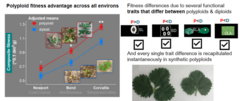
Jack of All Trades and Jack and Master
1. Jack of all trades have polyploids equally fit for all environments
2. Jack and master has polyploids increase fitness as the environment becomes more favorable, still better than regular version at all points

Are polyploids jack of all trades?
1. No
2. The are actually jack and master, meaning they are better in all enviornments
Do polyploids succeed by making more or better friends with microbes?
1. Both benefit from the same friends
2. DO, however, benefit more from the friendship itself
Are polyploid benefits and weakness revealed at the population level?
1. Yes, but the same is true for non-polyploids
2. Context determines whether it is a net positive or negative effect
Evolution
Changes in gene frequency over time
Lamark theory
1. Offered a mechanism of evolutionary change
2. Organisms in particular habitats find that particular traits are better and pass them down
3. Organism changes in response to environment (acquires traits during their lives), which are then passed down
Darwinism theory
1. Offered a mechanism of evolutionary change
2. Evolution is a byproduct of natural selection
3. Includes diversity, population growth, not all individuals surviving, and non-random survival based on traits
Tenets of natural selection
1. Individuals must vary in their traits
2. Different variants have different fitness
3. Traits must be heritable
Sources of variation in natural selection
Introduction of new variants with:
1. Mutations
2. Migrants from other areas
Rearrangement of alleles already present in the community
1. Sexual reproduction
2. Asexual reproduction
What is the ultimate source of variation?
1. Mutations
2. Migration can follow with the introduction of brand new variants
3. Migration can be even better if the migrator is a different species that participates in hybridization (breeding between species)
Rearrangement of alleles for variation
1. In sexual reproduction: meiosis, recombination, and more lead to unique variants
2. In asexual reproduction: mitosis and progeny are identical copies (new new variants)
Stabilizing selection
1. Intermediate intermediate trait is most fit
2. Loss of extreme variants, same mean

Directional selection
1. One phenotypic trait is highly favored
2. Loss of certain variants, different mean

Disruptive selection
1. Both extreme traits are favored over the intermediate
2. Increase in variants, same mean
3. Can lead to speciation

Artificial selection
1. Similar to natural selection but the breeder chooses which traits instill better fitness
2. Evidence of natural selection
Cline
1. Geographic gradient in a trait that reflects an environmental gradient
2. Caused by varying selection
Ecotypes
1. Population along a cline adapted to a specific environment
2. Is most fit in their own environment
What are clines and ecotypes evidence of?
Natural selection
Species
Most fundamental categorization in biology to form higher levels of classification
Morphological species concept
1. Smallest group of organisms that can be consistently distinguished based on morphology
2. Really up to whoever is looking at it to determine what counts as different, so not always consistent
Biological species concept
1. Organisms that can breed with themselves and produce viable offspring
2. Very good for animals, problematic in plants because they can reproduce asexually
3. Some organisms look very different (morphologically different) but can still successfully breed together
Genetic species concept
1. Sort of like morphological but instead looks at proteins, DNA, enzymes, etc
2. Still must decide what % different makes a different species
3. Useful for tiny microbes
Paleontological species concept
Based on morphology found in fossils, as well as the time they should have lived during
Evolutionary species concept
1. Species found in fossils
2. Morphologically lines up with a still living organism
Types of speciation
1. Allopatric
2. Parapatric
3. Sympatric
Forces responsible for speciation
1. Divergent/disruptive selection
2. Evolution of reproductive isolating mechanisms (restricts gene flow)
Allopatric speciation
1. Geographic barrier prevents gene flow between populations
2. Different locations have differential selection
3. Unlikely to evolve reproductive isolating mechanisms
4. Most common in animals

Parapatric speciation
1. No geographic barrier but some other barrier causes disruptive selection (like different soil)
2. Reproductive isolating mechanisms in the hybrids makes them unsuitable for each extreme environment

Sympatric
1. No geographic barrier
2. Instantaneous reproductively isolating mechanism caused by unlikely mutations or changes in ploidy
3. Most common in plants

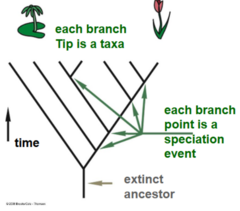
Cladograms
1. Trees reflecting the evolutionary branching of taxa
2. Tip of branch has taxa (species)
3. Each fork / branch point is a speciation event where a species split
4. Very end is the shared extinct ancestor
Character state
1. Different states of various traits (flower color is trait, red or blue is state)
2. Ancestral states come first, then evolve into a derived state

Polarity
1. Direction of character state changes
2. Always occurs from ancestral to derived
Out group
1. Taxa known to be related but evolved much earlier
2. Have determined ancestral states

In group
1. Taxa that evolved much later
2. Have the derived states
3. Usually are the ones studied

Shared-derived traits
1. Traits that are shared between different taxa
2. Delineates groups
Homology
1. Trait state in two species was derived from the same common ancestor
2. Due to the same mutation

Homoplasy
1. Trait state in two species were each derived from different ancestors
2. Two different mutations can lead to the same trait
3. Convergent evolution

Monophyly
Group that shares the taxa at the tips and its shared ancestors

Paraphyly
Group that shares taxa at the tips but not the ancestors

Parsimony
1. Tree that makes the fewest character state changes is best
2. Right is most parsimonious (best)

Sexual reproduction advantage
Genetic variation
Dipoidy advantage
Can make up for one allele being bad
Multicellularity advantage
Zygotic life cycle
1. Zygote undergoes meiosis to make haploid cells, which then also undergo meiosis to make haploid individuals
2. Individuals undergo mitosis, making a haploid zygote

Gametic life cycle
1. Zygote undergoes meiosis to form
Spore life cycle
1. Zygote undergoes meiosis and makes a sporophyte (diploid multicellular body)
2. Sporophyte undergoes meiosis to make spores
3. Spores undergo meiosis to make gametophytes (haploid multicellular body)
4. Gametophytes make gametes by mitosis
Isomorphic
Haploid and diploid states look the same
Heteromorphic
Haploid and diploid states look different
Sporophyte and gametophyte dominance
1. Shifts over evolutionary time
2.
How did original aquatic plants make it to land
1. Stayed close to the ground and near water to avoid desiccation, some are also better at recovering from desiccation than others
2. Used a sporic life cycle
3. Archegonium retains embryo to ensure the survival of offspring
Bryophyte
1. True mosses
Gametophyte (first stage)
1. Haploid moss spore grows protonema
2. Breaking protonema fragments can be used for sexual reproductions
Enation
Leaf-like structure but have no vasculature
Rhizoid
Multicellular structure to anchor gametophyte to soil, root-like but not roots
Hydroids and leptoids
1. As stalk truly grows these structures form
2. Hydroids like xylem and conduct water
3. Leptoids have living protoplasts and conducts nutrients
4. Lack lignin so not very strong, moss cannot get very tall
5. Convergent evolution
Archegonium
Where eggs are made by mitosis
Antheridium
Where sperm cells are made by mitosis
Sporangiom
1. Where spores are made
2. Also known as capsules
Calpytra
1. Came from part of gametophyte
Operculum
Capsule lid
Peristome teeth
1. Sporagania
2. Chase the spores out of the capsule
3. Dispersal structures
Liverworts thalli
1. Thallous (flattened)
2. Close to ground
3. Have rhizoid attach them to ground
3. Have suction cups called gemmae cups that disperse seed when water goes in
Gametangiophore
1. Vessel that holds on to gametangia
2. Antheridia on top
3. Archegonia on bottom
Peat bogs
1. Bogs covered in sphagnum
2. So acidic they can preserve things thrown into them, including humans
Bryophyte economic importance
1. Dressing for wounds (in the past not today)
2. Energy source, like burning it for fires
SVP
1. Sporic life cycle
Gametophyte
1. Short lived, microscopic
2. Photosynthetic or saprophytic (associated with fungi)
3. Externally swimming sperm
4. Egg is retained
Sporophyte
1. Perennial, most organism time in diploid state
2. Nutritionally independent
3. Sporangia, aggregate into cones (strobilus)
4. Cutinized spores to protect from dessication
Sporophyte adaptations to life on land
1. Well developed vascular system, stele
2. Lignified cells
3. Extensive cuticles
4. Functioning stomata
5. Leaves (some groups)
6. Heterospory (some groups)
Microphylls
1. Single vein/strand of vasculature
2. Evolved from enations
3. Common in l
4. Can be small and very large, even up to 1 meter long
Megaphylls
1. Complex vasculature
2. Evolved from modified branching system
3. Ferns are a good example
Homospory
1. Has 1 type of spore
2. Leads to bisexual gametophytes (has both an archegonia and antheridia)
3. Most SVP
Heterospory
1. Has 2 types of spores
2. Microspores (many made) and megaspores (4 made)
3. Less likely to self-fertilize and more likely to breed with other organisms, different sized spores travel different distances
Microspore
Male gametophyte (has antheridia)
Megaspore
1. Female gametophyte (has archegonia)
2. Requires more resources than microspores
Psilotophyta / whisk ferns
1. Only member is Psilotum
2. Lacks roots and leaves
3. Homosporous
4. Prophylls
Lycopodophyta / club,spike "mosses"
1. Only 10-15 living genera
2. 360m years ago when earth was warm and swampy
3. Fossil fuels made of these
4. Lycopodim homosphorous, selaginella heterosporous
Equisetophyta / equisetum (horsetails)
1. Megaphyll leaves
2. Ball spores can float but have structure to drop them to the ground
3. Bisexual gametophytes
4. Protogenous
Pteridophyta / ferns
1. Most common today, can be small or giant
2. Megaphylls with complex leaves and multiple leaves
3. Sporangia clustered into sori on underside of fern leaves
4. Indusium covers sori
5. Annulus flings the spores
Key seed plant innovations
1. Evolution of the seed
2. Elimination of requirement for external water for fertilization
Evolution of the seed
1. Retention of the megaspore (and subsequent megagametophyte) within the sporophyte tissues, megagametophyte develops in the tissues
2. Reduction in the number of megaspores (4 to 1), 4 spores created but only 1 is retained/functional
3. Enclosure in an integument
4. Opening for pollen (micropyle)
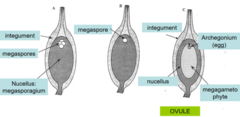
Ovule
1. Seed pre-fertilization
2. On leaf
3. Integument - part of sporophyte
4. Inside is the nucellus - also known as megasporangium
5. Megaspores as made and 3 disintegrate, 1 stays
6. Megaspore becomes archegonium (egg), surrounded by megagametophyte an surrounded by nucellus
7. Integument and nucellus are diploid, archegonium and megagametophyte are haploid
Ovule form

Seed
1. Fertilized ovule
2. Pollen grain reaches pollination droplet and sticks to it
3. Develops into zygote within megagametophyte
4. Seed has seed coat (diploid), nucellus (diploid), megagametophyte (haploid and is the food for embryo), and embryo (diploid)
5. Contains 3 generations
