Management
 Call Kai
 Learn
 Practice Test
 Spaced Repetition
 Match
 Flashcards
 Knowt Play
1/261

There's no tags or description
Looks like no tags are added yet.
262 Terms
Trait theories
implies leaders are born
personality, social, physical, intellectual, or other personal characteristics
Trait theories pros and cons
pros:
clear framework
useful for selection and guidance
cons:
ignores situational context
fails to explain development
risk of subjectivity and stereotyping
Behavioural theories
implies leaders can be made
sees leadership as a set of style or behaviours that help other perform a task and reach a goal
Behavioural theories pros and cons
pros:
fosters innovation
improves morale
cons:
human behaviour is complex
context-dependent
may focus too much on social satisfaction
Task-oriented behaviours
providing structure, direction, and aiding performance
People-oriented
demonstrating concern, respect, and care for the wellbeing of others
The full range leadership model

Transformational Leadership
Idealised Influence or Charisma
Inspirational Motivation
Intellectual Stimulation
Individualised Consideration
leadership for exploration and change
Idealised influence or charisma
Leads followers to a higher purpose
acts as a role model
promotes high standards of moral or ethical conduct
Inspirational Motivation
Leads followers to believe in a better future
communicates high expectations to followers
uses symbols and emotional appeals to communicate a shared vision
Intellectual stimulation
Leads followers to find new solutions
stimulates followers to be more creative and challenge their beliefs
Individualised consideration
Leads followers to self-actualisation
provides a supportive climate
Contingency/Situational theories
Predicting leadership success is more complex than isolating a few traits or preferable behaviours.
appropriate style of leadership is contingent on the requirements of the situation
Contingency/situational theories pros and cons
pros:
high adaptability
improves organisational fit
encourages social awareness
cons:
demanding on leaders (complex)
reactive over proactive (causes leaders to focus on the present more than long-term strats)
Situational model

Transactional leadership
leadership for exploitation
Traditional leaders
sees leadership as a rank to obtain
uses power and control to drive performance
measures success through output
Servant leaders
sees leadership as an opportunity to serve others
shares power and control to drive engagement
measures success through growth and development
Interactive leadership
leaders favour a consensual and collaborative process
Ineffective leadership
fails to produce the desired outcome
Unethical leadership
fails to distinguish between right and wrong
Charisma pros and cons
pros:
followers experience strong feelings towards the mission and the leader
they full-heartedly trust the correctness of the leader’s belief, and obey willingly
cons:
may use power for personal gain
insensitive to followers needs (maybe)
censure critical or opposing views
Factors influencing obedience
status of location
legitimacy of authority figure
peer support
personal responsibility
status of authority figure
proximity of authority figure
Expert power
stems from special knowledge or skills in tasks performed by employees
Referent power
stems from the characteristics that command employees identification, respect, and admiration
Personal effort
shows initiative beyond what is expected of them, gains power as a result
Network of relationships
more interpersonal connections = knowledge on organisation and industry
Information
people who have access to info can control how and to who it is distributed to
Communication
the process by which info is exchanged and understood by two or more people, usually with the intent to motivate or influence behaviour
Effective communication
Share info
Achieve coordinated action
Express feelings or emotions
Model of the Communication Process
Encode - choose symbols to compose message
Choose a medium/channel
Decode - translate the symbols and interpret
Feedback (it’s a two-way process)

Communication fidelity
Correspondence between the intention and understanding
Why communication infidelity occurs
source may withhold or filter info
encoding/decoding issues may occur
receiver may be overloaded, not listening, focusing selectively
feedback may be insufficient to verify fidelity
Barriers to effective communication
filtering
selective perception
information overload
emotions
context
languages
gender differences
generational differences
cultural differences
Filtering
senders purposefully withholds or distorts info
Selective perception
receiver selectively interprets transmitted info on basis of interests, background, experience, and attitudes
info overload
info inflow exceeds individual’s processing capacity
emotions
how a receiver feels at the time a message is received
Context
enviro (noise/visibility)
type of place
Languages
words and non-verbal symbols may have different meanins to different people (shaped by culture)
Gender differences
men talk to emphasise status
women talk to create connections
Cultural difference
High-context culture - communication is seen as a means to engage with someone
relo focused
nonverbal, implict, indirect
Low-context culture - communication is seen as a way to exchange info
task-focused
verbal, explicit, direct
Sender’s responsibilities: Persuasive communication
establish credibility
emphasise common ground and mutual beliefs
connect emotionally
use multiple media to add weight to the message
communicate with candour
Sender’s responsibilities: Relational meta-communication
choose correct body language and tone to establish a particular relational context
manage content and relational aspects of communications
Sender’s responsibilities: choosing the right medium
high channel richness vs low channel richness
Media richness theory
suggests that rich media are better suited for non-routine messages
rich media also communicate care and may be especially useful in challenging times or for sensitive communications
High channel richness pros n cons
pros:
personal
two-way
fast feedback
cons:
no permanent record
spontaneous
difficult to disseminate
Low channel richness pros and cons
pros:
permanent record
premeditated
easy to disseminate
cons:
impersonal
one-way
slow feedback
Direction of communication flow
Upward
Downward
Horizontal
Downward communication
refers to messages and information sent from top management down to employees
traditionally emphasised (authoritarian structure)
Involves:
goals and strats
job instructions and rationale
procedures and practices
performance feedback
indoctrination
Cons of Downward Communications
Distortion
Information overload/ambiguity
Filtering
Distortion
the loss of content/meaning as the message travels downward through multiple people
Information overload/ambiguity
sending too many (possibly contradictory) or too vague messages
Filtering
management withholding valuable info from employees and potentially communication low regard for them
Upward communication
includes messages that from from the lower to the higher levels of the organisation’s hierarchy
increasingly encouraged (participative management—empowerment)
5 types of info communicated upward:
problems and exceptions
suggestions for improvement
performance reports
grievances and disputes
financial and accounting info
Cons for upward communication
managers may resist hearing about employee problems or react defensively
employees may not trust managers sufficiently to push info upward (fear of being ignored, embarrassed or punished for speaking up)
Horizontal communication
refers to the lateral or diagonal exchange of messages among peers or coworkers
increasingly encourages (decentralisation and cross-functional teamwork for more flexible and faster responses in complex enviro)
3 main categories:
Intradepartmental problem solving
Interdepartmental coordination
Change initiatives and improvements
Cons with horizontal communication
not enough time or opportunities
cultural barriers - people from different functions are unwilling or incapable of effectively communicating with one another (territoriality and rivalry; specialised knowledge, vocab, and convo style)
Formal communication channels
systems designed by management to dictate who should talk to whom to get a job done
used for organisational purposes exclusively
Informal communication channels
patterns of interaction emerging from shared personal interest, proximity, shared dislike
used for both non-work and work-related purposes
can enable faster and more effective communication than formal channels
Informal channels pros and cons
pros:
quick (uncontrolled) info flow
jump-start stalled initiatives
mobilise actions to achieve difficult deadlines
can stimulate entrepreneurial energies
cons:
blocks, diverts, distorts communications
mobilise actions to oppose change
breeding ground for politics
Entrepreneurship
the process of initiating a business venture, organising the necessary resources, and assuming the associated risks and rewards
The context of entrepreneurship
economic changes
globalisation and increased competition
tech
new opportunities and market niches
organisational innovation
social entrepreneurship
Economic changes
fertile
economy changes constantly, providing opportunities for new businesses
Globalisation and increased compeition
demands entrepreneurial behaviour, organisations have to find ways to do things faster, better, and less expensively
globalisation and increased competition also give an advantage to small businesses (can offer flexibility and fast responses) rather than huge organisations which rely on economies of scale
Tech
rapid advances and falling prices in tech have spawned new industries asw as new methods of producing and delivering goods and services
New opportunities and market niches
entrepreneurs are taking advantage of the opporunity to meet changing needs in the market place
Organisational innovation
the processes of developing new products or services, technologies, systems, business models, and ideas
innovation involves taking an idea for something new or different through full-scale commercialisation
act of invention is the first step in innovation
Social entrepreneurship
focuses on creating social value by providing solutions to social problems with a secondary purpose of generating profits and returns
Incremental innovation
more like continuous improvement
Radical innovation
a product/service/system/tech that is brand new to the industry, country, or world
Business plan
a document specifying the business details prepared by an entrepreneur prior to opening a business
forces entrepreneur to think abt the issues and problems associated with starting and developing a business
most entrepreneurs have to borrow money (business plan helps persuade lenders and investors to participate)
Successful business plan criteria
clear, compelling vision w air of excitement
clear and realistic financial projections
detailed info abt potential customers and target market
detailed info abt industry and competitors
evidence of effective entrepreneurial management team
good formatting n clear writing
plan is short (50 pages max)
critical risks that may threaten business success
sources and uses of start-up funds and operating funds
capture reader’s attention w great summary
Choosing a legal structure - Sole proprietorship
an unincorporated business owned by an individual, carried on for profit
they own more than half the business
this form is popular because it is easy to start and has few legal requirements
they have total ownership and control of the business and can make all decisions without consulting someone
Choosing a legal structure - Partnership
an unincorporated business owned by two or more people
relatively easy to start
cons of a partnership: the unlimited liability of the partners and disagreements that almost always occur w strong-minded people
Choosing a legal structure - Company
created as a legal entity by the state and exists apart from its owners
has a legal life of its own
continues to exist regardless of whether the owners (shareholders) live or die
the structure is sued when the structure is legally liable
pros: continuity and limits on owner’s liability
Choosing a legal structure - The franchise appeal
a firm collects upfront and ongoing fees in exchange for allowing individuals or other firms to offer products and services under its brand name and to use its processes
Choosing a legal structure - Participate in a business incubator
typically provides shared office space, management support services and management and legal advice to its entrepreneurs
5 stages of growth for an entrepreneurial company
existence
survival
success
takeoff
resource maturity
Intrapreneur
innovate within a business
less risky
access to resources
job security
Arranging financing
Debt financing - can involve borrowing money from friends, family, personal credit cards, or a bank load
typical source of funds for businesses with high potential is through angel financing
angels are wealth individuals typically with business experience and contacts who believe in the idea for the start-up and are willing to invest their personal funds to help the business get started
CSR - Corporate social responsibility
the obligation of an organisational management to make decisions and take actions that will enhance the welfare and interests of society as well as the organisation
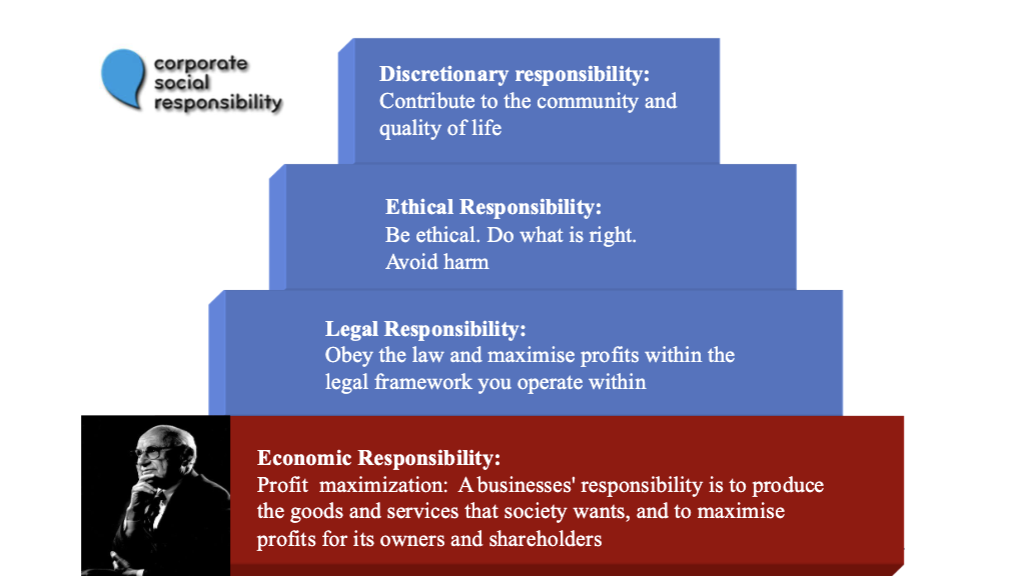
Carroll’s CSR Pyramid
Discretionary responsibility - contribute to community and quality of life
Ethical responsibility - be ethical
Legal Responsibility - obey the law and maximise profits within the legal framework
Economic responsibility - profit maximisation, produce the goods and services a society wants and profits for owners and shareholders
Pros fo CSR
Image - can create a favourable public image
Risk Management - can prevent criticism and discourage further government involvement or regulation
Resource endowment - have financial and human resources to support public and charitable projects that need assistance
Long-run profitability - studies argue that socially responsible companies tend to have more secure long-run profits
Cons for CSR
Profit maximisation goal - pursuing social goals dilutes businesses’ primary purpose—profit maximisation
Costs - many socially responsible actions don’t cover costs
Jurisdictional domain - not the responsibility of a business to address social and environmental problems (government’s job) bc businesses alr pay taxes
Lack of skills - business leaders lack the skills needed to address social issues
Stakeholder engagement
CSR requires consideration and balancing of stakeholders’ needs and interests
organisations can use stakeholder mapping to identify stakeholders’ needs and expectations
an open view of stakeholder engagement is often an indicator of a genuine and strong commitment to CSR
The triple bottom line

Managerial ethics
the code of moral principles and values that govern managerial behaviour and decision-making with respect to what is right or wrong
economic pressures can muddy ethical waters
simply acting within the law doesn’t constitute ethical behaviour
Managers’ levels of moral development
Preconventional
Conventional
Postconventional
Preconventional
follows rules to avoid punishment
acts in own interest
obedience for its own sake
Conventional
lives up to the expectations of others
fulfils duties and obligations of the social system
upholds laws
Postconventional
follows self-chosen principles of justice and right
aware that people hold different values and seeks creative solutions to ethical dilemmas
balances concern for common good
Structural and culture influences
don’t blame the individuals involved without considering how the situation contributed to the behaviour
risks associated with management by objective
barriers to upward communication flow
the subtle messages that the corporate culture sends to employees
Building an ethical organisation
structure
culture
politics
Structure
chief ethics officer
ethics committee
code of ethics and ethics training
hotlines and support for whistleblowers
Culture
reemphasise values of openness, critical self-assessment
humble, moral leaders
beware of incongruences between values and reward structures
Politics
power to diverse individuals
build diverse networks to avoid groupthink
ESG Excellence Framework
environment, society, governance

Organisational structure
refers to the framework in which the organisation defines how tasks are divided, the work of employees and departments coordinated, and authority distributed
affects organisation’s ability to reach their goals
Steps for formal organisation design
Degrees of formalisation:
division of labour (differentiation)
coordination of mechanisms (integration)
distribution of decision rights (decentralisation)