thermal physiology III
 Call Kai
 Learn
 Practice Test
 Spaced Repetition
 Match
 Flashcards
 Knowt Play
1/27

There's no tags or description
Looks like no tags are added yet.
28 Terms
metabolic heat production (?) during exercise
increases
body temperature increases with increasing (?) intensity
exercise
body temperature will eventually (?) depending on work rate
plateau
body temp rises until heat loss is (?) to heat production
equal
why is thermoregulation negative feedback control and not positive?
counteracts changes and reverses the direction of a stimulus to maintain the body's internal temperature
exercising in heat creates trade-off between (a) and need of (b)
(a) exercise performance
(b) thermoregulation
target of blood flow (prioritising exercise performance vs prioritising thermoregulation)
exercise performance → blood flow to muscles
thermoregulation → blood flow to skin → heat loss
wet-bulb globe temperature index
index of how easy it is to lose heat to the environment
wet bulb calculation

natural wet bulb-temperature
Measures lowest temp possible achieved by evaporative cooling and windspeed
Bulb of thermometer covered in cloth kept wet
Therefore evaporation from the wet bulb will lower temp reading of the wet bulb thermometer
If wet bulb reads lower than the dry bulb -> evaporation occurring from the bulb of the wet bulb thermometer
Difference between dry and wet bulb is called the wet bulb depression
The drier it is, the lower the reading on the wet bulb
The more humid it is the higher the reading on the wet bulb

ventilated wet-bulb temperature
Temperature is independent of the wind speed
Function of just the humidity
Measures lowest temp possible achieved by evaporative cooling
stevenson screen
Shields dry bulb thermometer from environmental radiation
As wet-bulb test is performed in sunlight
So the dry bulb thermometer is registering just the temperature of the air and not the radiation temp
black globe
Purposely captures environmental radiation
Registers increase in temperature when the globe is exposed to radiation in the environment
globe temperature
measured by a black-bulb thermometer
accounts for air temperature, radiation temperature, and wind speed
recommendations based on wet bulb globe temperature
26.5 - 28.8 → use discretion especially if unacclimatised
29.5 - 30.5 → avoid strenuous activity in the sun
>31.2 → avoid any exercise
why is there a decrease in exercise performance on hotter days?
due to compromise cardiovascular system reaches to satisfying the demands of blood flow between the muscle and skin
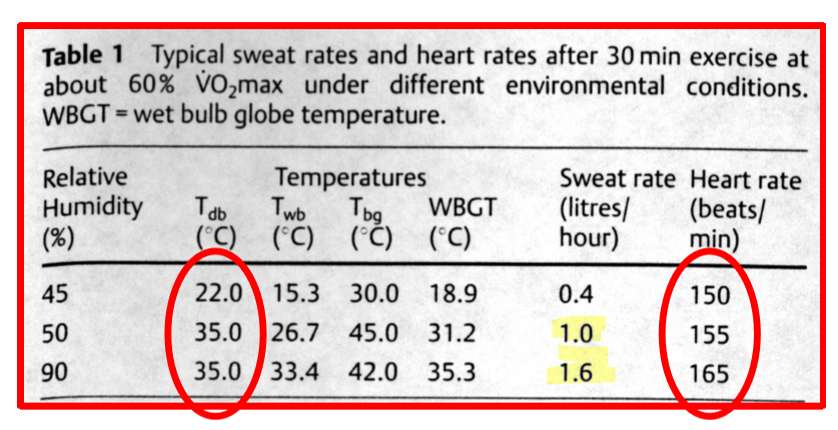
explain the difference in sweat rate between the different relative humidity %
When exercising at the same work rate
Heart rate is higher when it's hotter
VO2 max (maximum O2 your body can use per minute during high-intensity exercise) is limited by your maximum heart rate
VO2 max is lower in the heat -> exercise performance compromised
50% humidity vs 90% humidity at 35 degrees dry bulb temp
Exercising at 60% VO2 max at 35 degrees under 90% humidity requires a 60% increase in sweat rate compared to the same exercise at 50% humidity
Demonstrates physiological strain caused by humidity
dehydration (before exercise or during exercise) compromises (?) performance
exercise

effect of dehydration on % change in blood volume
replacing fluids during exercise will result in minimal % change or even a % increase in blood plasma volume
no fluid replenishment during exercise will result in a % decrease in blood plasma volume

dehydration will (?) stroke volume during exercise
decrease

dehydration will (?) heart rate to a greater extent by the end of exercise
increase → heart rate highest in subjects that did not replenish fluids at the end of exercise
muscle and skin blood flow compromised due to loss of fluids (smaller blood volume thus heart workload increases)
skin blood flow (?) as a result of dehydration
decrease
esophageal and rectal temp (?) with dehydration
increase
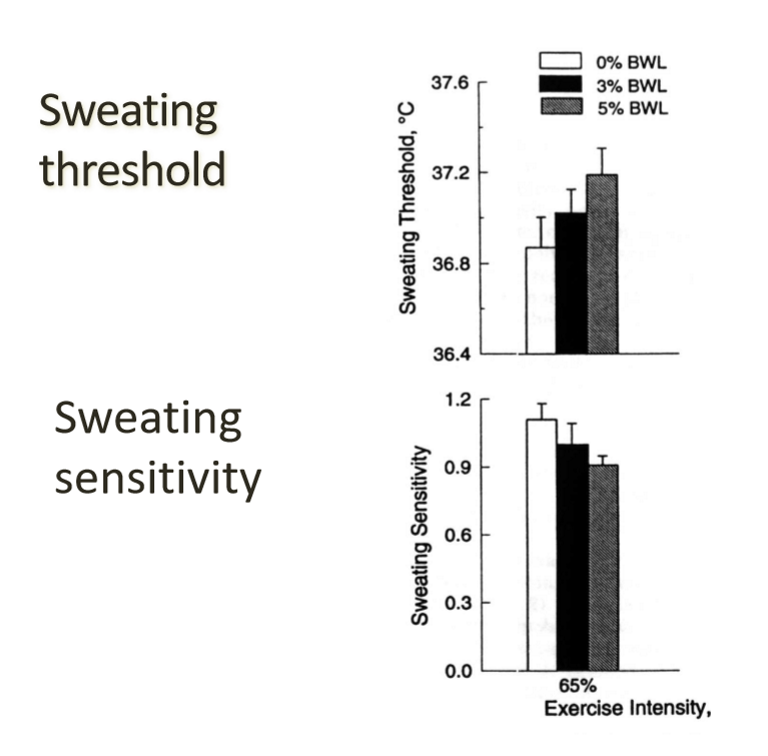
the sweating threshold (?) with progressive dehydration
increases
thirst is a poor indicator of dehydration:
you don’t feel thirsty until you have lost about 2% body mass

the sweating threshold is (?) in acclimatised individuals
decreased
vital signs of heatstroke (list 3)
high body temperature (more than 40 degrees celsius)
significantly low blood pressure
deteriorating mental status → confusion, coma)
summary
metabolic rate increases → from increase in heart/muscle workload
increase from 100 watts at rest to 1500 watts during exercise
activation of heat loss mechanisms
thermoregulation relies on negative feedback → counteracts change and reverses the direction of a stimulus to maintain the body’s internal temperature
many challenges to assessing thermal environment → multiple variables, human variability in thermal sensation
wet bulb globe temperature index → how easy it is to lose heat to the environment
natural wet bulb test → wet bulb covered in damp cloth
if temp reading is lower than dry bulb thermometer → evaporation occurring
the lower the reading on the wet bulb thermometer → the lower the humidity of the environment
natural vs ventilated wet bulb → measurement of wind speed and evaporative cooling vs only evaporative cooling
stevenson screen → protects dry bulb → dry bulb only measures air temp rather than radiation temp
black globe → intentionally measures increase in temp due to environmental radiation
WBGT used to measure environmental temp and conditions
exercise performance compromised in humidity due to increase in sweating → increase in fluid loss
cardiovascular compromise between distribution of blood flow to muscle (for exercise performance) vs skin (for heat loss via vasoconstriction and sweating)
dehydration compromises exercise performance → (decreases blood plasma volume and stroke volume, increases heart rate, decreases skin blood flow, increased sweating threshold) → elevated body temp from greater heat storage due to compromised heat loss mechanisms
