BR Oligopolies
 Call Kai
 Learn
 Practice Test
 Spaced Repetition
 Match
 Flashcards
 Knowt Play
1/74

There's no tags or description
Looks like no tags are added yet.
75 Terms
What is a BR?
A best response function associates to every a_-i a best response in a_i.

steps to finding the BR NE pair
find best response function for every action that every player i can take
Plot them both and find the point of intersection, where both actions are the best response to one another. This is the NE pair
Symmetric utility functions have _____ BR functions
symmetric. This means that in the same NE they choose the same action.
How to find the BR function?
Find the derivative of the utility function with respect to one quantity. Set it to zero to find the function in terms of x or y at which utility is maximised. This is the BR function.
How do symmetric BR functions help with finding the NE?
If the BR functions are symmetric Y* = X*
Free-riding
Described by a downwards sloping best response. If other contribute more, I contribute less.
Guess the average game
Predict correctly ½ of the average of the numbers chosen by all players. In a two player games, we delete dominated actions (from the top) halving each time as the average can never be more than the top possible value to choose, until we find the NE at 0,0.

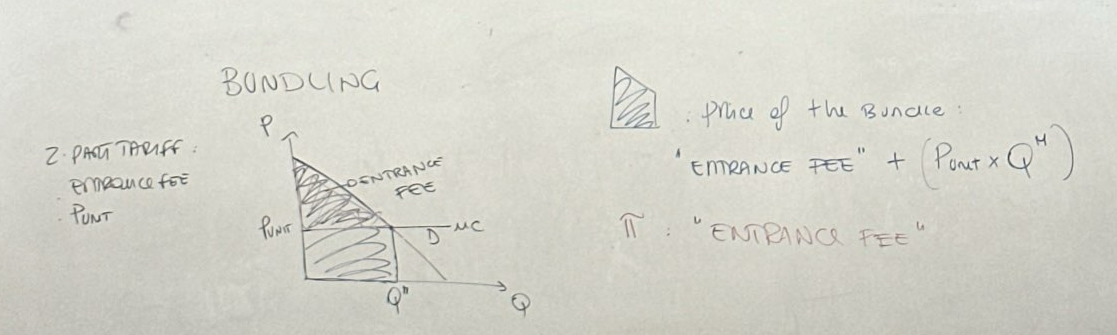
What is the profit in the two part tariff?
The entrance fee
What is price in the two-part tariff?
Price of the bundle = entrance fee + price per unit x equilibrium quantity (this maximises total surplus = ps)
What happens when we repeat the prisoner’s dilemma infinitely many times?
The potential for worse punishment allows for cooperation.
Betrand model of oligopoly vs Cournot model of oligopoly
Cournot: firms choose quantities, and market demand determines the price.
Bertrand: firms choose prices, and customer demand determines how much each sells.
Price with identical constant marginal cost - Betrand model vs Cournot model
Betrand: P=MC
Cournot: P>MC
Profit in Cournot (chooses output holding competitors’ output fixed)
Profit = P(Q) x Q_i - Q_i x MC
Maximising by setting the derivative with respect to Q_i = 0. This is how you find the BR to (q_-i)
What is the equilibrium quantity individual for most Cournot models?
q_i * = constant / n+1, as number of firms increases q_i decreases
What is equilibrium quantity for all firms together for Cournot models?
q_i * x n = constant x n / n+1, so as n increases, it approximates a constant = quantity in perfect competition

Why do firms limit output in the Cournot model?
Because selling more lowers the market price on all its units.
What is the relationship between price of A and B in Betrand model with homogeneous, identical products:
If pA < pB, A gets all market demand, B sells nothing
If pA > pB, B gets all market demand, A sells nothing
If pA = pB, they share demand, usually assumed equally (1/2 of what it is at max)
Why does price fall to MC in the Betrand model?
NE, if each firm charges slightly less and consequentially captures the whole market, they make more profit, This incentive to undercut persists until pA = pB = MC.
Betrand paradox
Under these assumptions, two firms produce at the competitive price.
Does Betrand always imply P = MC?
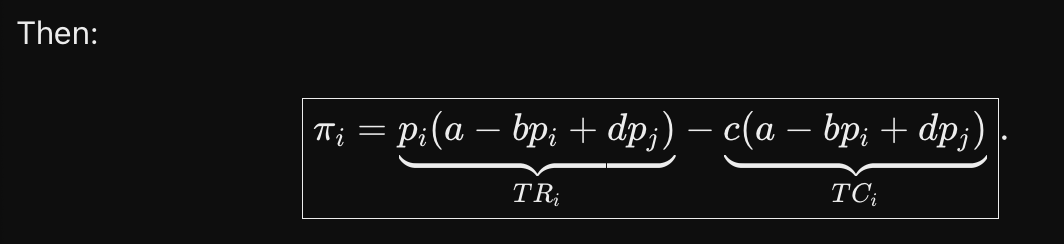
No, with differentiated products, a small price increase does not necessarily lose every customer. So, each firm faces its own demand. A higher own price reduces demand, a higher rival’s price increases demand because the products are substitutes. q_i = a - bpi + dpi
Do firms have market power in Betrand model?
Yes, but only if goods are differentiated. If goods are differentiated, Firms can charge a little above MC, because some customers prefer their product.
Does adding firms increase total output / individual output in the Cournot model?
Adding firms increases total output, but decreases each firm’s individual output. As n approaches infinity, total output approaches the competitive quantity. Price decreases as it depends on total output and total output is increasing.
Does Betrand assume firms can produce infinite quantities?
It assumes no binding capacity constraint: each firm can supply all the demand it would attract at its chosen price. Not actually infinite production but each firm is capable of serving the entire market for the standard undercutting argument to apply.
Betrand profit
For either homogeneous or differentiated products: profit = pi qi - Ci (qi)
Does demand function change for homogeneous / differentiated goods in Bertrand?
Yes, for homogeneous goods, buyers choose the cheapest firm. With two firms and equal sharing at equal prices. A tiny price cut can make demand jump from halt the market to the whole market. meanwhile, for differentiated substitutes demand depends on price of both products at all prices. Demand usually changes smoothly: charging slightly more than a rival does not mean losing every customer.
What changes in Cournot if products are differentiated?
With homogeneous goods, firms sell the same product at a common market price. With differentiated goods, each product can have its own price that depends on the quantity of produced by both firms, but is different for each good.
What is q_-i for a two firm model?
q_i + q_-i = Q
price equation for differentiated goods in betrand vs cournot
Cournot: p_i = a -bqi - dqj
Betrand: q_i = a -bpi + dpi
Cournot: more output from your rival lowers the price you can charge
Betrand: a higher rival price increases demand for your product. NOT SAME COEFFICIENTS.
Do prices remain above MC for differentiated substitutes in Cournot model?
Yes, and weaker substitution can give firms more market power.
What happens to price in betrand model with differentiated substitutes?
Prices generally exceed MC because customers do not all switch after a small price increase.
Do firms have markup in homogeneous Cournot?
Yes, because by restricting output and keeping P>MC, they retain some market power and make a profit.
Do firms have markup in homogeneous Betrand?
No, firms do shave their markups all the way to zero by driving the price to MC.
Does differentiation allow for greater markup in both Bertrand and Cournot models?
Yes, differentiation softens substitution between firms’ products, generally allowing greater markups, especially in price competition.
Why does adding firms increase total Cournot output?
As n increases, 1/(n+1) decreases, so total output increases towards a maximum. Each firm restricts its own output to protect its profits. A new entrant adds output, while existing firms reduce their, but their combined reduction is smaller than the entrant’s output.
Cournot why is MR = MC
Profit maximising quantity, when adding one extra stops increasing TR, as MR and MC now cancel each other out.
For homogeneous goods, what is the relationship between p_i, and p_-i in Bertrand model?
p_i = p_-i.
Identical constant MC, homogeneous goods, no capacity constraints means that equilibrium has pi=pj=MC
Are prices equal in the Bertrand model with differentiated goods?
Prices need not be equal. If firms have identical costs and symmetric demand, their symmetric equilibrium usually has equal prices, above MC. Firms choose prices independently, equality is an equilibrium result under particular assumptions.
Why do the Cournot and Bertrand demand equations look different?
Cournot: more rival output lowers willingness to pay for your product, so -dqi
Bertrand: a higher rival price shifts customers towards your product + dpj

Why is P>MC in Cournot model?
Each firms knows that producing more increases total market output and lowers the market price. Selling an extra unit brings in revenue, but the lower price also reduces revenue on all the units the firm was already selling. Therefore, MR<P. The firm maximises profit by choosing output where MR=MC, since price is above the MR, this means that P>MC. Price must exceed the cost of producing the extra unit to compensate for the revenue lost on existing sales.
When do firms choose the price in the bertrand model?
Simultaneously (both for homogeneous and differentiated goods).
Assumptions we make to solve Bertrand model problems
Duopoly (2 firms)
Homogeneous goods
No FC, AC = MC hatW
Why do we assume no FC in the standard bertrand model?
for simplicity, otherwise ac>mc. this just makes it so ac = mc = a constant cost per unit

Firms goal in the betrand model and how to reach it
maximising profit, by setting p_i < p_-i
What actions are dominated in a Bertrand model BR function?
Anything below the MC is dominated as it is never a BR, and anything above the monopoly price is also dominated as it is never a BR. Then you undercut every time and shave off the topes price until you eventually choose MC. This is the unique nash equilibrium.
Bertrand model outcome homogeneous goods
In the standard Bertrand model with homogeneous goods, identical constant marginal costs, and no fixed costs, profit is zero at equilibrium.
NE for Bertrand model with homogeneous goods but different marginal costs
The goods are identical; the difference is how cheaply each firm produces them: MC1 > MC2 which implies that monopoly price 1 > monopoly price 2.
First you cut off everything below the marginal cost of each for each player above the monopoly price of each for each player. Anything above the lowest monopoly price (pm2) is cut off. we shave off a little of of the top until eventually we get to MC1 and MC1-\epsilon. Firm 1 cannot undercut that price without selling below its own marginal cost. Therefore:
Firm 2 captures the whole market and earns positive profit because P_2 = MC_1 - epsilon > MC2
Firm 1 sells nothing and earns zero profit, assuming no fixed costs.

prices bertrand model with homogeneous goods but different mc
p2 wins here so profit 1 = 0, and profit 2 > 0, quantity 1 = 0, quantity 2 = Q, price = MC-\epsilon

efficiency under betrand model homogeneous goods
MC1 = MC2 → P=MC → efficiency as DWL = 0
MC1>MC2 → P = MC1-e → efficiency as DWL = 0
If we repeat the same game (Betrand model) N = infinity times, then…
Firms may sustain collusion, keeping prices above marginal cost and earning positive profits. As undercutting today could seriously undermine future profits. If firms value future profits sufficiently, the temporary gain from undercutting is smaller than the future profits they would lose, so cooperation can be sustained. Infinite repetition makes collusion possible; it does not guarantee it. Charging \(p=MC\) every period is still an equilibrium.
Pareto efficiency
Means that you cannot make anyone better off without making someone else worse off, no pareto improvements possible (improvement that improves for at least one person and harms nobody).
More than 2 firms Bertrand model homogeneous goods with same mc
All marginal costs are equal → P = MC and Quantity produced by each firm are equal and = Q/N
More than 2 firms Bertrand model homogeneous goods with different MCs
If MC1 = MC2 > MC3 = MC4 → P = MC3 = MC4 and Q3 = Q4 = Q/2 while Q1 = Q2 = 0
etc.
Capacity limit and its effect on the Bertrand model
Firms may be able to keep market power (P>MC) → profit > 0 if efficiency price cannot meet demand at the efficient price. This means that other firms can charge prices above the marginal cost.

When do oligopolies decide on quantity in Cournot model?
Simultaneously
Bertrand model profit?
Qc depends on prices of both products, because both prices affect how much C sells, \(Q_c\).

Maximum investment to switch from a homogenous good to a differentiated one
= profit differentiated - profit homogeneous
Difference in finding profit for Cournot and Bertrand
Cournot = you derive with respect to quantity as you change quantity
Bertrand = you derive with respect to price as you change price
If you expect your opponent to increase production what do you do (Cournot)
decrease production to keep price higher, same reason that if a new firm enters the market you decrease individual production but overall quantity increases
Q total cournot
Q1* + Q2*
P cournot (constant)
Firms sell at the same market price in a standard Cournot model with homogeneous goods
P cournot = Pˆ-1(Q cournot)
If profit is greater than 0 in the COurnot model, then…
it is inefficient as P>MC and DWL > 0
individual profit is calculated using the individual Q1* and Q2*
Cournot with N players rival output
Q_-1 = (N-1) Qi in equilibrium
When N increases, every producer produces less but the total quantity produced increases.
Symmetry in COurnot implies
Q1 = Q2
difference in perfect competition and bertrand competition
Perfect competition, = firms take the price as given, and equilibrium has P = MC, meanwhile in Bertrand competition, firms can choose prices. But equilibrium is pushed down to P = MC. So consumers buy the same total market quantity at that price QPC = Q Bertrand.
Profit Cournot
P = a - b (Q1 + Q2)
Profit = (a - b(Q1+Q2))Q1 - cQ1
Maximising profit cournot
0 = a - 2bQ1 - bQ2 - c
→ Q1 = (a - bQ2 - c)/2b
Symmetry implies Q1=Q2
Q2 = (a - bQ2 -c)/2b
Q2 = 1/3 (a-c)/b
Q cournot = 2/3 (a-c)/b
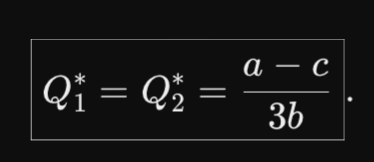
Q cournot
after profit max, c is cost per unit, a and b are from the price function

TO increase efficiency in Cournot model do you increase number of firms or decrease it?
N increases, increases total output, decreases price of cournot so P>MC but less, and P is closer to MC which increases efficiency
Comparing prices at n players for monopoly, cournot model, pc and bertrand
P^M > PˆC > PˆPC = PˆB

Markup
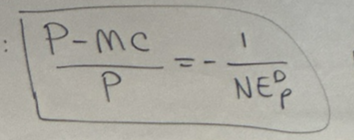
(P-MC)/P measures the gap between price and marginal cost as a fraction of price—the Lerner index.
As number of firms increases in Cournot, how does markup change?
markup decreases
How does number of firms affect price elasticity of market demand?
We divide by \(N\) because the formula uses market demand elasticity, whereas each firm supplies only \(1/N\) of the market. SO mhm much the quantity per firm changes.
Profit of monopolist to find Q monopoly
Profit = (a-bQ)Q-cQ
derive: 0 = a - 2bQ - c
Q_m = (a-c)/2b
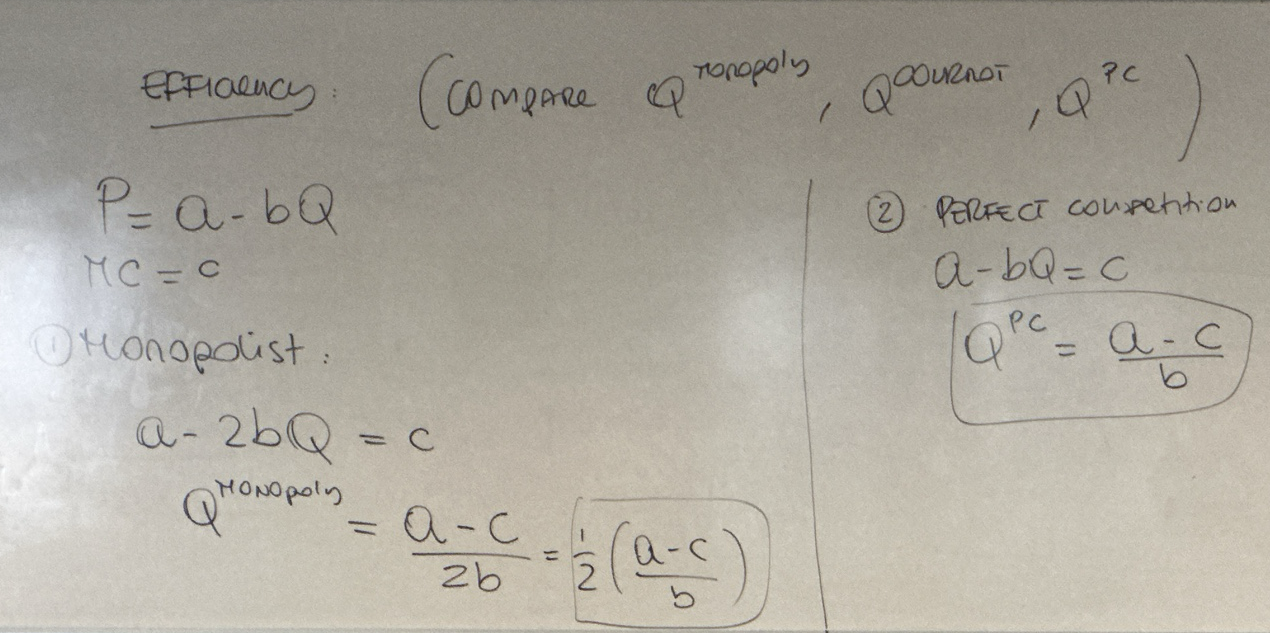
QPC in perfect competition
P = MC
a - bQ = c
QˆPC = (a-c)/b
quantties monopoly cournot pc
Q PC = (a-c)/b > Q monopoly = (a-c)/2b > Q PC = (a-c)/3b = Q bertrand