Organic Chemistry 1 - synthetic rxns Straumanis
 Call Kai
 Learn
 Practice Test
 Spaced Repetition
 Match
 Flashcards
 Knowt Play
1/28

There's no tags or description
Looks like no tags are added yet.
29 Terms
1) Hg(OAc)2, H2O/THF
2) NaBH4
"Oxymercuration- demercuration":
Treatment with an alkene gives a Markovnikov addition of H and OH across the alkene. Mercury prevents carbocation rearrangements.

1. Hg(OAc)2, HOR/THF
2. NaBH4
Alkoxymercuration-demercuration: Mercury prevents carbocation rearrangements. Markovnikov. Addition of OR group instead of OH in Oxymercuration-demercuration

1) BH3, THF
2) H2O2, NaOH, Water
Antimarkovnikov addition of H and OH. OH attaches to least substituted carbon.

1. HBr, peroxides (ROOR)
2. heat or light
Antimarkovnikov addition of H and Br. Double bond between carbons is moved to less sub carbon and bond is formed to Br. H attaches to more sub carbon

HX, cold, dark, no peroxides
Markovnikov Addition of H and X (X = Cl, Br, or I). H bonds to less sub carbon and x bonds to more sub carbon.

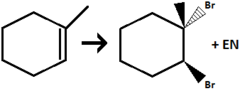
Br2
Addition of Br2 to an alkene. TRANS ONLY OBSERVED. NO CIS. This is a stereoselective transformation.
mCPBA
Oxidation of an Alkene to an Epoxide. mCPBA creates epoxides. Many peroxy acids of this general form can accomplish this transformation. Breaks double bond between carbons and they both bond to an oxygen, creating epoxide ring.

1) Strong Base (nuc)
2) Dilute Acid
anti-Markov. Epoxide Ring Opening (Basic Conditions). Epoxide ring breaks when nuc attacks carbon thats less substituted, O that formed epoxide swings to more sub carbon. In step 2 an H or an R group is added to the O on the more sub Carbon.

H+, HOR
MARKOVNIKOV Epoxide Ring Opening (Acidic Conditions). HOR attacks more sub carbon, epoxide opens and o swings to less sub carbon. H bonds to the O and boom there ya go

Br2, HOR
Markov. Addition of Br and OR to an Alkene. RO bonds to more sub carbon, Br to least sub carbon, stereochemistry is cis, but they lay anti to eachother.

formation of carbene. either CHCl3 and KOH or CH2I2 and Zn(Cu)
Cyclopropane Ring from an Alkene. Carbene forms in situ. double bond (pi bond) breaks between two carbons, they both attach to another carbon from reagent and form cyclopropane ring.

H2 and Pt0 or H2 and Pd0
Catalytic Hydrogenation. Syn addition of H's. H2 and Pt or Pd metal will reduce both pi bonds of a triple bond.

H2/Ni2B or H2 and Lindlar Catalyst
careful use of a weaker catalyst in catalytic hydrogenation (e.g., Lindlar catalyst) will reduce only one pi bond, giving an=]===========alkene. cis addition
![<p>careful use of a weaker catalyst in catalytic hydrogenation (e.g., Lindlar catalyst) will reduce only one pi bond, giving an=]===========alkene. cis addition</p>](https://assets.knowt.com/user-attachments/f564dcda-5663-4d53-8154-9595bfd87ede.png)
Na0 and NH3
Another catalytic hydrogenation but anti/trans addition of H's are observed. complementary to lindlar rxn

PCC
Oxidation of primary Alcohol to an Aldehyde. breaks H bonds on O and one on C. product is aldehyde. Double bond formed between C and O

KMnO4 or Na2Cr2O7/Acid/Water or CrO3/acid/water or PCC
Oxidation of secondary Alcohol to a Ketone. Ketone is formed from secondary alcohol. H on O and C are removed. Double bond formed between C and O

1) PCC - optional starter, it allows you to stop at aldehyde.
2) KMnO4 or NaCr2O7 acid/water or CrO3 acid/water - takes you all the way to carboxylic acid
Oxidation of a primary Alcohol or Aldehyde to a Carboxylic Acid. There are two ways to get carboxylic acid from a primary alcohol, you can do it in two steps starting with PCC and then using KMnO4, or you can do it in one step by just using KMnO4. The reason you'd use PCC is to stop at aldehyde before reaching carboxylic acid. H on O and C are removed. O added to H on C to form OH group.

1) OsO4
2) H2O2 or NaHSO3
Syn Addition of Two OH Groups to a pi Bond. Double bond between carbons break and carbons bond to two O's on OsO4. Then OsO2 leaves and H2O2 donates 2 protons to create 2 OH groups on the Ring. They are syn and cis in configuration.

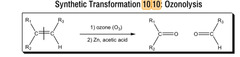
1) Ozone (O3)
2) Zn, acetic acid
Ozonolysis. double bond is cleaved and capped with an O on each cleave site.
1) KMnO4 (hot)
2) H3O+/H2O
Permanganate MnO4-. Double bond is cleaved and capped at cleave site with an O on each site, then OH groups form on lone H's on C's that directly attached to the O.

1) HX, dark, cold, no peroxides. 2) more excess HX
Markovnikov Addition of H and X (X = Cl, Br, or I). Step 1 - One pi bond breaks and X bonds to more sub C, Step 2- then another pi bond breaks and another X bonds to the same more sub carbon. Every time this happens, an H binds to less sub c. neither cis or trans configuration.

1) X2 then 2) X2 excess
Addition of X2 (X = Cl or Br). Trans configuration. Pi bond breaks, then an X bonds to each carbon, equally. another pi bond breaks then both carbons gain an X.

enol form, tautomerize, keto form
Enol to Keto Tautomerization. double bond on o forms, c double bond breaks and ch2 turns into methyl group.

H2O, H2SO4, HgSO4
Markov. Addition of H2O to an Alkyne. triple bond on c breaks, double bond on o forms, addition of 2 h's to c with h already.

1) BH3, THF
2) H2O2, NaOH, H2O
anti-Markov. Alkene to alchohol.

NaNH2
Deprotonation of an Alkyne. Hydrogen leaves less sub carbon

H2O, H2SO4
Nitrile Hydrolysis. triple bond between c and n breaks, only single sigma bond left, c gains o and is double bonded to it, n gains 2 hydrogens. yields carboxylic acid.

HX
Halogenation of an Alcohol using HX (X = Cl, Br, or I). HX protonates OH group, OH group turns into H2O and X takes its place.

SOCl2 or PBr3
Halogenation of an Alcohol using SOCl2 or PBr3. Basically same thing but each one is separate rxn that replaces OH group .
