12. Bandwidth Utilization: Multiplexing
 Call Kai
 Learn
Learn Practice Test
 Spaced Repetition
 Match
Match Flashcards
 Knowt Play
1/36

There's no tags or description
Looks like no tags are added yet.
Name | Mastery | Learn | Test | Matching | Spaced | Call with Kai | Chat |
|---|
No analytics yet
Send a link to your students to track their progress
37 Terms
bandwidth utilization
It is the wise use of available bandwidth to achieve specific goals.
efficiency
It can be achieved by multiplexing.
multiplexing
Efficiency can be achieved by ______.
shared
Whenever the bandwidth of a medium linking two devices is greater than the bandwidth needs of the devices, the link can be _____.
multiplexing
It is the set of techniques that allows the simultaneous transmission of multiple signals across a single data link.
single data link
Multiplexing is the set of techniques that allows the simultaneous transmission of multiple signals across a ______.
traffic
As data and telecommunications use increases, so does _____.
n
a single link contains _ channels.
frequency-division multiplexing (FDM)
wavelength-division multiplexing (WDM)
time-division multiplexing (TDM)
categories of multiplexing (HINT: FWT)
analog
Frequency-Division Multiplexing: analog or digital?
analog
Wavelength-Division Multiplexing: analog or digital?
digital
Time-Division Multiplexing: analog or digital?
TRUE
[TRUE or FALSE] # of input/output lines = # of channels
FDM
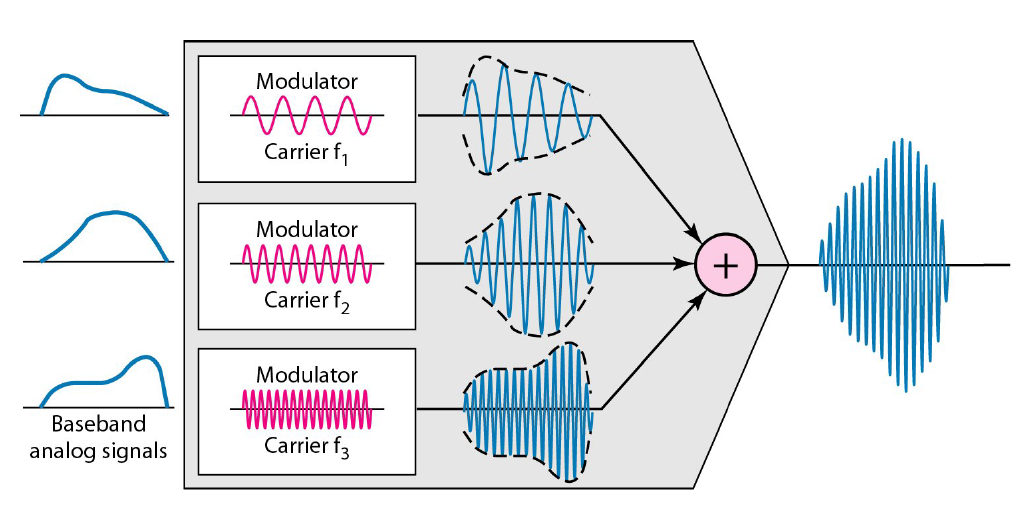
It is an analog multiplexing technique that combines analog signals.
FDM process (3 carrier signals combined/added)
FDM demultiplexing
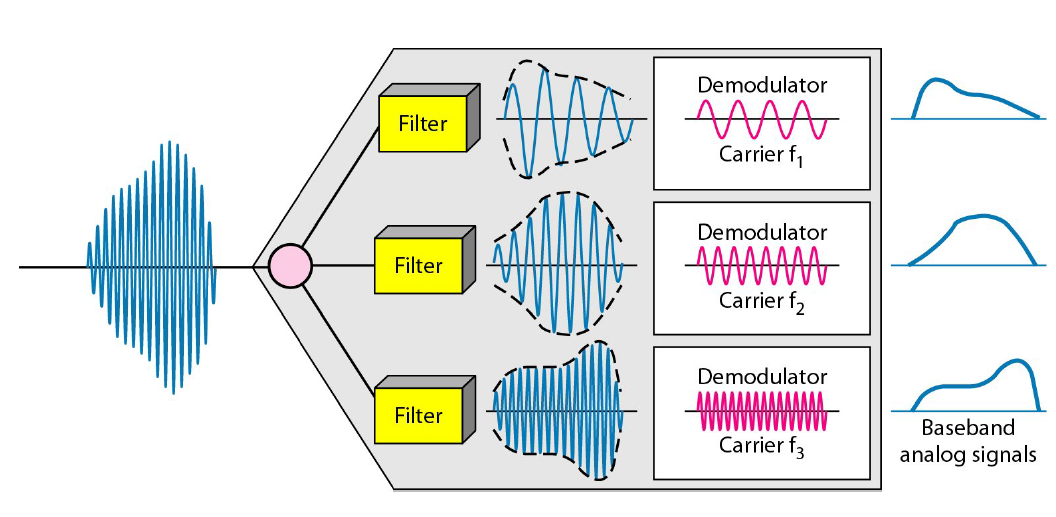
bandpass filter
FDM demultiplexing uses a ___.
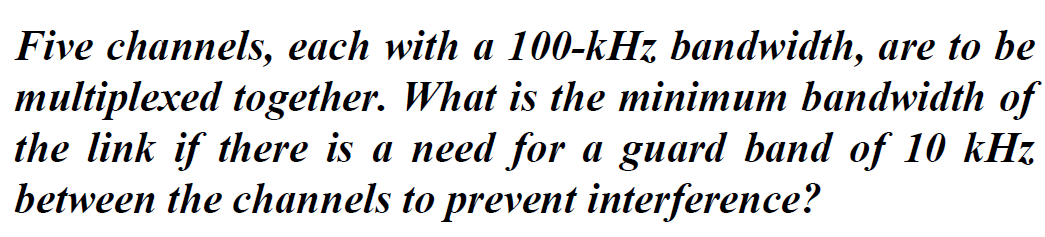
540kHz
wavelength-division multiplexing (WDM)
It is designed to use the high-data-rate capability of fiber-optic cable.
TRUE
[TRUE or FALSE] The optical fiber data rate is higher than the data rate of metallic transmission cable.
TRUE
[TRUE or FALSE] Using a fiber-optic cable for one single line wastes the available bandwidth.
multiplexing
It allows us to combine several lines into one.
synchronous time-division multiplexing (synchronous TDM)
It assigns a fixed time slot to each connected device, whether the device transmits data or not.
asynchronous time-division multiplexing (asynchronous TDM)
With _______, time slots are flexible, and assigned when connected devices have data that is ready to send.
time-division multiplexing (TDM)
It is a digital multiplexing technique for combining several low-rate channels into one high-rate one.
TRUE
[TRUE or FALSE] In synchronous TDM, data are taken from each line every second.
synchronous TDM
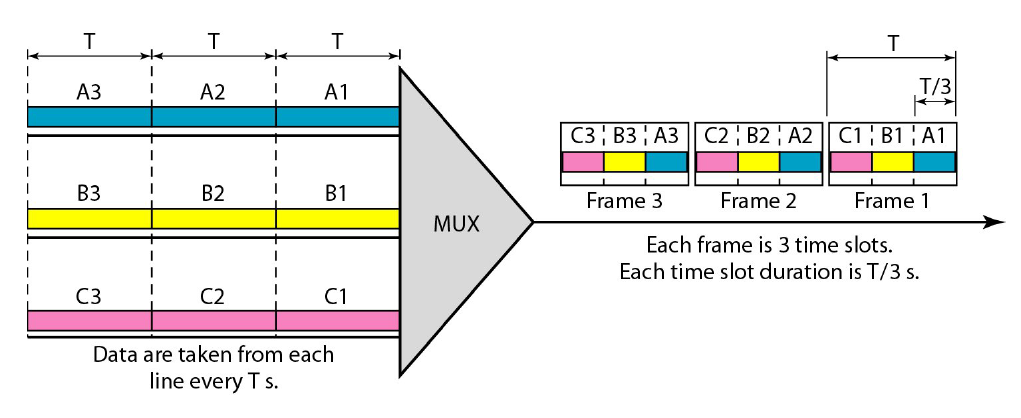
synchronous TDM
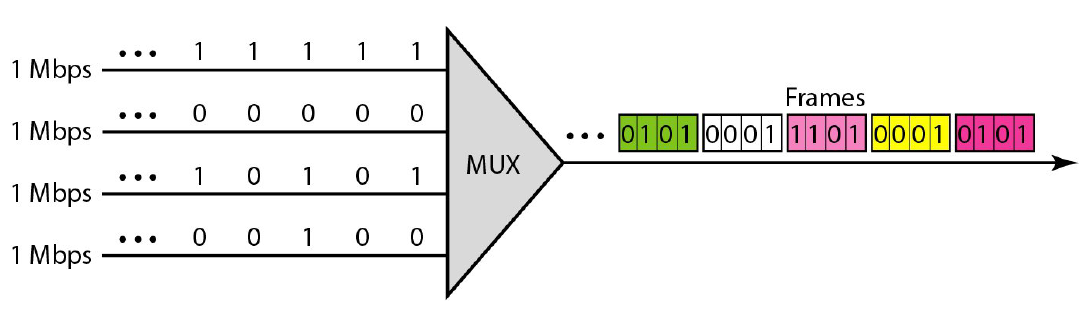
empty slots
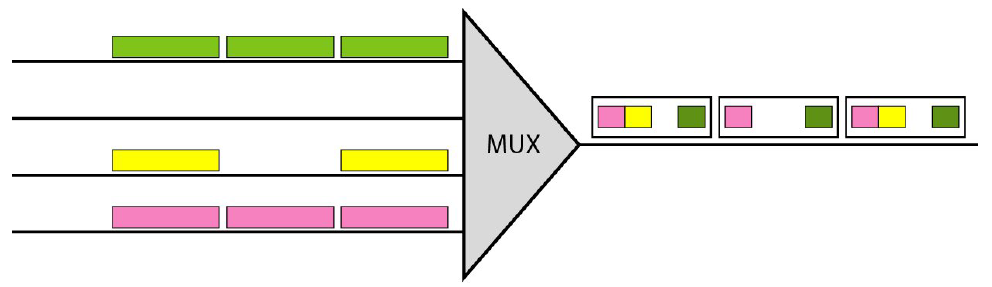
synchronous TDM
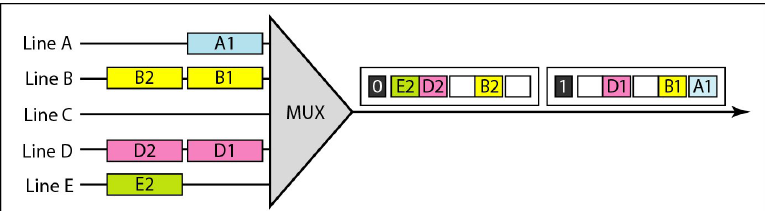
statistical TDM
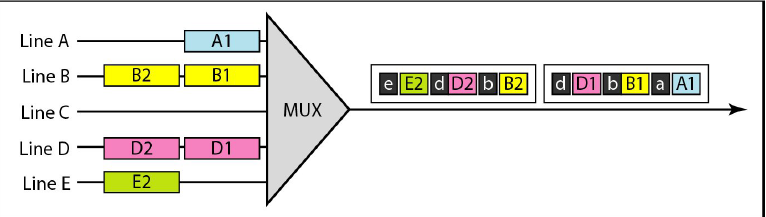
multilevel multiplexing
It is a technique used when the data rate of an input line is a multiple of others.
TRUE
[TRUE or FALSE] In multilevel multiplexing, sometimes the bit rates of sources are not multiple of integers of each other.
dummy bits
To make the data rate compatible in multilevel multiplexing, _____ are added to input lines.
pulse stuffing
It is the practice of adding non-data bits to a binary signal before that signal is transmitted over a network.
pulse stuffing
It is often used as a means of controlling synchronization in systems that require both transmitter and receiver to transmit at the same bit rate.
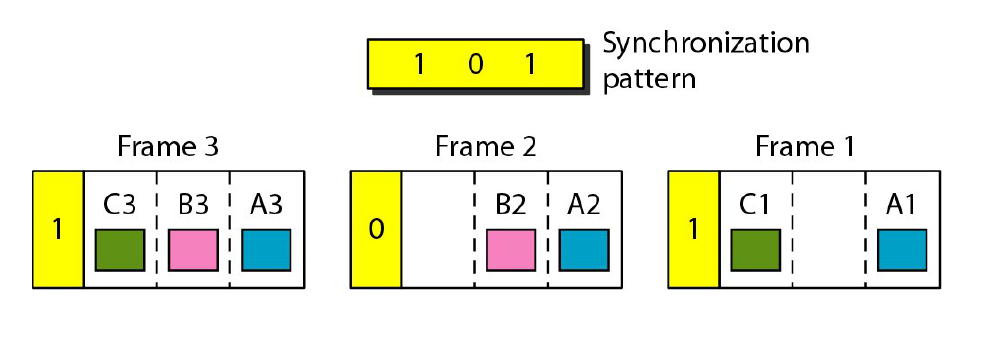
framing bits