Physics Electricity and Magnetism
 Call Kai
 Learn
 Practice Test
 Spaced Repetition
 Match
 Flashcards
 Knowt Play
1/65

There's no tags or description
Looks like no tags are added yet.
66 Terms
Current
The rate of flow of charge carriers. Amps
Conventional current vs electron current
Conventional current is from the positive to negative terminal. Electron flow is the opposite.
Volmeter
Measures the potential difference between two points in a circuit and is connected parallel
Ammeter
Measures current flowing in a circuit and is connected in series
Potential energy
Stored energy an object possesses due to its position or state
Electric potential energy
Stored energy a charge has due to its position in an electric field. It represents the work needed to move a charge against and electric force
Electric charge
A property of some particles and objects positive and negative. q, Coulombs
Charged particles
Exert electrostatic forces on each other. Like charges exert repulsive forces on each other, opposite charges exert attractive forces on each other
Coulombs Law of electrostatics or inverse square law
The electrical forces between two charged objects is directly proportional to the product of the quantity of charge on the object and inversely proportional to the square of the separation distance between two objects

When F is positive
Force is repulsive
When F is negative
Force is attractive
What law is electrostatic forces consistent with
Newtons 3rd law as the force q1 exerts on q2 is equal in magnitude but opposite in direction to the force q2 exerts on q1
Electric field
Charged particles and objects produce electric fields in the space that surrounds them. Charges experience a force when inside the field of another charge
Electric Field Strength
Force per unit charge at a given point in an electric field N/C

Electric field intensity/strength
Measure of force experiences by a unit positive charge placed in the field. It is affected by factors like the charge creating the field (Q) and distance from charge (r)
Electric field in closed hollow conductors
Charges spread out evenly over the surface of a conductor. The charges exert repulsive forces and come to electrostatic equilibrium where they don’t move. There is no excess charge or electric field inside a hollow conductor of any shape.
Electrostatic shielding
The process of isolating a certain region of space from an external electric field. The process is based on the fact that there is no electric field inside a hollow conductor.
Electric field in charged conductors of an irregular shape.
Electric fields are strongest near sharp points on irregularly-shaped conductors. The electric field near very sharp points may be strong enough to ionise the air. Excess charge on the conductor is then dissipated into the air.
Corona discharge
A strong electric field near a conductor ionises air molecules, forming ions. The ions have the same charge as the conductor and are repelled away from its surface. The flow of charge away from the conductor’s surface is called corona discharge.
Electric fields do work on charged particles or objects.
Work is done whenever a charged particle moves or is moved between two points in an electric field.
Electric potential
The electric potential changes when a charge is moved between two points in an electric field. The potential difference is the work done per unit charge.
A positive charge moves in direction of the electric field
The field does positive work on the charge(charge is speeding up). The potential energy of the charge decreases and kinetic energy increases

A positive charge moves opposite to the electric field
The field does negative work on the charge(charge is slowing down). The potential energy of the charge increases and kinetic energy decreases

A negative charge moves in direction of the electric field
The field does negative work on the charge(charge is slowing down). The potential energy of the charge increases and its kinetic energy decreases
A negative charge moves opposite to the electric field
The field does positive work on the charge(charge is speeding up). The field does positive work on the charge
Work done =
Change in kinetic energy. force * distance moved in direction of force
The electronvolt (eV)
A unit describing the energy of an electron. It is the work done when an electron moves through a potential difference of 1 volt.
Electric field between two plates
The magnitude of the electric field strength between two oppositely charged plates is dependent on the distance and potential difference between plates.

Forces on charge in Electric field
The force on a charged particle moving in a uniform electric field is constant in magnitude and direction. The constant force produces constant acceleration. The charge experiences no horizontal force in the field.
Trajectory of a charge in Electric field
A charged particle moving perpendicular to a uniform electric field follows a parabolic path and its motion is described using the equations of projectile motion.
Cyclotron
A cyclotron is a particle accelerator that uses electric and magnetic fields to accelerate ions to high energies and speeds for a range of useful purposes.
Cyclotron - The Dees
The dees are hollow conductors with zero electric field that do not increase the speed or kinetic energy of particles.
Cyclotron - The alternating potential difference
The alternating potential difference continuously changes the potential on the two terminals to attract the ions into the dees.
Cyclotron - The ion source
The ion source introduces ions into the electric field between the dees
Cyclotron - The uniform electric field
The uniform electric field does work on the ions which increases their speed and kinetic energy
Electromagnetism
Done through induction of Magnetic field in a current carrying conductor. Induction of current when a conductor moves in a magnetic field
Electromagnets
An electromagnet is a type of magnet in which the magnetic field is produced by an electric current. Temporary magnet. The moving charges during the flow of current produce a magnetic field surrounding the conductor.
Magnetic field
A permanent magnet, moving charge, or electric current creates a magnetic field at all points in the surrounding space. The magnetic field exerts a force on any other moving charge.
Magnetic field Strength, B
A measure of the force exerted by the field on a moving charge. The magnetic force acting on a moving charge or current carrying conductor. Unit: Tesla
Magnetic field on a moving charge
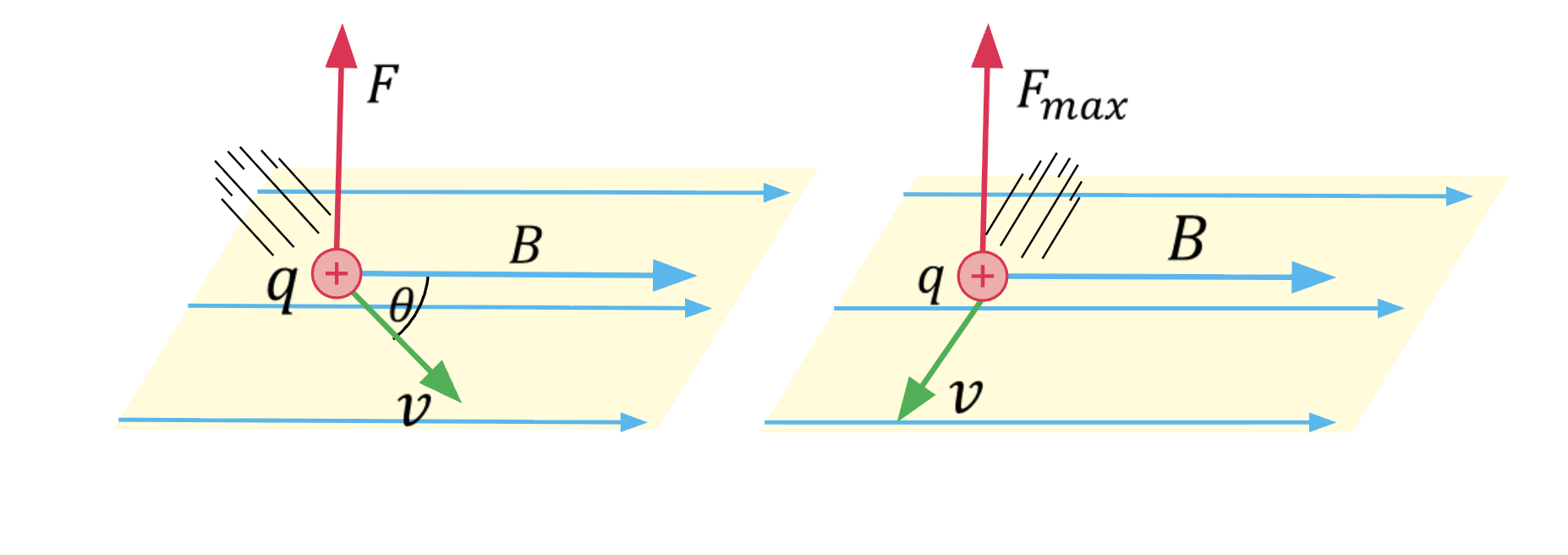
A charge moving at an angle to an magnetic field experiences magnetic force. The magnitude of F depends on the magnetic field strength, speed and charge of the particle
Electrostatic Equilibrium
Excess charge is distributed on the surface of the conductor such that each charge is optimally distance to minimize repulsion with neighboring charges. The charges have fixed positions on the conductors surface and are not moving,
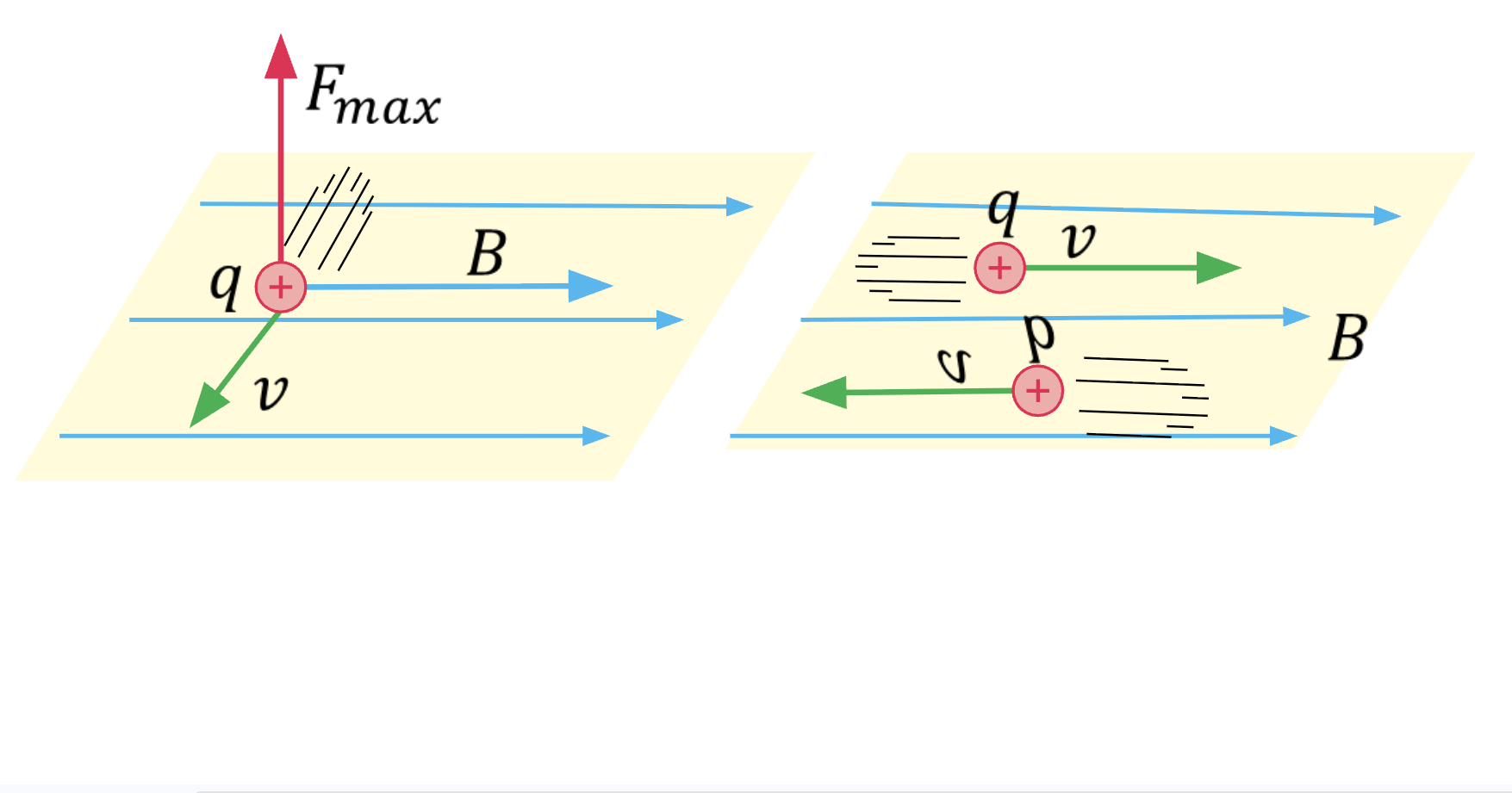
Magnetic force on a moving charge
A charge moving perpendicular to the magnetic field experiences the maximum magnetic force. A charge moving parallel or antiparallel to a magnetic field experiences zero magnetic force.
Force on a charge moving perpendicular to magnetic field
A charged particle has uniform circular motion in a uniform magnetic field when the magnetic force is perpendicular to its velocity.
Explain why the protons must be accelerated to high speeds to produce a radioisotope
The proton and target isotope both have a positive charge. The proton must have a high speed to overcome the force of repulsion and collide with the target isotope
Describe how protons can be accelerated to high energies in a cyclotron
Work is done on the ions when they cross the electric field between the dees. The work done increases the speed and kinetic energy of the ions each time they cross the electric field. Magnetic fields within the dees repeatedly steer the ions in the direction of the electric field.
Magnetic flux
Magnetic flux is a measurement of the total magnetic field that passes through a given area Φ
Electromagnetic induction
The process in which a changing magnetic flux induces a potential difference that causes current to flow in an electrical conductor.
Electromotive Force
The induced potential difference is referred to as an electromotive force (emf).
Faraday’s Law
The induced emf is equal to the rate of change of the magnetic flux
Lenz’s Law
The direction of the induced current is such that the induced magnetic field opposes the change in magnetic flux.
Eddy currents
Eddy currents are loops of electrical current induced within conductors by a changing magnetic flux.Eddy currents produce a magnetic field in the conductor.
Generator
A generator is a device that converts mechanical energy to electrical energy. A generator contains many coils of wire that are rotated within a magnetic field.
How does a generator work
A generator contains many coils of wire that are rotated within a magnetic field. As the coils of wire rotate in the magnetic field, the magnetic flux through the loop changes continuously. This change in magnetic flux induces an emf in the coil, which is transported through the brushes on slip-rings
Transformer
A transformer is a device for increasing or decreasing an AC voltage before it is used. A transformer consists of two coils of wire known as the primary and secondary coils.
Explain how a transformer reduces voltage.
An AC current in the primary coil produces a changing magnetic flux that induces an emf in the secondary coil. The rate of change in magnetic flux is the same in both coils but the secondary coil has fewer turns. This results in a proportional decrease in the emf according to Faraday’s law
Explain how generators produce an electric current.
A generator contains one or more coils of wire that are rotated within a permanent magnetic field. The magnetic flux through the coil changes when the coil is rotated which induces an emf and current to flow in the coil.
State the reason why the coil contains many loops.
As the magnitude of the emf is proportional to the number of loops in the coil.
State two other ways in which the maximum induced emf could be increased.
Increasing the strength of the magnetic field between the two poles of the permanent magnet.
Decreasing the period over which the magnetic flux is changing.
Describe how an electric field between the dees can transfer energy to a proton passing between the dees
The electric field does work on the proton. This work increases the kinetic energy of the proton as work is equivalent to a change in energy
Observation that would indicate that the magnetic force on the conductor is equal in magnitude to its total weight
The current carrying conductor will be at rest or moving at constant velocity
Explain why a charged particle in a uniform magnetic field follows a circular path
The magnetic force is always perpendicular to the velocity. This force changes the direction but not the speed. The force causes centripetal acceleration which causes the particle to form a circular path.
Explain why ions gain kinetic energy each time it moves across the gap between the dees
The potential difference between the dees does work on the ion. The work done on the ion becomes extra kinetic energy
Explain why increasing the potential difference between the dees has no effect on the kinetic energy of the ion as it leaves the cyclotron
Increasing the potential difference increases the kinetic energy gained each time the ion moves from dee to dee. Due to r=mv/qB, the faster ions will move with paths of larger radii which means less movement from dee to dee occurs. So the smaller number of gains of kinetic energy is balanced by the increased size of each gain
Positive ion in a uniform electric field
Path is parabolic and down the page
Electric force is constant in magnitude and direction and always vertically down the page
Only acceleration in the vertical direction as there is no force in the horizontal direction
Positive ion in a uniform magnetic field (B into the page)
Path is circular, initially deflected up the page
Magnetic force is constant in magnitude but always perpendicular to both magnetic field and velocity
Speed doesnt change but there is a centripetal acceleration
Use Lenz’s law to explain the production of eddy currents
Lenz’s law states that the direction of the induced current is such that the induced magnetic field opposes the change in magnetic flux. Therefore, an eddy current is produced in closed circular loops in the metal underside to oppose the changing flux produced by the conducting loop