Module 5 need to know
 Call Kai
 Learn
Learn Practice Test
 Spaced Repetition
 Match
Match Flashcards
 Knowt Play
1/23

There's no tags or description
Looks like no tags are added yet.
Name | Mastery | Learn | Test | Matching | Spaced | Call with Kai | Chat |
|---|
No analytics yet
Send a link to your students to track their progress
24 Terms
Scientific notation
Scientific notations express a very large or very small number as the product of a number between 1 and 10 and a power of 10
The number of places the decimal point is moved determines the power of 10
Fundemental SI units

Common metric system prefixes

Metric system length

Fundamental and common unit of volume
A measure of the amount of 3-D space occupied by a substance
The fundamental SI unit of volume is the cubic meter (m3)
Volume is commonly measured in cm3 or mL in the chemistry labs
Litre and millilitre relationship

Fundamental unit of mass
A measure of the amount of matter present in an object
kilogram (kg)
common metric units for mass
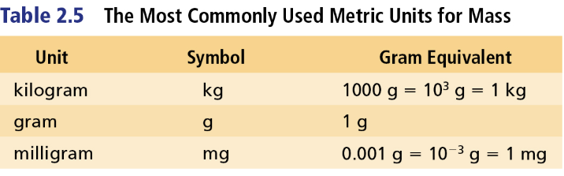
Rules for counting significant figures
Non-zero integers always count as significant figures (sig figs)
There are 3 classes of zeros
| Leading zeros | Captive zeros | Trailing zeros |
What? | Zeros that precede all of the non-zero digits | Zeros that fall between non-zero digits | Zeros at the right end of the number |
Significant? | No | Always yes | Significant only if the number contains a decimal point |
Exact numbers have an unlimited number of significant numbers
Limiting terms in calculations
multiplication & division: The limiting term is the one with the smallest number of sig. figs
addition and subtraction: The limiting term is the one with the smallest number of decimal places
5-step procedure for Conversion of one unit to another via conversion factors
To convert from one unit to another, use the equivalence statement that relates the two units. The conversion factor needed is a ratio of the two parts of the equivalence statement
Choose the appropriate conversion factor by looking at the direction of the required change (make sure the unwanted units cancel)
Multiply the quantity to be converted by the conversion factor to give the quantity with the desired units
Check that you have the correct number of significant figures
Ask whether your answer makes sense
Atomic mass unit (amu)
- a smaller unit of mass used for counting atoms
1 atomic mass unit (amu) = 1.66 X 10⁻²⁴ g
Individual atoms are far too small to see and have very tiny masses, so scientists created a unit to avoid using very small numbers
We must learn to count atoms by weighing samples containing large numbers of them
The mole
- the unit all chemists use in describing numbers of atoms
- defined as the number equal to the number of carbon atoms in 12.01 grams of carbon
6.022 × 10²³ (Avogadro’s Number) one mole of anything consists of 𝟔.𝟎𝟐𝟐 × 𝟏𝟎𝟐𝟑 units of that substance
Understanding the mole concept
For any element on the periodic table:
We know the mass of 1 mol of atoms of any element.
We can determine the number of moles of an element’s atoms in any other sample by weighing the sample and comparing its mass to its amu
Also, we know that 1 mole is 6.022 × 10²³ units. Once we know the moles of atoms present, we can determine the number of atoms present
Molar mass
- of any substance is the mass (in grams) of 1 mole of the substance
The unit is g mol-1 (g/mol)
is obtained by summing the masses of the component atoms
Calculations that can be done with molar mass
Calculating Mass from Moles
Calculating Moles from Mass
Calculating Number of Molecules
Percent composition of compounds
Obtain this information from the formula of the compound by comparing the mass of each element present in 1 mole of the compound to the total mass of 1 mole of the compound
Represent by the mass fraction
The mass fraction can be converted to mass percent by multiplying by 100%
What a balanced chemical equation tells us:
the identities (formulas) of the reactants and products
how much of each reactant and product participates in the reaction
the ratio of the coefficients - which allows us to convert from moles of 1 substance in a balanced equation to moles of a second substance in the equation
We can use a balanced equation to:
determine the mole ratio – predict the number of moles of products that a given number of moles of reactants will yield
using mole ratios in calculations – determine the number of moles of reactants required to react to produce a given number of moles of products
Steps for Calculating the Masses of Reactants and Products in Chemical Reactions:
Balance the equation for the reaction
Convert the masses of reactants or products to moles
Use the balanced equation to set up the appropriate mole ratio(s)
Use the mole ratio(s) to calculate the number of moles of the desired reactant or product
Convert from moles back to masses
methods to identify the limiting reagent in a chemical reaction:
i. By comparing the moles of reactants to see which run out first
ii. By considering the amounts of products that can be formed by completely consuming each reactant. The reactant that produces the smallest amount of product must run out first and thus be limiting
Summary for method i of identifying the limiting reagent in a chemical reaction:
Calculate the number of moles of the 2 reactants from the given mass
Compare the moles of the reactants in the actual mixture to the moles of the reactants expected in a stoichiometric reaction, using mole ratios
Calculate the moles of product produced when the reaction runs to completion by using mole ratio of the limiting reactant and product in the balanced equation
Convert the number of moles of the product to mass. Need to determine the molar mass of the product first
Summary for method ii of identifying the limiting reagent in a chemical reaction:
Calculate the number of moles of the 2 reactants from the given mass
Compute the number of moles of the product that would be formed by the complete reaction of each reactant. The reactant that produces the smallest amount of product must run out first and thus be limiting
Convert the number of moles of the product to mass. Need to determine the molar mass of the product first.
Theoretical, Actual & Percent yield
Theoretical Yield
The maximum amount of a given product that can be formed when the limiting reactant is completely consumed
Actual Yield
The amount actually produced. Is usually less than the maximum expected (theoretical yield)
Percent Yield
The actual amount of a given product as the percentage of the theoretical yield
an important indicator of the efficiency of a particular laboratory or industrial reaction
