orgo II chapter 18 - the chemistry of aryl halides, vinylic halides, and phenols
 Call Kai
 Learn
 Practice Test
 Spaced Repetition
 Match
 Flashcards
 Knowt Play
1/56

There's no tags or description
Looks like no tags are added yet.
57 Terms
An aryl halide is a compound in which a halogen is directly bonded to the _________ of a benzene ring (or another _________ ring).
carbon; aromatic
In a vinylic halide, a halogen is bonded to a carbon of a ________ _________
double bond
The reactivity of aryl and vinylic halides is quite different from that of ordinary alkyl halides. In fact, one of the major points of this chapter is that aryl halides do not undergo nucleophilic substitution reactions by the ______ or _____ mechanisms.
SN2; SN1
A relatively recent field of organic chemistry involves the use of ____________-__________ catalysts in organic reactions, particularly in reactions that involve the formation of carbon-carbon bonds.
Certain transition-metal catalysts dramatically increase the __________ of aryl and vinylic halides in substitution reactions, and this heightened reactivity is the vehicle through which we present some of the basic principles involved in transition-metal catalysis.
transition-metal; reactivity
The nomenclature of vinylic halides follows the principles of _______ nomenclature (Sec. 4.2A), and the spectroscopy of vinylic halides, except for minor differences due to the halogen, is also similar to that of _________.
alkene; alkenes
18.1 - lack of reactivity of vinylic and aryl halides under SN2 conditions
The two most important mechanisms for nucleophilic substitution reactions of alkyl halides are the SN2
(bimolecular _________-___________ substitution) mechanism and the SN1
(unimolecular __________) mechanism (Secs. 9.4 and 9.6). What happens to vinylic and aryl halides under the conditions used for SN1 or SN2 reactions of alkyl halides?
opposite-side; carbocation
Consider first the SN2
reaction. One of the most significant contrasts between vinylic or aryl halides and alkyl halides is that simple vinylic and aryl halides are ________ under SN2 conditions (example is EtO- in EtOH at 55 degrees celsius)
inert
Why don't vinylic halides undergo SN2 reactions? In Sec. 9.4C (see Fig. 9.2), we showed that in the transition state of an SN2 reaction of an alkyl halide, the carbon undergoing substitution has a 2p orbital to which the nucleophile and the leaving group are partially bonded, and is therefore
sp2-hybridized. In other words, this carbon rehybridizes from _____ in the alkyl halide to _______ in the transition state.
Sp3; sp2
the carbon undergoing substitution in a vinylic halide is sp2-hybridized in the starting material; it contains a 2p orbital involved in the double bond
if the SN2 reaction results in the development of a second 2p orbital at this carbon, then this carbon must become ____-hybridized.
Therefore, an SN2 reaction at a _________ carbon involves rehybridization from sp2 in the vinylic halide to ____ in the transition state
sp; vinylic; sp
The sp hybridization state has such _______ energy (Sec. 4.5C) that conversion of an sp2 hybridized carbon into an sp-hybridized carbon requires about 21 kJ/mol more energy than is required for an sp3 to sp2 hybridization change
high
The relatively high energy of the transition state caused by sp hybridization reduces the rate of SN2 reactions of vinylic halides by almost ______ orders of magnitude
This means that, under the conditions in which the SN2 reaction of ethyl bromide takes an hour, __________-__________ __________ alone would cause the same reaction of vinyl bromide to take almost ______ days.
four; transition-state hybridization; 200
Rehybridization, however, is not the only reason that vinylic halides are unreactive in the SN2 reaction
A second reason is that the C=C-halogen bond angle changes from about ______ degrees in the vinylic halide to _____ degrees in the sp-hybridized ___________ state
120; 90; transition
This brings the leaving group and the nucleophile very close to the alkene substituents on the ___________ _________.
adjacent carbon
This arrangement results in significant van der Waals repulsions (a _______ effect) of both the nucleophile and the leaving group with the groups on the other vinylic carbon.
steric
When the groups on the other vinylic carbon are _________ than hydrogen, the repulsions are even greater. These repulsions raise the energy of the transition state and __________ the reaction rate even further.
larger; decrease
In summary, both __________ and _____ ____ __________ repulsions (steric effects) within the transition state retard the SN2 reactions of vinylic halides to such an extent that they do not occur
hybridization; van der Waals
SN2 reactions of aryl halides have the same problems as those of vinylic halides and ______ other problems as well
two
First, an opposite-side approach to the carbon of the carbon-halogen bond would place the ___________ on a path that goes through the _______ of the benzene ring—an obvious impossibility (ask)
nucleophile; plane
Furthermore, because the carbon at which substitution occurs would have to undergo stereochemical __________, the reaction would necessarily yield a benzene derivative containing a _________ and ________ ________ double bond.
inversion; twisted; highly strained

do example 18.1
18.2 elimination reactions of vinylic halides
Although SN2 reactions of vinylic halides are unknown, base-promoted β-elimination reactions of vinylic halides do occur and can be useful in the synthesis of ________.
alkynes

In Eq. 18.9, two successive eliminations take place. The first gives a ________ _______, and the second gives the ______.
vinylic halide; alkyne
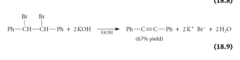
Many vinylic eliminations require rather _______ conditions (heat or very strong ________), and some of the more useful examples of this reaction involve the elimination of β-hydrogens that have enhanced _________.
harsh; bases; acidity
Can aryl halides undergo β-elimination? Try to answer this question by constructing a model of the alkyne that would be formed in such an elimination from bromobenzene. (This possibility is explored in Problem 18.88.)
yes (ask)
18.3 lack of reactivity of vinylic and aryl halides under SN1 conditions
Recall that _________ and some _________ alkyl halides undergo nucleophilic substitution and elimination reactions by the SN1 and E1 mechanisms
tertiary; secondary
_________ and _______ halides, however, are virtually inert to the conditions that promote SN1 or E1 reactions of alkyl halides.
Vinylic; aryl
Certain vinylic halides can be forced to react by the SN1-E1 mechanism under __________ conditions, but such reactions are relatively uncommon
extreme
To understand why vinylic and aryl halides are inert under SN1 conditions, consider what would happen if they were to undergo the SN1
reaction. If a vinylic halide undergoes an SN1 reaction, it must ________ to form a vinylic _________.
ionize; cation
Vinylic cations were also encountered as reactive intermediates in the addition of HBr to alkynes (Display 4.62, Sec. 4.9) and in the hydration of alkynes (Display 5.27a, Sec. 5.5). Figure 18.2a shows again an orbital diagram of a vinylic cation. The geometry at the electron-deficient, positively charged carbon is ________, so this carbon is ____-hybridized
linear; sp
The __________ 2p orbital is not __________ with the π-electron system of the double bond; in order to be conjugated, it would have to be coplanar with the double-bond pi system
vacant; conjugated
Vinylic cations are considerably less stable than alkyl carbocations because their ____ hybridization has a higher energy than the _____
hybridization of alkyl cations (the same reason that _________ are less stable than isomeric _________
sp; sp2; alkynes; dienes
Vinylic cations also are considerably less stable than alkyl carbocations because because the electron-withdrawing _________ effect of the double bond discourages formation of positive charge at a vinylic carbon
polar
Therefore, one reason that vinylic halides do not undergo the SN1
reaction is the instability of the ________ __________ that would necessarily be involved as reactive ___________.
vinylic cations; intermediates
The second reason that vinylic halides do not undergo the SN1 reaction is that __________-_________ bonds are stronger in vinylic halides than they are in _________ __________.
carbon-halogen; alkyl halides
A vinylic carbon-halogen bond involves an _____ carbon orbital, whereas an alkyl carbon-halogen bond involves an _____ carbon orbital
so, a vinylic carbon-halogen bond has more ____ character
recall that bonds with more s character are __________
sp2; sp3; s; stronger
Consequently, it takes more energy to break the carbon-halogen bond of a vinylic halide. This additional bond energy ___________ the rate of ionization.
decreases
The SN1 reactions of aryl halides would involve an _______ cation as a reactive intermediate.
aryl
An aryl cation is a carbocation in which the electron-deficient carbon is part of an aromatic ring. An orbital diagram of the phenyl cation, the simplest aryl cation, is shown in Fig. 18.2b. Because the electron-deficient carbon in an aryl cation is bonded to two groups, it should have a ________ geometry.
linear geometry is associated with _____ hybridization
linear; sp
Because an aryl cation is forced to assume a nonoptimal geometry and hybridization, it has a very high energy. The electron-withdrawing polar effect of the ring double bonds also destabilizes an aryl cation, just as a double bond destabilizes a vinylic cation.
Therefore, SN1 reactions of aryl halides do not occur because they would require the formation of carbocation intermediates—aryl cations—with very _______ energy.
high
18.4 Nucleophilic aromatic substitution reactions of aryl halides
Although aryl halides do not undergo nucleophilic substitution reactions by SN1 and SN2 mechanisms, aryl halides that have one or more _________ groups ________ or _______ to the halogen undergo nucleophilic substitution reactions by a different mechanism under relatively ________ conditions
nitro; ortho; para; mild
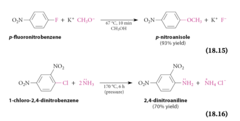
These reactions are examples of nucleophilic aromatic substitution
like SN2 reactions, nucleophilic aromatic substitution reactions involve nucleophiles and leaving groups, and they also obey second order rate laws
rate = k[________ _________][____________]
aryl halide; nucleophile
However, nucleophilic aromatic substitution reactions do not involve a concerted ___________-side substitution for the reasons given in Sec. 18.1.
opposite
Two clues about the reaction mechanism come from the reactivities of different aryl halides. First, the reaction is _______ when there are more nitro groups ortho and para to the halogen leaving group:
faster

Second, the effect of the halogen on the rate of this type of reaction is quite different from that in the SN1 or SN2 reactions of alkyl halides. In nucleophilic aromatic substitution reactions, aryl _________ are most reactive
fluorides
reactivities of aryl halides;
Ar-____ >> Ar-____ = Ar-____ = Ar-____
F; cl; br; i
In SN2 and SN1 reactions of _______ halides, the reactivity order is exactly the reverse: alkyl fluorides are the _________ reactive alkyl halides
alkyl; least
These data are consistent with a reaction mechanism in which the nucleophile reacts at the halide-bearing carbon above or below the _______ of the aromatic ring to yield a ___________-__________ anion called a ____________ complex
plane; resonance-stabilized; Meisenheimer

The negative charge in this complex is also delocalized into the _______ group.
nitro

The Meisenheimer complex breaks down to products by loss of the __________ ion.
halide
Ortho and para nitro groups accelerate the reaction because the rate-limiting __________ _________ resembles the Meisenheimer complex, and ortho and para nitro groups (but not meta nitro groups) stabilize this complex by ___________.
transition state; resonance
Fluorine also ___________ the negative charge by its electron-withdrawing polar effect, which is greater than the polar effect of the other halogens. Because the loss of halide is not rate-limiting, the basicity of the halide—or, equivalently, the _________ of the carbon-halogen bond—is not important in determining the __________ rate.
stabilizes; strength; reaction
Although we have used aryl halides substituted with ortho and para nitro groups to illustrate nucleophilic aromatic substitution, it stands to reason that other ____________ that can provide resonance stabilization to the Meisenheimer complex can also activate nucleophilic aromatic substitution
substituents
Notice how the nucleophilic aromatic substitution reaction differs from the SN2 reaction of alkyl halides. First, there is an actual ___________ in the nucleophilic aromatic substitution reaction - the ______________ complex
(in some cases, this complex is sufficiently stable that it can be directly observed)
intermediate; Meisenheimer
There is no evidence for an _____________ in any SN2 reaction
intermediate
Second, the nucleophilic aromatic substitution reaction is a _____________ ___________; it requires no inversion of configuration
The SN2 reaction of an alkyl halide, in contrast, is an opposite-side substitution with ___________ of configuration
frontside substitution; inversion
Finally, the effect of the halogen on the reaction rate (Display 18.19) is different in the two reactions. Aryl _____________ react most rapidly in nucleophilic aromatic substitution, whereas alkyl ____________ react most slowly in SN2 reactions
fluorides; fluorides