biochem exam 2
 Call Kai
 Learn
Learn Practice Test
 Spaced Repetition
 Match
Match Flashcards
 Knowt Play
1/121

There's no tags or description
Looks like no tags are added yet.
Name | Mastery | Learn | Test | Matching | Spaced | Call with Kai | Chat |
|---|
No analytics yet
Send a link to your students to track their progress
122 Terms
what are enzymes?
why are they important to life?
enzymes = proteins biological catalysts
they efficiently and selectively catalyze chemical reactions
4 benefits of catalysts for biochemistry
increase reaction rates
allow milder reaction environments (bodily conditions)
greater reaction specificity for substrates and products
capacity for regulation
can enzymes catalyze L and D isomers of their substrate?
No, enzymes are isomer/stereo-specific
4 mechanisms that allow regulation of enzymes
allostery
covalent modification
assembly into macromolecular complexes
feedback inhibition
allostery-
covalent modification-
feedback inhibition
allostery = binding of an inhibitor/activator at one site regulates activity at the substrate-binding site
phosphorylation, acetylation, removal of inhibitors, etc…
a product in a pathway regulates an earlier catalytic enzyme in the same pathway
apoenzyme (apoprotein)
holoenzyme
apoenzyme (apoprotein) = without its cofactor, nonfunctional
holoenzyme = cofactor bound, functional
active/catalytic site
binding site
cofactor
coenzyme
difference b/t cofactor and allosteric modulator?
enzyme site where reaction happens : substrate → product
the main part of the active site that binds substrate
cofactor = nonprotein helper mC/metal ion needed for enzyme to catalyze a reaction.. binds the active site
coenzyme = organic cofactor usually made of vitamins. may bind transiently or tightly (prosthetic groups). required as carriers of specific atoms or functional groups
cofactor binds active site
why do we need to intake vitamins?
used as cofactors for our enzymes. we will get sick if we don’t have them
differentiate b/t (under what conditions):
dG,
dG-zero,
dG’-zero
dG-double-dagger
for what reaction are we using them?
dG = free energy change under any conditions
dG-zero = standard free energy change
298K, 1M, 1 atm, etc…
dG’-zero = biochemical standard free-energy change
biological conditions = 1M pH7
dG-double-dagger =activation energy
any reaction substrate(s) → product(s)
DG’0 v. dG-double-dagger… what info do these give us about a S→P reaction?
for a given reaction S→P":
dG’-zero = how likely that a reaction will happen
thermodynamics
dG-double dagger = how fast it will happen
kinetics
what happens at transition state?
50% chance of product or substrate
General free energy Reaction Graph:
x and y axis
where are the substrate and product ground states
what is double dagger
2 dG-double daggers
standard free energy change?
s


will the product be made/why?
how fast will it take for the product to be made/why? (large DG-double dag)
what about if P→S?
yes bc -dG (energetically favorable) b/t S → P
a long time bc there’s a large activation energy
less likely bc even more activation energy to overcome
not energetically favored
exergonic v. endergonic?
what if dG = 0?
exergonic = -dG, energy released, spontaneous/favorable
endergonic - +dG, energy absorbed, not spontaneous/favorable
equilibrium, nothing favorable
for reaction S→P:
what is k?
how is it related to dG-double dagger?
how is it related to reaction speed?
k = rate constant
big dG-double dagger = small k = slow reaction
uncatalyzed reaction
catalyzeddreaction
reaction intermediate
rate limiting step
do enzymes catalyze both forward and reverse reactions?
S ← k → P
S+E ←k1→ ES ←k2→ EP ←k3→ P+E
ES and EP are detectable reaction intermediates
step with the highest barrier energy/lowest rate constant k
yes

how do enzymes affect equilibrium?
they don’t set equilibrium they simply get you there faster
why enzymes needed?
explain how enzyme accelerate reaction
cat v uncut
do enzymes affect dG, dG’-zero?
if dG-double dagger (activation energy) high, the rxn won’t happen
enzymes lower dG-double dagger
dG-double dagger (cat) < dG-double dagger (uncat
NO, do nothing to difference in free energy b/t the substrate and product as that is chemical differences. ONLY reduces activation energy to get to transition state
3 steps enzyme catalysis
how do enzymes bind to substrate?
what is DG-B?
what is it the result of?
what is the effect?
initially binds unstressed substrate → when fully bound, substrate at transition state → substrate forms products
enzyme active site is complementary to/optimized for transition state (stressed state)
binding energy = difference b/t activation energies (dG-double dagger) of the uncatalyzed vs. catalyzed reaction
many weak interactions/bonds b/t enzyme and substrate
activation E reduced
1 main but 4 things contribute to a high activation energy (dG-double dagger)?
how do enzymes overcome
entropy reduction (entropically unfavored)
desolved substrates
enzyme gets water out of the way
flexible/distorted substrates
binding causes substrate conformation change towards transition state, holds it rigid
catalytic functional groups on E must be properly aligned
induced fit = enzyme binding causes enzyme to change conformation
main reason activation E high
uncatalyzed bimolecular reactions
uncatalyzed unimolecular reactions
why catalyzed reactions different?
entropy reduction is what makes activation E high:
both are entropically unfavored
two free reactants → single restricted transition state
flexible reactant → rigid transition state
catalyzed reactions = favorable
entropy cost is paid during binding. puts subtrate into rigid ES complex
rigid reactant complex → rigid transition state = entropically OK
why protein structure important for enzymatic function?
tertiary and quaternary protein creates cradle for the active site
is dG-B the only way enzymes catalyze?
3 other ways
no, some enzymes do more than stabilize transition states
acid-base catalysis
covalent catalysis
metal/ion catalysis
acid-base catalysis:
what is it
why is it needed
specific acid-base catalysis v. general acid-base catalysis
what group is the acid/base in an enzyme? / where
which is most popular and why?
when acids/bases neutralize charges by donating or abstracting proton
charged intermediates aren’t stable and can decay back to reactants
specific = H+ donation/abstraction is carried out by water
general = H+ donation/abstraction carried out by enzyme
ionizable AA R groups/side chains act as acids/bases in the active site
histidine bc it has aKa closest to physiological pH
covalent catalysis:
what is it
result?
why does this catalysis happen?
a covalent E-S complex forms that helps drive the reaction forward
a new reaction pathway than the uncatalyzed reaction
steps of forming and breaking covalent bond are faster (lower dG-double dagger) than uncatalyzed reaction
metal ion catalysis:
metals normally are enzyme ____
3 ways it can help catalyze substrate
cofactors
3 ways
can orient substrates
contribute to binding E (stabilized transition state
can donate/absorb protons = change redox state
V0:
what is it
equation
why focus on V0
what determines V0? why?
rate at which product is being formed at time 0
delta [P] / delta time
initial useful bc velocity decreases over time as substrate drops and products form causes reverse reaction to start
V0 proportional to [S], but only at lower [S] concentrations!
as [S] rises, V0 approaches Vmax bc enzymes get saturated. when they saturate, adding substrate won’t increase velocity
![<ol><li><p>rate at which product is being formed at time 0</p></li><li><p>delta [P] / delta time</p></li><li><p>initial useful bc velocity decreases over time as substrate drops and products form causes reverse reaction to start</p></li><li><p>V0 proportional to [S], but only at lower [S] concentrations!</p><ol><li><p>as [S] rises, V0 approaches Vmax bc enzymes get saturated. when they saturate, adding substrate won’t increase velocity</p></li></ol></li></ol><p></p>](https://assets.knowt.com/user-attachments/137d98b1-2a21-4eca-b5a6-2a8fa7b92c26.png)
enzyme kinetics plot:
x and y axis, variables
Michaelis menton equation
units for x and y
x axis = [S], y = [V0]. Km is [S] when V0 =½ Vmax
½ Vmax like theta, Km like ki
V0 = Vmax x [S] / Km + [S]
V0 = uM/min, [S] = mM
3 assumptions for V0 for S+e - ES - P+E
steady state assumption = in the initial reaction, delta [Etotal] / delta time = 0
in the initial reaction, [ES] is constant. delta [ES]/delta t = 0
[E] constant bc enzyme not being used up in reaction
second step, k2, is rate limiting. k2 determines V
no k-2 bc no [P] in the beginning
at saturation, Vmax, [ES] = Etotal]
Michaelis Vmax variation V0 = (k2)(Etotal)[S] / Km+[S]:
2 reasons why
Vmax = ?
Vmax is what?
2 reaons
V0 approaches Vmax as [S] increases, but only until enzyme saturated, (when [ES] = [Etotal] )
Vmax = k2 x [Etotal]
at Vmax, enzyme saturated, adding [S] won’t increase rate
Km the Michaelis constant:
equation
what does it represent
when is the equation true
Km relationship to biological substrate concentration? why?
small Km = ?, big Km = ?
Km = (k2 +k-1) / k1
Km = [S] at which V0 is ½ Vmax.
indirect measure of ES binding/affinity of substrate for an enzyme/how well substrate binds enzyme
when k2 is the rate limiting step
sits around Km (1/2 Vmax) so it can be up or down regulated
its like Kd, small Km means tight binding (high affinity), large = weak binding (low affinity)
double reciprocal kinetics plot (line weaver burke plot):
why?
y intercept
x intercept
slope
equation
turns exponential plot into linear plot where its easy to find variables
y intercept = 1/Vmax
x intercept = -1/Km, but 1/Km if just looking at it to find Km
slope = Km/Vmax
equation: (1/V0) = (Km/Vmax) (1/[S]) + (1/Vmax)
y = mx + b
![<ol><li><p>What happens when to MM when [S] = Km</p></li><li><p>is Km an affinity constant</p></li><li><p>what kind of reactions </p></li></ol><p></p><ol><li><p>which substrate does hexokinase process faster? which does hexokinase have higher affinity for?</p></li></ol><p></p>](https://assets.knowt.com/user-attachments/1f635f27-5126-4a20-9906-432757796714.png)
What happens when to MM when [S] = Km
is Km an affinity constant
what kind of reactions
which substrate does hexokinase process faster? which does hexokinase have higher affinity for?
V0 = Vmax / 2
no, indirect measure of affinity for SIMPLE enzyme reactions (E+S-ES-E+P) bc acts as dissociation constant for ES
more steps = less reliable
glucose for both
2 differences between kinetics plot at low [S] v high [S]?
what is [S] and V0 at biological conditions? why?
low [S]
linear relationship b/t [S] and V0, Michaelis Minton equation
more [E] than [ES]
high [S]
V0 approaches Vmax
[ES] approaches [Etotal]
Km (MM) v. Kd (ligand binding w/ theta)
Km = measures the “affinity” of an enzyme to its substrate/ligand, even though its more a measurement of velocity
V0 = Vmax + [S] / Km + [S]
Kd = measures how “tight” and enzyme binds to substrate/ligand
theta = [L] / [L] + Kd

kcat:
what is it
specifically
turnover #
units
what is kcat for reaction in image
what is Vmax equation adjustment for the reaction in the image
when do you want a small kcat (slow enzyme)
kcat = limiting rate of an enzyme catalyzed reaction at saturation
rate limiting step AT SATURATION
kcat = “turnover number” = # mCs substrate converted to product by 1 enzyme per second
unit = sec^-1
Vmax = k2[ET] = kcat[ET] if k2 is rate limiting step
kcat = k3 if k3 is rate limiting step
for balance. don’t want 1 enzyme using all of that substrate, also don’t want to produce too much product
![<ol><li><p>kcat = limiting rate of an enzyme catalyzed reaction at saturation</p><ol><li><p>rate limiting step AT SATURATION</p></li></ol></li><li><p>kcat = “turnover number” = # mCs substrate converted to product by 1 enzyme per second</p></li><li><p>unit = sec^-1</p></li><li><p>Vmax = k2[ET] = kcat[ET] if k2 is rate limiting step</p><ol><li><p>kcat = k3 if k3 is rate limiting step</p></li></ol></li><li><p>for balance. don’t want 1 enzyme using all of that substrate, also don’t want to produce too much product</p></li></ol><p></p>](https://assets.knowt.com/user-attachments/6944759b-6f0b-4f8f-9cb7-69e8e56a8586.png)
specificity constant:
what is it equation
how is it useful
what does it tell you
new V0 equation
when
kcat/Km (M-1sec-1)
comparing how good two enzymes or an enzyme working on 2 diff substrates are
catalytic efficiency = how efficiently an enzyme catalyzes the reaction in each encounter b/t E and S
V0 = (kcat/Km) x [Et] x [S]
![<ol><li><p>kcat/Km (M-1sec-1)</p></li><li><p>comparing how good two enzymes or an enzyme working on 2 diff substrates are</p></li><li><p>catalytic efficiency = how efficiently an enzyme catalyzes the reaction in each encounter b/t E and S</p></li><li><p>V0 = (kcat/Km) x [Et] x [S]</p></li></ol><p></p>](https://assets.knowt.com/user-attachments/261e31e9-e7a1-42ce-bb0b-7880b0066bf2.png)
Catalytic perfection:
what is it based on
when does it happen
diffusion limit of E an S in the cell = 10^8 - 10^9
how fast 2 things in the cell can come together/diffuse together
specificity constant (catalytic efficiency) reaches the diffusion limit, the enzyme is so efficient that it catalysis happens every time E meets S = catalytic perfection
enzymes that have 2 enzymes:
ternary complex
random order
ordered
no turnary complex
enzymes that have 2 enzymes:
ternary complex = when enzyme is bound to more than 1 substrate at the same time
random order = enzyme can bind substrate 1 or 2 and then the other in any order
ordered = enzyme has to bind 1 substrate before the other
ping pong mechanism = no ternary complex
enzyme is modified by first substrate, producing a product that we don’t care about and the reaction continues to get ultimate product, ultimately enzyme unchanged

feedback inhibition
first enzyme in a pathway allosterically down-regulated by the product of the pathway
pre-steady state v. steady state amounts: which applies for Michaelis menten
substrate
Enzyme
ES
Product
pre steady state
substrate = very high
Enzyme = high
ES = low
Product = low
steady state = when MM is used
E and ES both relatively constant


top hat
how to find Vmax and Km from data
from LB plot (image in answer card)
Vmax = 150 (highest V and its plateuing)
good estimate, actual may be 151
Km = 8
[S] at ½ Vmax
Vmax =
1/y intercept
slope = Km/Vmax, Vmax = “run”
Km =
1/x intercept if you ignore the negatives. technically its -1/Km = x intercept, but since x intercept is neg, just ignore it
slope = Km/Vmax, Km = “rise”
left V0 = 1/5 uM/min, left Km = ¼ mM
right V0 = 1/200 uM/min, right Km = ½ mM
![<ol><li><p>Vmax = 150 (highest V and its plateuing)</p><ol><li><p>good estimate, actual may be 151</p></li></ol></li><li><p>Km = 8</p><ol><li><p>[S] at ½ Vmax</p></li></ol></li></ol><p></p><ol><li><p>Vmax =</p><ol><li><p>1/y intercept</p></li><li><p>slope = Km/Vmax, Vmax = “run”</p></li></ol></li><li><p>Km =</p><ol><li><p>1/x intercept if you ignore the negatives. technically its -1/Km = x intercept, but since x intercept is neg, just ignore it</p></li><li><p>slope = Km/Vmax, Km = “rise”</p></li></ol></li></ol><p></p><ol><li><p>left V0 = 1/5 uM/min, left Km = ¼ mM</p></li><li><p>right V0 = 1/200 uM/min, right Km = ½ mM</p></li></ol><p></p>](https://assets.knowt.com/user-attachments/5aba7266-79d7-4a1b-9e41-6a8cc83842eb.png)
what else can you get from a LB plot/how?
k2 kcat and Vmax
specificity constant?
for simple reactions, kcat = k2
Vmax = k2 [ES], but ES = Et when maxed out, so Vmax = k2[Et]
k2 = kcat, so Vmax = kcat[Et]

top hat
c
some more regulations of enzymes
homotropic allostery
heterotropic allostery
phophorylation
suicide inhibitor
cleavage
homotropic allostery = regulatory mC (effector) is the substrate
heterotropic allostery = regulatory mC is not substrate
phophorylation =
suicide inhibitor = mimics substrate permanently covalently binds active sight and stops activity
cleavage = cleaving an inactive protein to an active state
cleavage:
what happens
why
nomenclature proteins v enzymes
inactive precursors converted to active enzymes by enzymatic (specific cleavage)
many enzymes produced in an inactive form called a zymogen = proenzyme
nomenclature
pro at the beginning is for inactive uncleaved proteins
“gen” at end for inactive uncleaved enzymes (zymogens) = chymotrypsinogen is inactive form of chymotrypsin
covalent modifications:
what are they
what do they do
how
what does it result in
covalent modification = variety of permanent, not transient modifications possible, can only be changed by enzyme
affect structure and function
phosphorylation can activate/deactivate enzyme, enzyme is phosphorylated/dephosphorylated by enzymes
many things
enzyme on/off, change localization, change substrate preference, degrade, etc…
phosphorylation:
what is it
who does it/who removes it
how specific
covalent attachment of phosphate
kinases attach phosphate
specific = recognizes motif (specific AA sequence), usually serine threonine, tyrosine
phosphatase removes phosphate
less specific
glycogen phosphorylase:
what does it do
2 forms
how switch b/t forms
turns glucose into glycogen,
switches b/t active a form and less active b form via phosphorylation
phosphorylation of 2 Serines convert b to a
phosphorylase kinase coverts b to a = activates
proteins phosphatase 1 converts a to b = inhibits
enzyme inhibitors:
what do they do
how
what do folic acid metabolism inhibitors do
prostaglandin synthestase inhibitor
aromatic amino acid synthesis inhibitor
reduce enzyme activity
mimics substrate
mimic transition structure
reducing turnover number kcat
prevent cancer by inhibit building block of DNA to stop proliferating
enzyme inhibitors:
reversible v irreversible
how regulated metabolic processes
3 reversible 1 irreversible
how do they affect MM / LB equations
reversible = not permanent, can bind and unbind
feedback inhibition
3 reversible
competitive = mimics substrate binds in active site
uncompetitive = not directly competing for active site, but modulates ES complex
mixed
“apparent” constants ; can impact Vmax and Kmapp in different ways
V0 = Vmaxapp x [S] / Kmapp + [S]
![<ol><li><p>reversible = not permanent, can bind and unbind</p></li><li><p>feedback inhibition</p></li><li><p>3 reversible</p><ol><li><p>competitive = mimics substrate binds in active site</p></li><li><p>uncompetitive = not directly competing for active site, but modulates ES complex</p></li><li><p>mixed</p></li></ol></li></ol><ol><li><p>“apparent” constants ; can impact Vmax and Kmapp in different ways</p><ol><li><p>V0 = Vmaxapp x [S] / Kmapp + [S]</p></li></ol></li></ol><p></p>](https://assets.knowt.com/user-attachments/e5fc3b1b-96a0-4df6-b768-ae17f9ca6d25.png)


competitive inhibition:
what is it
how affect Vmax and Km
what happens if add more S while [I] is constant?
affect on MM
affinity calculation Ki
reversible inhibitor competes directly w/ substrate for enzymes’s binding site
doesn’t affect Vmax, affects apparent Km (alpha)
more S = more product if overcome inhibition
V0 = Vmax[S] / [S] + alpha x Km
“affinity” = Ki = [E][I] / [E]
![<ol><li><p>reversible inhibitor competes directly w/ substrate for enzymes’s binding site</p></li><li><p>doesn’t affect Vmax, affects apparent Km (alpha)</p></li><li><p>more S = more product if overcome inhibition</p></li><li><p>V0 = Vmax[S] / [S] + alpha x Km</p></li><li><p>“affinity” = Ki = [E][I] / [E]</p></li></ol><p></p>](https://assets.knowt.com/user-attachments/cc06d18b-1228-4284-b74a-d68ad7979428.png)
competitive inhibitor affect on Km:
affectt of more competitive inhibition on Km
what is alpha of no inhibition?
alpha equation
what about Vmax? meaning?
how do you reverse effect of competitive inhibitor?
affect on Km
as alpha increases, Km increases
makes Km appear larger/ [S] more dilute
Kmapp = alphaxKm > Km, when comp inhibitor present
alpha = 1 when no inhibiiton. alpha > 1 = inhibitor
alpha = 1 + [I]/Km
competitive inhibitor no affect on Vmax, if you add [S] eventually you will reach Vmax
BUT need higher [S] to reach Vmax as alpha increases
reverse affect by adding [S]
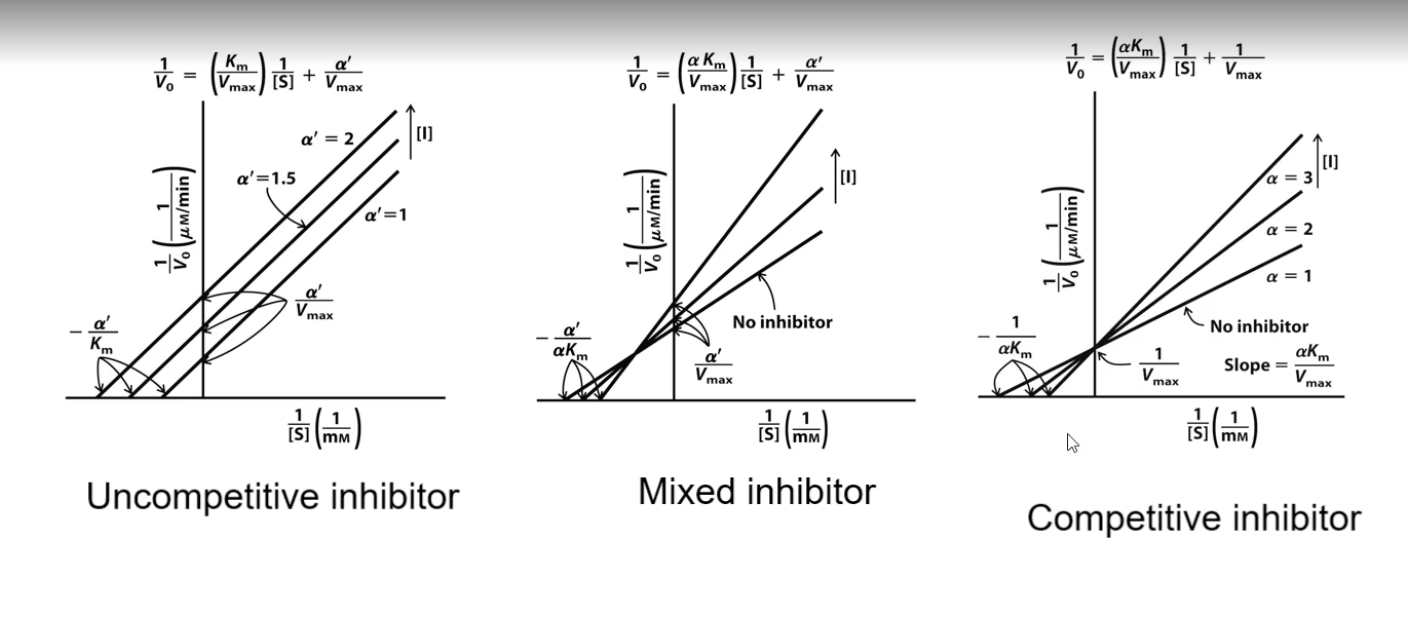
competitive inhibitor affect on LB
1/Vmax?
1/Km?
on MM plot?
competitive inhibitor = turns counter clockwise (more vertical) as alpha rises
no change in 1/Vmax
adding inhibitor → higher Kmapp
MM plot

uncompetitive inhibition:
what is it
Ki équation
MM modification
how affect Vmax and Km
3 rules
high [S] values
kcat
increasing [S]?
inhibitor binds to ES-complex, but not to the free enzyme
not directly competing w/ substrate for active site
Ki = ES][I]/[ESI
V0 = Vmax)[S]/ alpha' x Km x [S]
affects Vmax, affects Km
more inhibitor = lower Vmax
more inhibitor = smaller Km
3 rules
at high values of [S], V0 approaches Vmax/alpha’
catalytic function kcat reduced by not substrate binding
affect of uncompetitive inhibitor can’t be reversed by increasing [S]
![<ol><li><p>inhibitor binds to ES-complex, but not to the free enzyme</p><ol><li><p>not directly competing w/ substrate for active site</p></li></ol></li><li><p>Ki = ES][I]/[ESI</p></li><li><p>V0 = Vmax)[S]/ alpha' x Km x [S]</p></li><li><p>affects Vmax, affects Km</p><ol><li><p>more inhibitor = lower Vmax</p></li><li><p>more inhibitor = smaller Km</p></li></ol></li><li><p>3 rules</p><ol><li><p>at high values of [S], V0 approaches Vmax/alpha’</p></li><li><p>catalytic function kcat reduced by not substrate binding</p></li><li><p><strong>affect of uncompetitive inhibitor can’t be reversed by increasing [S]</strong></p></li></ol></li></ol><p></p>](https://assets.knowt.com/user-attachments/5f22f053-9c11-498d-96f3-a970aa9d41f3.png)
uncompetitive inhibitor affect on LB
1/Vmax?
1/Km?
on MM plot?
higher alpha’ (more inhibitor) = raises line vertically
smaller inhibitor = smaller Vmax
more inhibitor = smaller Km
Km and Vmax drop

mixed inhibition:
what is it
Ki équation
MM modification
how affect Vmax and Km
3 rules
high [S] values
kcat
increasing [S]?
reversible inhibitor binding to E and ES at a site distinct from substrate
both Ki (competitive) and Ki’ (uncompetitive)
V0 = Vmax[S]/a’[S] + aKm
affects Vmax and Km
higher inhibitor = Vmaxapp gets smaller, larger Km (depends on a/a’)
larger a = larger Km
smaller a = smaller Km
![<ol><li><p>reversible inhibitor binding to E and ES at a site distinct from substrate</p></li><li><p>both Ki (competitive) and Ki’ (uncompetitive)</p></li><li><p>V0 = Vmax[S]/a’[S] + aKm</p></li><li><p>affects Vmax and Km</p><ol><li><p>higher inhibitor = Vmaxapp gets smaller, larger Km (depends on a/a’)</p><ol><li><p>larger a = larger Km</p></li><li><p>smaller a = smaller Km</p></li></ol></li></ol></li></ol><p></p>](https://assets.knowt.com/user-attachments/fa12f4e8-8bb8-4ed7-818e-39723de770c0.png)



what is rate constant k
higher or lower speed
4 rate constants for standard enzyme catalyzed reaction at any given time:
E + S ←> ES ←> E + P
which 2 rate constants indicate the V (reaction rate)?
which do we use, why?
In a typical enzyme-catalyzed reaction, when & why is the rate constant k -2 negligible?
Pearson
indicator of reaction rate efficiency under set conditions
higher k = faster, k = 0 means no reaction
4 k’s
k1 = rate constant for E+S → ES
k-1 = rate constant for E+ S ← ES
k2 = rate constant for ES → E+P
k-2= rate constant for ES ←E + P
the k that affects the products, k2 and k-2
k2 if we consider early reaction conditions when there is no product present
start of a reaction where S is highest, p is lowest, and reverse reaction unlikely
3 rate constants for E+S ←> ES ←> E+ P at initial stages?
why no k-2?
what is the V for this moment, and what does the equation^ change to?
rate limiting step?
Pearson
k1, k-1, k2
no products present, [P] = 0
V0 = enzyme catalyzed reaction at t=0
E+S ←> ES -> E+ P, no k-2
rate limiting step = slow step that dictates reaction rate = k2
[St] = ?
why?
Pearson
[S] bc normally [St] = [S] bc [S] > > > [E] and [ES] at V0
induced fit
general acid base catalysis
specific acid base catalysis
enzyme changes conformation upon substrate binding to help catalyze
general = mCs other than water, usually AA r groups donate/accept H+
specific = catalysis donating/accepting H+ carried out by water itself
for general enzyme catalyzed reaction:
equation
rate limiting step
because it is the sloweststep/lowest k2
why no k-2
[E]t =E + ES
[S]t = S + ES
E + S - ES - E + P
rate limiting step = ES - E + P
no P
why no k-2
[E]t =E + ES
[S]t = S + ES
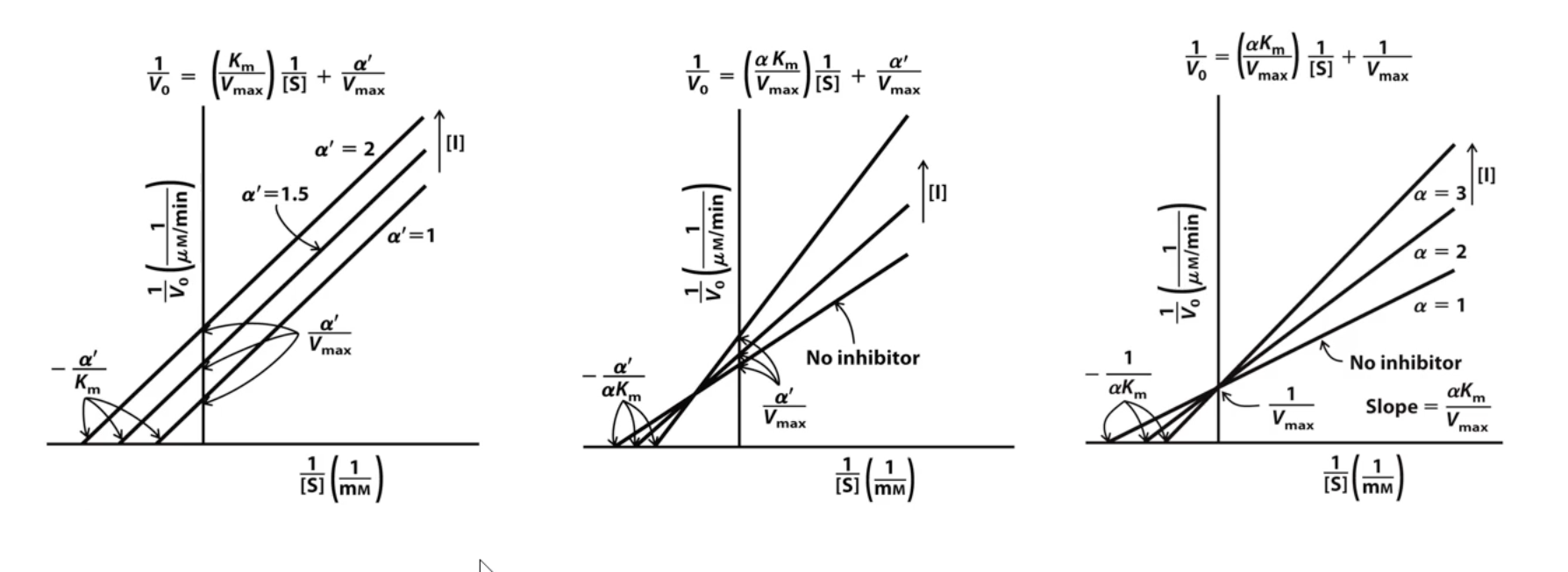
what type of inhibitor?

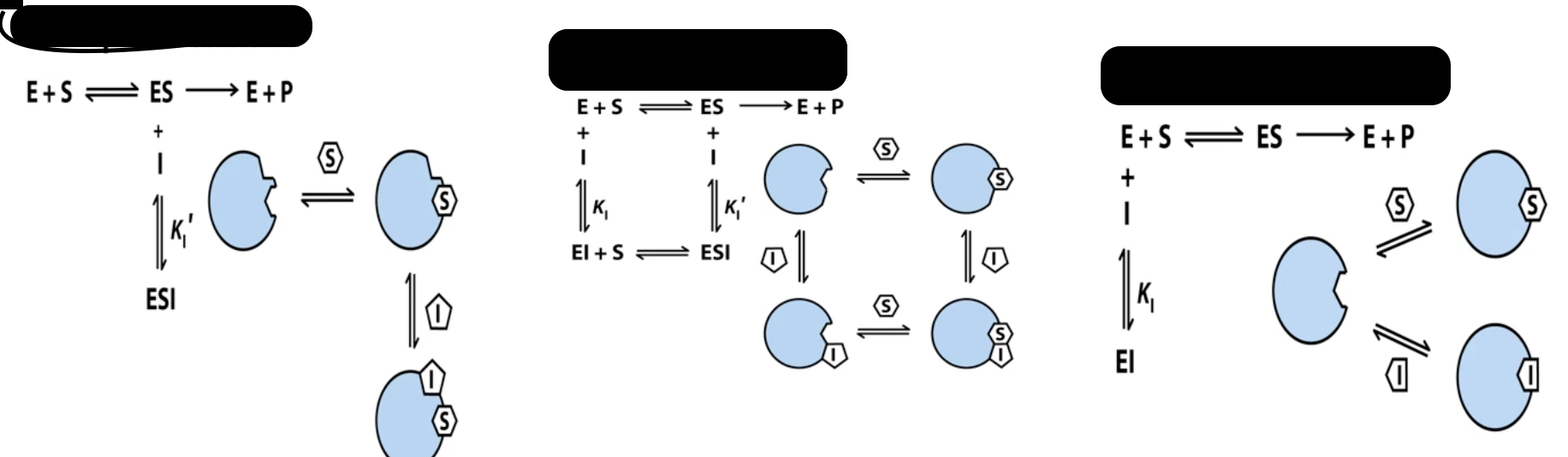
what type of inhibitor?
competitive v. uncompetitive v. mixed inhibitors:
what do they do
competitive = compete w substrate in substrate binding site
doesn’t change V max
uncompetitive = doesn’t compete in binding site but binds ES complex
no matter how much substrate you add you can’t overcome it
mixed = not competitive, don’t just bind ES complex
can bind ES complex and to the Enzyme w/o substrate
cannot overcome with additional substrate
affects both Km and Max


irreversible inhibitor:
suicide inhibitor
how medically relevant?
modify or destroy a catalytic functional group of an active site by covalent or extremely tight non covalent modification
potent poisons
type of irreversible inhibitor that binds like a substrate and is then acted upon by enzyme
at some point during catalysis converted into an irreversible inhibitor intermediate
suicide inhibitors medically important bc specific and become activated only when bound to enzyme (lower side effects)
is serine ionizable (acid/base reactions) under physiological conditions?
pH affect on enzyme activity
an AA reside that may participate in reaction catalyzed by pepsin (stomach protein is)
serine pka 13 or Glu pka 3?
normally no bc of pka but it is in enzyme reaction
enzyme activity pH dependent
glu pka 3 close to where it operates at
define a and a’
a = inhibitor binding to free enzyme → EI complex
competitive
a’ = inhibitor binding to ES complex → ESI
uncompetitive or mixed
serine proteases:
what are they
what is the prototypical one
catalyze the hydrolytic cleavage of peptide bonds
chymotrypsin
chymotrypsin:
structure
catalytic triad?
substrate binding pocket?
highest level protein structure?
chymotrypsinogen?
3 polypeptides (a, b, c chains) linked by disulfide bonds.
critical active site AA residues for catalytic reaction
His Ser Asp
hydrophobic = binds (Trp/Phe/Tyr) to position substrate for active site
zymogen (proenzyme) form before cleavage makes it chymotripsin
acylation then deacylation
chymotrypsin:
what does it do? 3 AAs?
what reaction does it catalyze
2 step mechanism
cleaves other proteins AFTER large hydrophobic/aromatic side chains (Trp/Phe/Tyr)
catalyzes peptide hydrolysis
2 steps
acylation then deacylation
3 steps how did scientists discover chymotrypsin had two step mech?
how did they identify active site residues
this protease cleaves peptide bonds but also slowly cleaves esters
product of ester cleavage reaction (p-nitrophenol) is yellow, used yellow pigment to track the reactions progress
saw a curve with both a pre-steady state burst phase in addition to a steady state phase, suggested it was a 2 step reaction
chemically labeled the specific residues in the active site

chymotrypsin 2 step mechanism?
what happens at each step?
what is water’s role?
fast step = acylation and release of p-NP
yellow product fast
slow step = water hydrolysis of acyl-enzyme intermediate (deacylation)
peptide bond breaking step
water directly attacks an acyl bond in an intermediate
water doesn’t attack the peptide bond of the substrate

what is histidine’s role
catalyses 2 acid base reactions
how is chymotrypsin reaction is a great example of 3 things:
general acid-base catalysis
transition state stabilization
covalent catalysis
involved in 2 acid-base reactions
4 parts chymotrypsin active site:
triad
oxyanion hole
glysine -
hydrophobic pocket
what are the jobs of Asp102 and His57
triad = Asp102, His57, Ser195
oxyanion hole
glysine = helps w/ hydrogen bonding
reaction cleaves peptide bond after aromatic group
hydrophobic pocket = where aromatic ring goes
to establish Ser195 as a strong nucleophile (O-)
chymotrypsin acylation phase:
starting products -(acylation)→ ending product
what happens (generally)
4 steps
E + protein -(acylation)→ ES complex
covalent catalysis forms an ester linkage that forms acyl enzyme and the peptide bond is broken
4 steps
Substrate binds active site: forms ES complex
His57 acts as general base and takes proton from Ser195 to establish Ser195 as a strong nucleophile (O-)
His 57+ stabilized by Asp102 carboxylate
H bonded chain makes Ser better n-phile
Nucleophilic attack:
Ser195-O- nucleophilic attack on C=O (covalent catalysis/ester linkage) to form short lived tetrahedral acyl-enzyme intermediate/transition state
substrate has short lived O- charge stabilized by H bonding w/ Ser195 and Gly193
H bond only occurs in this intermediate (TS stabilization)
removal of LG:
tetrahedral intermediate collapses reforming C=O and breaking peptide bond
His57 acts as an acid protonates N terminus of LG peptide so it can leave
product 1 (c-terminal half) is released
End:
acyl-enzyme remains (2nd transition state) = N terminal peptide is covalently bound to Ser195 via ester linkage
C term of substrate diffuses away
acid-base catalysis of His57 in acylation phase v deacylation phase
acylation
base to make See195 a good nucleophile (O-)
acid to protonate N on the LG 1 (C term half of substrate)
deacylation
base to make H20 good nucleophile (OH-0
acid to protonate Ser195 to release LG2 (N term half of substrate)
ES complex v acyl-enzyme intermediate
Gly193 role?
deacylation or acylation phase?
ES complex = double bonded O H bonded to Ser195
acyl-enzyme intermediate/TS= single bonded/neg charge O- stabilized by H bonding w/ Ser195 and Gly193 in the oxyanion hole
TS stabilization
acylation phase
chymotrypsin deacylation phase:
starting products -(acylation)→ ending product
what happens (generally)
4 steps
Acyl-enzyme -(hydrolysis)→ chymotrypsin
ester linkage of acyl-enzyme is hydrolyzed to regenerate original chymotrypsin
4 steps
Substrate binds:
H20 enters active site
Nucleophilic attack:
His57 acts as base and deporotonates H20
OH- nucleophilic attack on C=O (covalent catalysis/ester linkage)
oxyanion hole stabilizes short-lived tetrahedral acyl-enzyme intermediate
remove LG
tetrahedra intermediate collapse
His57 acts as an acid protonates Ser195 (-OH) facilitates displacement
2nd product (n-terminal half) diffuses
End:
system reset, ready to accept new substrate
2 transition states
4 acid base reactions
2 covalent catalysis
differentiate b/t tetrahedral intermediate and acyl-enzyme intermediate
when substrate carbon has 4 bonds and covalently bound to enzyme
When (O-) in oxyanion hole!!!
any time substrate or a substrate half is covalently bonded to enzyme
how are HIV proteases similar and 4 ways different than chymotrypsin?
similar
active site
water
complexes
cleave location
similar = cleaves proteases
active site = aspartate = aspartyl protease
water DOES directly attack peptide bond in HIV protease
no covalent enzyme-substrate complex
cleaves peptide bond b/t The and Pro AA pairs
HIV protease:
structure?
3 step mechanism (difference w/ chymotrypsin)
homodimer (2 same proteins in quad structure), each with 2 Asp25s at the active site
3 steps
substate binding:
hydrophobic pocket
nucleophilic attack:
General base catalysis: Asp25 (O-) takes H2O H+, OH- attacks carbonyl carbon
tetrahedral intermediate (transition state) with C-O- stabilized by H bonding w/ Asp 25s
(NO covalently attached intermediate, NO acyl-enzyme, NO oxyanion hole)
remove LG:
tetrahedral intermediate collapses to C=O (N term half released from 1 Asp25)
other Asp25 acts as acid protonates C term half
How do Anti-HIV protease inhibitors work
they’re transition state analogs (mimic HIV protease’s tetrahedral transition state)
OH mimics tetrahedral transition state O-
benzyl gorup fits hydrophobic pocket
Enolase:
how does it catalyze its reaction
3 parts active site
2 parts reaction
divalent cations = uses 2 Mg2+ cofactors
2 Mg2+, Lys345, Glu211
2 steps
Lys345 acts as general base and accepts substrate C2 proton
C2 made more acidic by adjacent carboxyl (C=O)
enolate intermediate C-O- charge stabilized by 2 Mg2+ (helps rearrange double bond)
remove LG:
Glu211 acts as general acid, protonates C-OH, and makes the -OH a better leaving group
LG = H2O
what is antibiotic target?
specifically?
how does cross-linking happen?
2 step reaction mechanism
transpeptidase?
why can we target peptidoglycan synthesis?
peptidoglycan synthesis
cell wall synthesis requires cross-linking of peptidoglycan molecules w/ each other
how
peptidoglycan chains linked via D-ala containing peptidecross bridges
transpeptidase carries out cross linking
cross linking mechanism
transpeptidase active site (Ser-OH) attachés carbonyl of peptide bond of a D-ala
cleaves a 2nd d-ala
covalent linkage b/t substate, peptidoglycan, and transpeptidase
peptide bond formation crosslinks 2 adjacent peptidoglycan chains (transpeptidase released)
peptidoglycan chain #2 rather than water does 2nd nucleophilic attack
transpeptidase = one peptide bond is replaced w/ another
because people have L-amino acids and D-ala is a D amino acid
B-lactam antibiotics:
what do they do
how
basic structure + how different
evolutionary arms race?
step 1
step 2
step 3
inhibit transpeptidase via suicide inhibition = irreversible covalent inhibitor
has B-lactam ring that looks like a peptide bond and mimics d-ala
all have b-lactam ring, side chain, thiazolidine ring that mimic substrate. differ by r groups
antibiotic resistance
penicillin
penicillin resistance
bacteria developed transpeptidase (B-lactamase) that breaks down penicillin so it can’t mimic (inactive transpeptide
clavulanic acid
suicide inhibitor of b-lactamase so it can’t inhibit penicilin
chymotrypsin 8 steps according to cummins
general base catalysis
his57 makes ser195 nucleophile
covalent catalysis and TS stabilization (oxyanion hole)
ser195 nucleophilic attack forms tetra O- in o hole w/ Gly
acid catalysis
tetrahedral collapse and this57 protonates LG
product release
general base catalysis
his57 makes water nucleophile
covalent catalysis and TS stabilization (oxyanion hole)
OH- nucleophilic attack forms tetra O- in o hole w/ guy
general acid catalysis
tetra collapse his57 protonates Ser195-OH
product release
allostery
homo v heterotropic, where bind?
positive or neg
covalent modification
cleavage
neg allosteric modulator v inhibitor?
reversible non-covalent binding of homotropic or heterotropic modulators (activator or inhibitor)
homo = multisubunit enzyme that can bind more than one substrate at a time, but binding of one alters the binding of another
often bind catalytic protein active site
hetero = not a substrate, modulator binds somewhere else other than active site on enzyme but modifies active site activity
modulator and substrate are DIFFERENT
often binds regulatory subunits
like phosphorylation
activation of zymogens (pro-enzymes, not pro-protein) by proteolytic cleavage
inhibitor = no activity, neg also = reduced activity
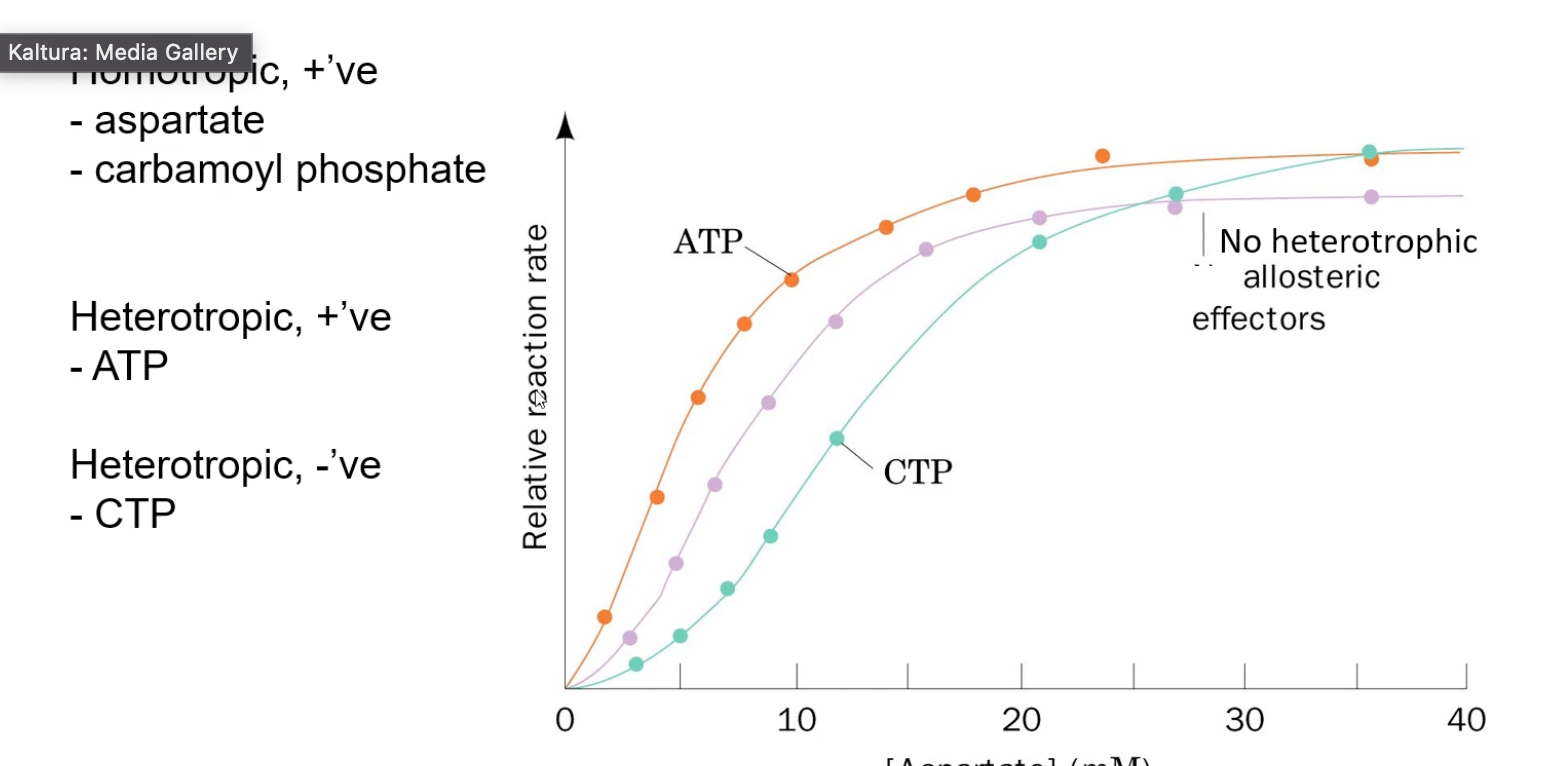
allosteric enzymes show what relationship on V0 v. [S] plot?
why
how similar to normal non regulatory micaelis Minton?
how do positive and negative allosteric modulators affect the curve?
what do modulators change?
KEY characteristic of sigmoidal kinetics
allosteric enzymes = sigmoidal instead of normal hyperbolic curve
usually complex multimer proteins w/ complex reaction
still reach saturation at high [S]
positive = hyperbolic, shift left (high activity/r state)
negative = shifts right (low activity/T state)
there are many diff kinds that could change max or rate etc.
small changes in modulator concentration can have large affects on activity
![<ol><li><p>allosteric enzymes = sigmoidal instead of normal hyperbolic curve</p></li><li><p>usually complex multimer proteins w/ complex reaction</p></li><li><p>still reach saturation at high [S]</p></li><li><p>positive = hyperbolic, shift left (high activity/r state)</p></li><li><p>negative = shifts right (low activity/T state)</p></li><li><p>there are many diff kinds that could change max or rate etc.</p></li><li><p>small changes in modulator concentration can have large affects on activity</p></li></ol><p></p>](https://assets.knowt.com/user-attachments/c4342145-de86-4afc-88a1-03b7e933f3b0.png)
aspartate transcarbamoylase (ATCase):
what does it do
how regulated (4) / how plot move
why sigmoidal
homo or hetero?
catalyses reaction of aspartate
has regulatory subunits and catalytic subunits
catalytic bind substrate
regulatory binding change conformation
aspartate and carbamoyl phosphate = positive homotropic (substrate)
ATP = positive heterotropic allosteric modulator → shift left relaxed state / high affinity
CTP = neg heterotropic allosteric modulator → shift right tense state / low affinity
binding of substrates aspartate and carbamoyl phosphate = transition from T state →R state
ATCase both homo and hetero allosteric kinetic behavior

aspartate transcarbamoylase (ATCase):
why does ATP activate and CTP inhibit?
what’s the mechanism?
what are pathways? what’s usually the final product usually do?
rationale behind ATP activating and CTP inhibiting?
allosteric control of ATCase by CTP = feedback inhibition
CTP is product produced at end of long pathway and acts feedback inhibitor of earlier ATCase reaction to control level of CTP in the cell
processes where product of one enzyme becomes substrate of next each step catalyzed by a different enzyme
final product usually heterotropic allosteric inhibitor of earlier enzymes in the pathway
rationale
ATP activates = want to make stuff when have energy
CTP feedback inhibitor = don’t want to waste E making too much

how covalent modification regulate enzyme function
how permanent are covalent mods
many different types/affects of cov mods catalyzed by enzymes
permanent until removed by another enzyme
describe usefulness of phosphorylation in enzymatic regulation and how glycogen phosphorylase is regulated in response to phosphorylation
Phosphorylation:
catalyzed by
what do they reconize
removed by
specificity
how is glycogen phosphorylase regulated by phosphorylation?
catalyzed by kinases
specific, kinases recognize seq motifs
removed phosphatase
not specific
its really complex, but simple version:
glycogen phosphorylase switches b/t active a form and inactive b form by phosphorylating 2 Ser residues
phosphorylase kinase activates = turns b → a
protein phosphatase 1 inhibits = turns a → b