Language and Communication
 Call Kai
 Learn
 Practice Test
 Spaced Repetition
 Match
 Flashcards
 Knowt Play
1/74

There's no tags or description
Looks like no tags are added yet.
75 Terms
Truth Conditional
The meaning of a sentence = the conditions that need to be met for the sentence to be true in the world
Cooperative Principle (Grice)
Make your conversational contribution relevent and purposful to the current exchange in which you are engasged in
by assuming that the speaker observed the conversational maxims
maxims of conversation
quantity: Say enough, not TMI (Informative)
quality: only say what you belive is true (Truthfullness)
relevance: say what is relative
manner: be breif, clear, unambiguous and orderly
Observing a maxim
It means following one or all of the maxims which are part of the co-operative principle.
"The speaker said X, and they oberved the maxim so they must mean Y"
violating a maxim
speaker is either outright lying by violating the maxim of quality, or being intentionally misleading by violating another maxim.
Non-overt + unco-op = lying (no implicature)
flouting a maxim
a obviouse violation of a maxim that is meant to be discovered, causing the listener to infer a different meaning
"The speaker X, X is obviously violating a maxim, but they are observing the more general co-op principles, so they must mean Y"
Opting out of a maxim
Clearly stated unwillingness to participate in a conversation
What is said (Grice)
truth-conditional
Not cancellable
Implicature
An implied meaning that has to be inferred as a result of a conversational maxim being broken
Not truth-comditional
cancellable
conventional implicature
not truth-contitional
not cancellable
no maxims involved
conversational implicature
not truth-contitional
cancellable
Derived on the basis of co-op principle & maxims
Genralized conversational implicature
Context-independent default (may be cancelled)
Some students were absent = not ALL students were absent
she got married and pregnant = she got married AND THEN got pregnant
Particularized conversational implicature
entirely context dependent
He's vegan
Constatives (assertives)
True or False
performatives (speech act theory)
felicitous or infelicitous
Direct Explicate performatived
Explicitly said, performative verb
I promise, to pay you back monday
Direct explicate performative
I'll pay you back monday
implied it'll hapen by then
-plausibly deniable
less vertain/reliable
Direct Implicite performative
"Canonical form" Clause type
Imperatives are Directives
Interrogatives are Question
Indirect Speach acts
The FORM of the utterance suggests ANOTHER speech act than the intendend one
Indirect explicate performatives
I tell you, I'd really like a drink (performative verb)
moisterize me
Indirect implicature performative
Declaratives sentences that aren't assertions
Imperative clauses that aren't directives
Interrogative clauses that aren't questions (i.e. rhetorical questions)
locutionary act
the act of saying something
He said he was feeling tierd
illocutionary act
performed in saying somthing, implying something in what we say
he suggested that we should go home
perlocutionaty act
achived by saying somthing
he convinced me it was time to go
felicity conditions
conditions that must be in place and the criteria that must be satisfied for a speech act to be succesfully performed
Felicity conditions rules
Propositional-content condition
preparatory conditions
sincerity conditions
essential conditions
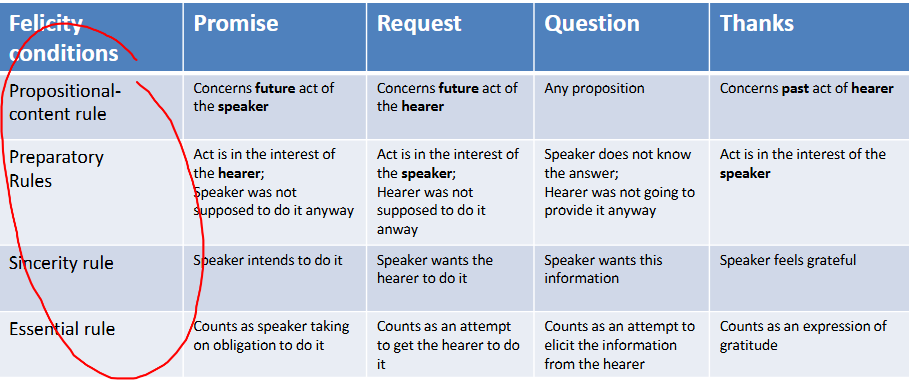
Propositional-content condition
requires that the words of the sentence be conventionally associated with the intended speech act and convey the content of the act
Preparatory conditions
Specific requirements prior to an utterance in order for it to count as a particular speech act (the appropriate person to use it in a perticular context)
e.g. when we promise to do something, the event will not happen by itself and it will have a beneficial effect.
sincerity condition
Participants must have the appropriate thoughts, feeling, and intentions
Essential conditions
The speaker sommits themselves to the speech act & take on the responsibility of carrying it out
Assertives
Speaker commits to the truth/value of a proposition
to state, deduce, claim, declare, hypothesize
John leaves the room
Directives
Speaker attempts to get the hearer to realise a proposition (to do something)
'ask', 'challenge', 'command', 'request'
John, leave the room
Commissives
Speaker commits themselves to realizing a proposition
'bet', 'guarantee', 'promise', 'swear'
Expressives
Speaker expresses their attitude/ psycological state
'apologise', 'deplore', 'thank', 'welcome', 'condole', 'congradulate'
Declatatives
Speaker makes a proposition true (simply by saying so)
I fire you, I resign, I name this ship…, I open the meeting
From Words to World
words adapt to fit reality (Assertives)
Describing what is already happening in the world
From World to Words
reality adapts to the words (Directives, Commissives, Declaratives)
Changing the world to make your words true
What is Entailment
Logical, semantic
Expressing p entails q, if the truth of q follows necessarillyfrom the truth of p
BOTH MUST BE TRUE
True or False: Entailment survives negation
False, the entailment changes
“My wife was kidnapped” → Someone was kidnapped
“My wife was NOT kidnapped” → Some was NOT kidnapped
What is Presupposition
To presuppose a proposition is to take its truth for granted to presume that the other involved in the context do the same
Presupposition triggers
Info which is linguistically codedas being part of the Common Grounf
Verbsd
Know, Regret, Forgot to, Marnaged to, Stopped, Started
Nounds and Determiners
Definites
Possessives
Adverbs and Partivles
Again
Anymore
Too
Only
Wh-questions
“Why did you break the vase?”
Common Ground
Everything the H & S knoe or bellive and know they have in common
Natural facts of the world (one sun and moon)
Obervable facts
Things previously mentioned in the conversation
True or False: Presupposition survive negation
True
“My dog is black” → I have a dog
“My dog is NOT black” → I have a dog
True or False: Presupposition is cancellable
True
“My dog is not black, I don’t have a dog”
“No, John didn’t finish his BA, he never even started”
T/F: entailment is cancellable
False
I broke your Ming dynasty jar
but the jar did not break: contradiction
but I’m not sure whether it broke: highly unnatural
and the jar broke: duh
Why are Presuppositions ‘partly’ pragmatic?
Context-dependent
faliures to make a presupposition are context-dependent
“The king of France is bald”
dependes on when in history it was utterted
Defensable
able to be cancelled or suspended
“John has stopped smoking, if he ever did smoke”
What are some issues with Grice
Difficult to use in practive,
Overlap in the Maxims of Quantity, Manner & Relation
Hard to distinguis semantic and pragmatic w/ (non) truth-conditional
What are the princeples of the Neo-Gricean (Horn) approach?
Q-Implicature: Say as much as you can
H pov: the S doesn’t more than what’s being said
What’s not said isn’t the case
Negative impicature
What the speaker could’ve said but didn’t
R-implicature: Don’t say more than necessary
H pov: the S means MORE than was said
allowed to infer anything that “speaks for itself”
Enrichment, elaboration
what is normal, stereotypical, unmarked, self-evifent, common sense
Neo-Gricean (Levinson): M-principle
Marked expressions indicates marked meaning
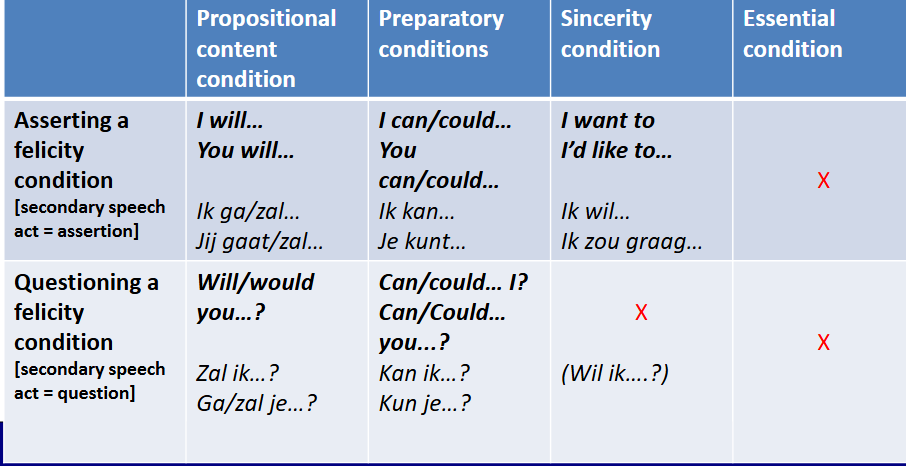
Indirect speech acts via felicity conditions
Relevancy theory: one principle
Cost & Benefits
Befefits: effects what you can ‘get’ from the uttereance, the interpretation (Contextual implicature)
more= more relevant
Cost: The processing effor needed to ‘get’ it (‘cognitive effort’)
less= more relevant
Guarentee of Relevance
The speaker’s intended meaning is sufficentrly relevant to be worth the trouble of processing
comes w/ every unnterance
Implicature/ Explicature of the following exchange
A. DId you enjoy your holiday?
B. The beaches were croweded and the hotel was full of bugs
Implicature: no, I didn’t enjoy my holiday
Explicature: The beaches at the holiday resort that the speaker went to were crowded w/ ppl and the hotel when he stayed was full of insects
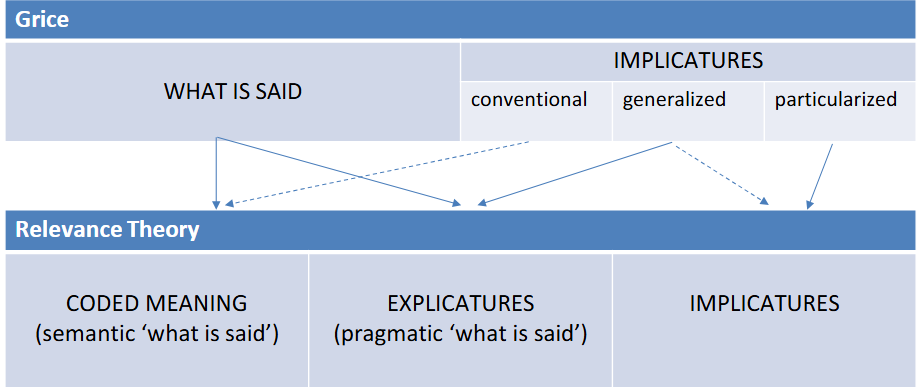
Linguistically encoded meaning
Everything added to the linguistically encoded meaning to get to the full proposition
coded meaning contributes to truth conditions
Context-dependent
From Grice to Relevance
Politeness Theory (Brown & Levinson)
Politeness (pragmatics) =/ Politeness (use)
Positive/ Negative Face
Positive
Need to be liked
to be appreciated
to be part of a group
Negative
Need for autonomy
to be left alone
to have one’s own domain
Problems with Brown & Levinson
Doesn’t equate to ppls real life experiences
Conventional politeness (politic) =/ polite
Depends on the contect & culture vs. inherent linguistic strategies
Can’t deal with impoliteness
sometimes ppl wanna do FTA
Positive Impolitness
Bad mouthing H, being mean to their face
Negative impolitness
Invading H’s space, threaten or scare H
Conversation Analysis
Data-driven: What is going on in this conversation?
(Rather than: what goes on in conversation in general?)
Authentic (real life) data, spoken discourse
Interpretation by participants in the conversation
(how do they experience an utterance?)
Analysis always beyond single utteranc
Structure of Conversation: Turn taking
who can talk when
TCU: Turn Constructional unit
TRP: Transition Relecance Place
syntax, speech act, intonation, eye gaze
Other speaker nominated
if not 1: self selection by another speaker
if not 2: same speaker continues (hold onto turn)
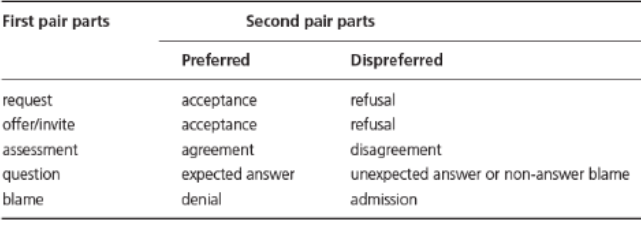
Structure of Conversation: Adjancey Pairs
“utterences produced by two successive speaker in a way that the 2nd utterance is identifed as related to the first one as an expected followed-up to that utterence”
What utterances’ belong together
What reaction (2nd pair part) is (dis)preformed
Preference Organization
Common adjeceny pairs and typical preferred and disprefereed seconf pair parts
Classic pragmatics (Arm chair)
Theoretical, philosophical (‘theory driven’)
• Standard examples, made up to make a point
• Interpretation by the researcher (intuition, introspection)
• Level of the single clause/utterance
• In the case of more clauses (anaphora): often written text
Critisism directed at CA
Is it really possible to analyze a conversation without preconceived
ideas/theory?
• Can you always tell from the conversation itself how the participants feel
about it and if and how they get implicit information?
• Is doing research not about finding generalizations beyond the one unique
conversation?
• The context (far) beyond the conversation is often relevant for the analysis,
e.g. information about culture and the relationship between the
participants (in terms of power)
• What if speaker intention is not recognized (but still there): framing,
lying/misleading, the power of words > commitment
Sequences in Conversations
Pre-sequence: alwasy in relation to the Basic
Basic sequence: Pair 1&2
Insertion sequence: additional pair between the Basic
Feedback: H shows S they are listening
Repair: S corrects themselves or someone else, and check if theyve understood what was said
Defence Lines
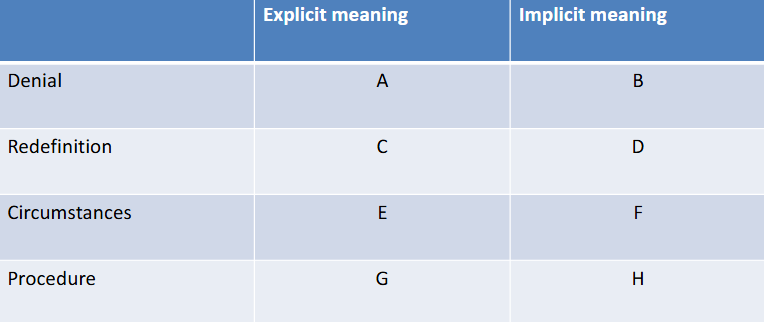
Explicate menaing denial
Accusations concerns implicature
“I didn’t say that, Nothing wrong if I did, but i just didn’t”
Redefinition (explicate)
Irony metaphor, hyperbole
“I was being Ironic!” = I am not commited to the literal meaning
Redefinition (implicate)
Denying implicature
“I was just askign a question!”= I am not committed to the implicatire
Denial w/ circumstances
Both explicate and implicate
“I was on coke, my account was hacked”
Denial w/ procedure
Both explicate and implicit
“Who are you to accurse me?!”
Explicatures
All that you add ti the linguistically encoded meaning in order to arrive at the full proposition
The beach at the resort that S went to were crowded with people and the hotel which the S stayed at was infested with bugs
five strats to politness
Dont do FTA
Off-recordç
On record badly
Positive politiness
Negative politness