Bio 180 exam 1
 Call Kai
 Learn
 Practice Test
 Spaced Repetition
 Match
 Flashcards
 Knowt Play
1/40

There's no tags or description
Looks like no tags are added yet.
41 Terms
pattern component
statement of fact, smth observed in the natural world
process component
mechanism that EXPLAINS the pattern
hypothesis
the claim/statement/proposed explanation/observation w/ just indep var
null hypothesis
'not' or 'no-effect' to the hypothesis
prediction
outcome/result (has indep and dep var)
❔How to explain the process of evolution from natural selection: (“is there differential reproductive success?”)
define the variation in the trait (ex: beak size)
compare parents to offspring (should be same/similar) and what to collect (birds w/ small beaks have baby birds that also have small beaks, measure beak sizes of birds)
diff individuals in [species] have diff # of offspring (diff birds have diff # of offspring)
explain what traits have more/less offspring and why (should include the change in environment) (due to the flood leaving only big seeds, birds with smaller beaks cannot eat the big seeds and die/do not reproduce, while birds with bigger beaks can crack open the seeds and eat them, leading to them surviving, reproducing, and passing on the trait of larger beaks)
theory
proposed hypothesis/explanation for a phenomenon that is testable
fitness
ability to survive and reproduce (produce viable offspring)
measure w/ # of offspring
applies for individuals, but can say for a pop on avg
also important to think abt viability of offspring, but can’t really measure that
adaptation
trait that improves fitness
^over mult gens, freq of trait changes from one gen to next
*refers to natural selection (trait is heritable and leads to differential reproductive success)
acclimation: in single gen/indiv, trait changes over time due to the environment w/in that indiv's lifetime
heritable variation
variation in a trait in a species that can be passed down to offspring
genes
segments of DNA double helix that contains info to code for a protein or RNA product, has structural and regulatory elements
^don’t code for mRNAs but RNAs that act as finished products in a cell
^info in genes help make RNA/protein molecules that function in the cell
^bases: A, T, G, C
structural vs regulatory elements of DNA
structural: codes for the actual physical gene product (the codons that specify the primary sequence of a protein via an mRNA, or the string of ribonucleotides in rRNA/tRNA/other RNA)
regulatory: control when/where/how much a gene is expressed (turn genes on/off/up/down)
allele
version of a gene; stretch of DNA that codes for a particular protein or RNA product
^ANY change in the base sequence of a gene (whether structural or regulatory) creates an allele (even if no measurable change in phenotype)
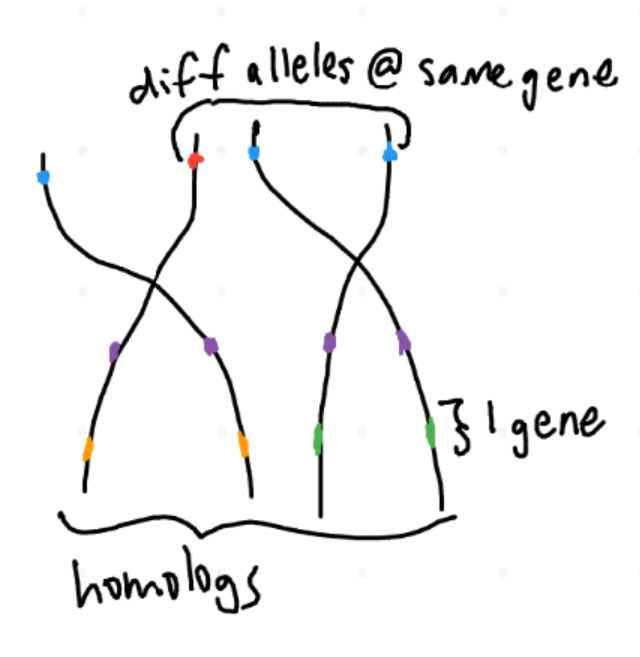
^diff alleles in the same gene have diff parts of the DNA base sequence (can be diff in structural sequence, regulatory sequence, or both))
chromosome
complex of DNA-binding proteins (histones) and DNA; specialized proteins that bind to the double helix
^bacteria/archaea=circular ⭕
^eukaryotes=linear I
histones
proteins that bind to DNA and form the chromosome
nucleosome
double helix wrapped around a ball of 8 histones
^DNA wraps twice around each histone octomer

How do histones and DNA stick tgt in a nucleosome?
(+) charge of histones (arginine/lysine amino acids) and (-) charge of DNA (phosphate group) → electrical (+/-) interactions! ⚡
haploid #
# of diff types of chromosomes found in each cell of an organism (indicate w/ n) (diff sizes) (humans n=23)
ploidy
# of copies of each type of chromosome present (eukaryotes usually 2 or more) (put as # before n) (humans diploid, 2n=46 bc human cells have 2 of each type of chromosome!)
^unreplicated chromosome, replicates, ploidy still the same!
haploid
cells only have 1 of each type of chromosome (diploid 2, triploid 3, tetraploid 4, etc.) (referring to ploidy)
^total # of chromosomes in a cell = haploid # * ploidy
homologous chromosomes/homologs
diff versions of the same type of chromosome
^have the same genes but potentially diff alleles
^pair of chromosomes, w/ 1 chromosome from each parent (only diploid species have homologous pairs. ex: if triploid, it is homologous ‘triplets’!)
steps of mitosis
(BEFORE: interphase: cell grows after telophase, dna replication makes replicated chromosomes, prepares to go into prophase again (bc cycle))
prophase: replicated chromosomes condense and the nuclear envelope breaks apart
metaphase: replicated chromosomes move to the middle of the cell and line up (homologs stay indep of each other and aren’t in pairs unlike metaphase I)
anaphase: sister chromatids in replicated chromosomes separated by spindle fibers, move to opposite ends of the cell
telophase: nuclear envelopes reform around each set of chromosomes
RESULT: cytokinesis: breaks cytoplasm, cell division splits the parent cell into 2 daughter cells (each have complete set of identical chromosomes)
daughter cells identical to each other and parent cell (copy dna, send 1 copy to each daughter cell)
*PMAT!

gametes
sperm/eggs
^combine at random regardless of genotypes
^egg has 23 chromosomes, sperm has 23 (haploid), when fuse to make zygote it has 46 chromosomes (diploid)!
germ cells
cells that become gametes
^undergo meiosis, divide to form sperm/eggs
somatic cells
rest of the cells in the body (undergo mitosis)
zygote
fertilized egg from when sperm and egg fuse (diploid cell) (has 2 of each type of chromosome, 1 from mom and 1 from dad)
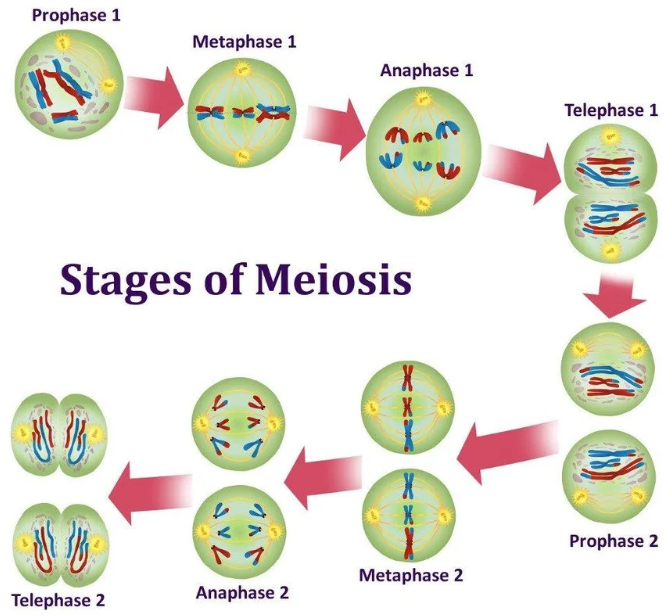
steps of meiosis
BEFORE: interphase: replicates DNA (duplicate chromosomes, still considered 46 bc attached) + cell grows + carries out cell processes
prophase I
chromosomes condense
homologs come tgt/synapse (pair up, physically join. approx. same size, have same types of genes in the same locations)
non-sister chromatids of homologous chromosomes physically cross each other (crossover/recombination) (exchange sections of DNA/some alleles, patchwork) (every chromosome in every gamete contains a new random/unique mix of maternal and paternal alleles)
spindle apparatus forms; nucleus disassembles
metaphase I
homologous pairs line up in the middle of the cell tgt randomly (independent assortment, leads to genetic variation)
anaphase I
spindle fibers help separate homologous pairs (not pulling apart sister chromatids like in mitosis); 1 homolog goes to either end
principle of segregation
telophase I and cytokinesis
2 newly formed nuclei, split cytoplasm into 2 genetically diff daughter cells prior to gamete formation
prophase II
have chromosomes, spindle fibers start to form, nucleus disassembles
metaphase II
replicated chromosomes line up in the middle of the cell (not in pairs, just the ‘X’)
anaphase II
sister chromatids separate and go to opposite sides of the cell (chromatids no longer attached and on their own, called chromosomes)
telophase II
nuclei reform, total 4 daughter cells (each have 1 chromosome)
cytokinesis - completely split the cytoplasm
independent assortment and what causes it
alleles (indiv letters like A, a, B, b) from diff genes (letters like As, Bs) go into gametes randomly/indep of each other (genes r not linked, do their own thing, phenotype ratio 9:3:3:1); random combo of maternal and paternal chromosomes
^metaphase I of meiosis: maternal/paternal homologs line up at random b4 separating at the end of meiosis I (see pic) (gamete combos: AB, ab, Ab, aB)
^principle of indep assortment correct for genes located on diff chromosomes, but genes on the same chromosome (linked) segregate to gametes TGT
^genes on diff chromosomes (not linked), alleles of diff genes go into gametes indep of each other, making every combo of alleles from diff genes equally likely (diff gamete genotypes should all be equally likely to occur!)
*some genes are linked (sex-linked) (phenotype ratio 3:1)
*when gametes form, an allele of 1 gene can end up w any allele of other genes. diff sets of homologous chromosomes

sexual vs asexual reproduction
sexual
fusion of gametes to produce offspring that are genetically unique (diff/unique combo of alleles) compared to parents
based on meiosis
genetic diversity even if change in environment species’ diverse offspring can survive and defend against virus/disease
more complicated, more time/energy, need another individual
asexual
based on mitosis and produces offspring that are genetically identical to the parent
bacteria/archaea no mitosis, reproduce asexually only (thru binary fission)
more efficient, don’t need another indiv
principle of segregation
during gamete formation in an organism, pairs of alleles segregate/separate randomly and go into diff gametes (unique combo of genetic material)
^anaphase I: homologous chromosomes separate
*draw chromosomes, write allele for each, show separation of the homologous pair/diff alleles (separation of Aa to A and a)
^each gamete has 1 allele of each gene
^never violated (unless mistake during meiosis where homologous pair wrongly doesn't separate)
^ex: Bb, one gamete gets B, another gamete gets b
^male gamete + female gamete —fuse—> form zygote (each offspring has 2 alleles, 1 from each parent)

homozygous vs. heterozygous
dominant vs. recessive
homo: 2 copies of the same allele at a gene (TT, tt)
hetero: 2 diff alleles at a gene (Tt)
dominant: phenotype shown that is associated w 1 allele
recessive: phenotype that does not appear and is the other allele present in the heterozygote
^only know if dominant/recessive from heterozygote or true breeding individuals (F1 shows dominant allele bc all offspring are heterozygous) (common trait =/= dominant)
^dominant allele presence means it WILL expressed (TT, Tt). recessive needs 2 alleles to be expressed (tt) to show the recessive phenotype
genotype vs. phenotype
genetics/alleles (listing of alleles that an indiv has (consist of the specific sequence of bases in genes))
vs.
physical, what you see, what is expressed
^individual's actual structure/behavior (what it looks like/does)
^RNAs and proteins (gene products) contribute to phenotype
meiosis
the process responsible for sexual reproduction in multicellular organisms
^makes gametes/sex cells (egg & sperm cells)
mitosis
type of cellular division responsible for asexual reproduction as well as growth/wound repair in multicellular organisms
^more somatic/body cells; makes copies
DNA
a molecule that stores hereditary info in code form
mutation
random mistake in DNA replication; any change in the base sequence of DNA (random, changes the genotype by creating new alleles)
^delete/add/change bases in a gene
*some mutations change RNAs/proteins produced by a gene -> may change phenotype
linked genes
genes found on the same chromosome
^write underline to show link (ex: TR)
polygenic traits
traits that show continuous variation, influenced by the products of MANY genes instead of just 1
^➕effects of each allele contribute to the trait sum (effects add up!)
^each gene in a polygenic trait has the same effect so there is an overall 'avg' effect of each of the many genes involved
genome
entire collection of genes in an individual
^indiv locations=loci, singular form is genetic locus

when do heritable mutations occur?
when there is a mistake in chromosome replication/change in DNA that is passed down to offspring
sexually reproducing organisms (ex: humans):
meiosis
NOT mitosis bc makes identical body cells
asexually reproducing organisms:
mitosis

!!! flip
interphase is highlighted section (big outside arrow)
