Geo Soils Exam #3 Review
 Call Kai
 Learn
 Practice Test
 Spaced Repetition
 Match
 Flashcards
 Knowt Play
1/185

Earn XP
Description and Tags
Dr. Gilliam UWF
186 Terms
soil organic matter
portion of soil composed of plant, animal, and microbial residues in stages of decomposition
NOT the same as the O horizon, but plentiful in the O horizon
global carbon cycle
transfer of carbon between the atmosphere, biosphere, pedosphere, hydrosphere, and geosphere
balanced fluxes when undisturbed
carbon pools
least to most:
vegetation: 620
atmosphere: 790
soil: 3,000 - 4,000
oceans & lakes: 38,000
carbonate rocks: 75,000,000
fluxes
photosynthesis
respiration
fossil fuel combustion
photosynthesis =
↓ carbon
respiration =
↑ carbon
fossil fuel consumption =
↑↑ carbon
top ACTIVE carbon pools:
soil
ocean
Keeling Curve
graphed figure of atmospheric carbon since 1960
up and down yearly balance between growing season and dormant season
overall exponential increase of atmospheric carbon
sources of carbon
most to least:
aridisols (very high)
entisols
gelisols
andisols (very low)
entisols
14.2% global carbon soil (2nd)
mostly inorganic carbon
lack of leaching, young, nature of parent material, low rainfall, alkaline pH
gelisols
12.9% global carbon soil (3rd)
mostly organic carbon
freezing temps, low decomposition, permafrost trapping OM, frost mixing, anoxic conditions, continuous organic input
aridisols
20.6% global carbon soil (1st)
mostly inorganic carbon
low leaching, alkaline pH, cation accumulation, subsurface mineral layer, dry climate, limited water movement
andisols
0.8% global carbon soil (lowest)
low organic carbon, NO inorganic carbon
carbon released from volcanic ash
plant residue composition
physical: 75% water, 25% dry matter
compounds: 45% cellulose, 20% lignin, 18% hemicellulose, 8% protein, 5% sugar and starches, 2% polyphenols, 2% fats and waxes
elemental: 42% carbon, 42% oxygen, 8% hydrogen, 8% ash
physical plant residue composition
75% water
25% dry matter (compounds, elements)
compound plant residue composition
45% cellulose
20% lignin
18% hemicellulose
8% protein
5% sugars and starches
2% polyphenols
2% fats and waxes
elemental plant residue composition
42% carbon
42% oxygen
8% hydrogen
8% ash
fats & waxes
plant matter: hydrophobic, insoluble lipids responsible for energy storage, cellular structure, and environmental protection
2% of plant residue
5th to disappear in decomp
cellulose
plant matter: complex carbohydrate responsible for plant cell wall structures, rigidity, shape, and strength
45% of plant residue
4th to disappear in decomp
hemicellulose
plant matter: complex polysaccharides responsible for flexible matrix binding cell walls together
18% plant residue
3rd to disappear in decomp
polyphenols
plant matter: diverse group of organic compounds responsible for chemical defense system, stress responders, and signaling molecules
2% plant residue
variable disappearance in decomp
lignin
plant matter: complex polymer responsible for the “cement” in plant structures, waterproofing vascular tissue, biotic and physical defense
20% plant residue
last to disappear in decomp (complex, hydrophobic structure)
protein
plant matter: macromolecule of amino acids responsible for biochemical reactions, metabolic pathways, and structural adaptations
8% plant residue
2nd to disappear in decomp
sugar & starches
plant matter: carbohydrates produced during photosynthesis responsible for storing and transporting chemical energy
5% plant residue
1st to disappear in decomp (simple structure, chemically accessible, high bioavailability/energy)
order of disappearance
sugar and starches
protein
hemicellulose
cellulose
fats and waxes
lignin
organic decay
biological process of microorganisms and fauna (k vs r) breaking down dead organic matter into simple compounds
r-strategists
opportunist microbes responsible for rapid decomposition
k-strategists
specialist microbes responsible for slow decomposition
priming effect
decomposition of soil humus during the most rapid microbial activity
decomposition/mineralization factors
C/N ratio
soil ecology
lignin and polyphenol
C/N ratio
mass proportion of organic carbon to total nitrogen in soils
high C/N = immobilization
low C/N = mineralization
soil ecology
community of living organisms interacting in and with the soil
↑ microbes = ↑ decomp rate
↑ macrofauna and detritivores = ↑ decomp rate
↑ lignin/polyphenols + ↑ C/N =
↓ N (immobilization)
↓ lignin/polyphenols + ↑ C/N =
↓↓ N (immobilization)
↓ lignin/polyphenols + ↓ C/N =
↑↑ N (mineralization)
↑ lignin/polyphenols + ↓ C/N =
↑ N (mineralization)
N mineralization
transition of organic N to inorganic N, increasing plant availability
low C/N
ex. soil microbes decomposing OM and releasing NH4
N immobilization
transition of inorganic N to organic N, decreasing plant availability
high C/N
ex. soil microbes absorbing NH4 or NO3 into their own biomass
labile OM
rapid carbon turnover
easily degradable
biomass, detritus, free particulate OM, dissolved biomolecules
drives biological activity and nutrient cycling
humus
protected/slow carbon turnover (through cold or wet environment)
resistant to degradation
protected particulate OM, protected biomolecules, char
builds soil structure, water retention, and long-term storage
rapid carbon turnover
fast movement of carbon through a soil ecosystem through labile OM
biomass
labile OM: living organisms
detritus
labile OM: free identifiable dead tissue
free particulate OM
labile OM: free pieces of partially degraded tissue
dissolved biomolecules
labile OM: free organic molecules and degradation products
protected carbon turnover
slow movement of carbon through a soil ecosystem through humus
char
humus: black aromatic products of fire
protected particulate OM
humus: protected pieces of degraded cell walls and tissue
protected biomolecules
humus: protected organic molecules, supramolecules, and degradation products
microbial transformations
labile carbon: rapid movement of carbon through fire, shredding, catabolism, enzymes, biomolecules, cell fragments, dissolved compounds, atmospheric CO2 release
stabilized carbon (humus): slow movement of carbon due to microaggregates, sorption to mineral surfaces, wet/cold environments
microbial transformations: carbon %
65 - 85% CO2
2 - 5% biomass
3 - 10% nonliving labile
10 - 30% relatively stable humus
organic carbon residues
carbon-containing decomposition products in soils
labile OM vs humus
allelochemical effects
plants:
cell membrane and energy disruption
growth and germination inhibition
hormone and photosynthesis blockade
soils:
small amount = stimulated microbial activity
large amount = alter OM and disrupt nutrient cycling
altered soil porosity and water capacity
decreased OM availability and absorption
allelopathic plants
plants which release biochemical compounds through root exudation, leaf litter leaching, volatilization, and decomposition
primary effects of OM
↑ soil surface protection
↑ macropores
↑ biodiversity and bioactivity
secondary effects of OM
↑ microbial activity
↑ decomposition
↑ N fixation
↑ denitrification
↑ protected humus
↑ polysaccharides, glomalin, and organic acids
subsequent effects of OM
↑ buffering capacity
↑ water capacity
↑ organism competition
↑ ion adsorption capacity
↑ darkness
↑ burrows and biopores
↑ mineralization
↑ metal ion chelation
environmental effects of OM
↓ water for irrigation
↓ fertilizer
↓ flooding
↑ or ↓ pesticides
↑ groundwater recharge
↑ plant production
↑ CO2 sequestering
↓ water pollution
↓ land degradation
active OM
labile, unprotected carbon
fast turnover
feeds microbes, releases plant-available nutrients, builds soil aggregates
↑ time after cultivation = ↓↓ OM
passive OM
stabilized, protected carbon
slow turnover
long-term carbon storage, CEC capacity, soil structure, buffering
↑ time after cultivation = ↓ OM
SPAC carbon balance
movement of carbon into soil OM and out of soil OM
input: litter, waste, bioproducts, roots
output: oxidation, removal, erosion, leaching
carbon input (SPAC)
surface:
plant litter/residues
animal wastes
imported bioproducts
depth:
rhizodeposition
root residues
carbon output (SPAC)
surface:
oxidation (CO2)
removal
erosion
depth:
dissolved organic carbon leaching
rhizodeposition
process of living plant roots release organic compounds and cellular material into the rhizosphere
(SPAC carbon input)
fine root turnover
process of fine root residues dying, decomposing, and being replaced, releasing them into the rhizosphere
(SPAC carbon input)
agroecosystems
human-managed food, fiber, or fuel producing ecosystem
↓ organic carbon in topsoil
natural ecosystems
naturally occurring, unmanaged ecosystem
↑ organic carbon in topsoil
carbon levels vs soil orders
aridisols: low carbon at all depths
alfisols: high carbon at topsoil, low below
spodosols: high carbon at topsoil and spodic horizon, low otherwise
mollisols: relatively high carbon throughout, lower with depth
much lower with agricultural plowing
climate
↑ soil temp = ↑ organic carbon
~ soil moisture = ↑ organic carbon
texture
↓ grain size = ↑ organic carbon
drainage
↑ porosity = ↓ organic carbon
fire exclusion
↓ forest fires = ↓ organic carbon
agricultural management
↑ tillage = ↓ organic carbon (long term)
climate change
damaging erosion
accelerated decomposition
agricultural feedback loops
CO2, NH4, N2O
wetland soils = HIGH storage
↑ C/N =
↓ decomposition (immobilization)
↓ C/N =
↑ decomposition (mineralization)
↑ N =
↑ CO2 released during decomposition
↑ C/N vs time
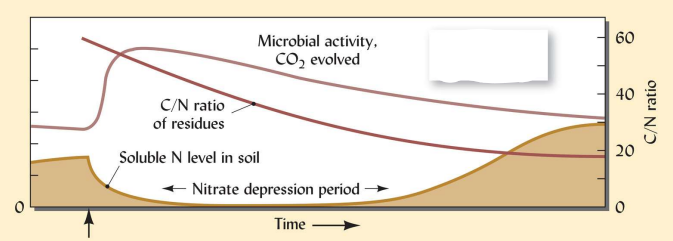
↓ C/N vs time

MAX mineralization variables
↓ C/N ratio
↓ lignin/polyphenols
↑ soil ecology activity
~ to ↑ moisture
↑ temp
↑ O2
~ pH
↑ soil moisture =
↑ decomposition rate
↑ soil temperature =
↑ decomposition rate
↑ drainage =
↓ carbon
↓ particle size =
↑ organic carbon
nutrient
element required by plants for growth, survival, and reproduction
soil chemistry
chemical composition, reactions, and properties of soil
soil fertility
capacity of soil to supply essential nutrients for plant growth
limiting factors
chemical in the shortest supply relative to plant requirements, restricting plant growth
often: nitrogen
sulfur: rarely
nitrogen
often limiting factor
gaseous cycle
role: amino acids, proteins, enzymes, chlorophyll
uptake: NH4, NO3, small amino acids
mobility: highly mobile through translocation and resorption
deficiency: chlorosis in older leaves
oversupply: lodging, root toxicity
nitrogen roles
amino acids
proteins
enzymes
chlorophyll
nitrogen uptake
NH4
NO3
small amino acids
nitrogen mobility
highly mobile in both forms
translocation and resorption
nitrogen deficiency
chlorosis
older leaves
nitrogen oversupply
lodging
root toxicity
translocation
transport and movement of nutrients through plants and soil
resorption
conservation of nutrients from dying plant organs to perennial tissue for future growth
chlorosis
condition in which too little chlorophyll is produced, turning older leaves yellow
nitrogen deficiency
nitrogen input
nitrogen fixation
deposition
nitrogen output
denitrification