Chapter 15- Term structure of interest rates
 Call Kai
 Learn
 Practice Test
 Spaced Repetition
 Match
 Flashcards
 Knowt Play
1/14

There's no tags or description
Looks like no tags are added yet.
15 Terms
Todays spot rates for different maturities imply forward rates, which are the rates of future periods.
Three theories explain why the yield curve has the shape it does
expectations
liquidty preference
market segmentation
Expecations theory
Forward rate = expected future short rate
liquidity premium = 0
upward yield curve: rates are expected rise
assumes bonds are interchangeable
Liquidity preference theory
short-term investors dominate and demand extra pay to hold long bonds
f > E(r)
upward curve: rates are rising and/or a liquidity premium. the curve has a built-in upward bias
assumes bonds are interchangeable
market segmentation theory
short and long bonds trade in seperate markets with different investors, each with its own supply and demand
upward curve: whatever each sgements supply and demand says
Liquidty and liquidity risk
liquidity: how easily an asset can be bough or sold at a fair price
risk: the risk you can’t trade at a fair price and take a loss. that risk is what generates the liquidity premium
Normal (upward) yield curve
longer maturities pay moe
typical case
Inverted (downward) yield curve
short rates are above long rates
it often signals expected rate cuts or a recession
flat or twisted (humped) yield curve
the theories don’t explain these wll.
possible reasons:
liquidity problems at the front of the curve
immediate geopolitical risk
long-term debt being percieved as lower risk
Spot rate (r₀,ₙ):
The rate from today (time 0) to maturity n. It’s the YTM on an n-year zero-coupon bond.
Short rate
the 1-period rate for a specific future interval (year 2 to year 3)
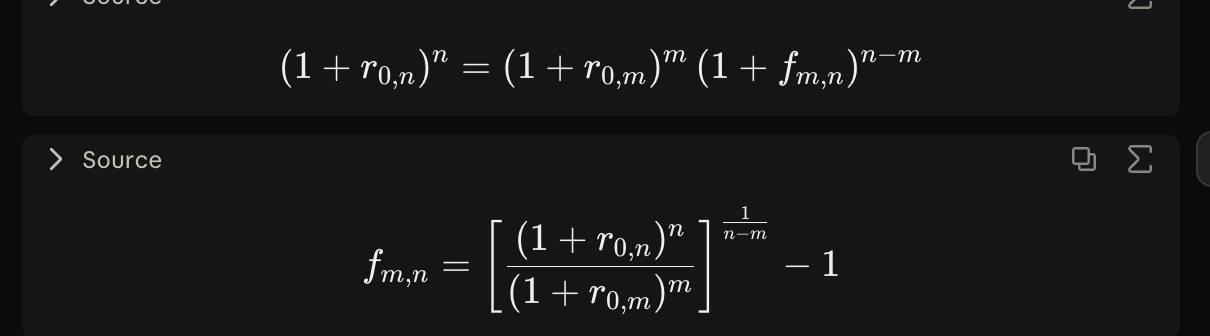
Forward rate (fₘ,ₙ)
the rate implied today for a loan that starts at time m and ends at time n. it starts later than today.
spot price vs forward price
spot: price today for an exchange today
forward: a price agreed today for an exchange at maturity F₀ = S₀(1 + r)ᵀ.
Why forward rates exist (replicating portfolios)
2 portfolio with the same payoff in every scenario must cost the same, so investors are indifferent between them.
Portfolio 1: invest for 2 years at the 2-year spot rate → FV = PV(1 + r₀,₂)²
Portfolio 2: invest 1 year at r₀,₁, then roll into the 1-year forward rate → FV = PV(1 + r₀,₁)(1 + f₁,₂)
Setting FV₁ = FV₂ gives the forward rate formula.
Implied forward rate formula
Pricing a coupon bond with spot rates
discount each cash flow at it’s own spot rate.
A 3-year 10% coupon bond = 100/1.05 + 100/1.06² + 1,100/1.07³ = $1,082.17. Its YTM is 6.88%, just below the 3-year spot rate of 7%, because some cash flows come earlier.