Clinical induction and maintenance
 Call Kai
 Learn
 Practice Test
 Spaced Repetition
 Match
 Flashcards
 Knowt Play
1/44

There's no tags or description
Looks like no tags are added yet.
45 Terms
What is the aim of induction
Produce state of anaesthesia
Suppress reflexes to allow endotracheal intubation
What are the induction injectable agents
Propofol
Alfaxalone
Ketamine
Thiopental
Etomidate
What are pharmacokinetics
Absorption, distribution, metabolism, elimination
Onset, offset
What are pharmacodynamics
Systemic effects
Quality of induction of recovery
Therapeutic margin
What are physicochemical properties
Formulation
Shelf life
Drug compatibility
What are patient specific factors
Species
Breed
Temperament
Co-morbidities
Pregnancy
What species are induction drugs licensed in

What are dog physiological consideration
Variation in sizes and temperament
IV usually readily accessible
What should not be used in sighthounds
Thiopental
What should be prioritised in brachycephalics
Airway access
What is important with dogs with heart disease
Maintain cardiac output
What cat physiological considerations are there
Common diseases such as CKD in older cats and hyperthyroidism
What is a reliable route of administration in cats
IV
Why should you care with propofol in cats
Heinz body anaemia reported following doses over sequential days
When should you take care with ketamine in cats
If they have anuric AKI as it is eliminated unchanged via the kidneys
What are the practicality problems for horses
Use drugs with lower volume so unlikely to be able to induce to effect due to safety
What is a risk in farm animals
High aspiration risk due to salivation and regurgitation
What are specific considerations for exotics
Small size so small drug volume
Diverse range in physiology
Lack of familiarity
IV access difficult
Prone to stress
High mortality rate
What are specific considerations for wildlife
Safety
Diverse range in physiology
Capture myopathy
What are the issues with mask induction
Highly stressful
High concentration required
Profound CV effects
High risk of exposure
Mortality risk
What are the routes of administration of injectables
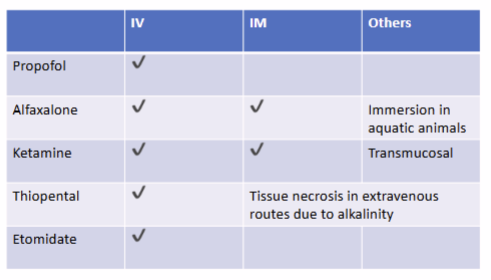
What is the purpose of airway management
Oxygen and anaesthetic delivery
Airway protection against reflux and aspiration
Provides means to ventilate
What are the approaches to airway management
Endotracheal intubation
Supraglottic airway devices
Face mask
How do you ET intubate small animals
Laryngoscope for visulisation of artenoids and glottis
Do not touch the epiglottis
How do you ET intubate a cat
Laryngospasm risk
Lidocaine spray required
Uncuffed or cuffed
How do you ET intubate a horse
Large silicon ET tube
Blind placement
Bite block or gag required
How do you ET intubate small ruminants
Narrow gape
Straighten head and neck
Long laryngoscope blade
Stylet
How do you ET intubate cattle
Manually displace epiglottis and arytenoids
What is the aim of cuff inflation
Provide seal to protect airways
Minimise anaesthetic exposure
Means to ventilate
What are the methods of cuff inflation
Minimal occlusive pressure against 20cmH2O pressure
Cuff syringe with built in manometer
What are supraglottic airway devices
Peri-laryngeal seal via inflatable cushion
LMA developed for humans but can be used in dogs
V-gel developed for cats and rabbits
What are alternative methods of airway access
Temporary tracheotomy
Pharyngostomy
Airway insufflation
Endoscopic guidance
What are the inhalation maintenance agents
Isoflurane
Sevoflurane
What are the total intravenous anaesthesia agents
Propofol boli / infusion
Alfaxalone boli / infusion
Triple drip
What is in a triple drip
Ketamine
Guaphensen
Alpha-2 agonist
What do inhalation agents require
Anaesthetic machine
Vaporiser
Breathing system
When is total intravenous anaesthesia required
Field anaesthesia
Indicated for procedures involving respiratory tract
How do you manually assess maintenance agents
Palpebral reflexes
Eye positioning
Jaw tone
Trends of vitals
What do gas analysers give you
End tidal anaesthetic agent
Which pig breeds are genetically predisposed so malignant hyperthermia
Landrance
Pietrain
Duroc
Poland china
What is the pathophysiology of malignant hyperthermia
Dysfunctioned ryanodine-sensitive Ca2+ channels
Lead to excess intracellular Ca2+ release and sustained muscle ontraction
Dramatic CO2 and heat production
Subsequent metabolic and respiratory acidosis, cell death, DIC and mortality
What species are the maintenance agents licensed in
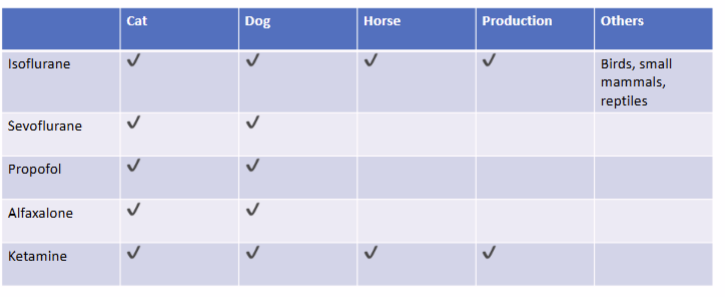
What negative environmental effects do inhalation agents have
Greenhouse gas
Ozone depletion
What are negative environmental effects of injectable agents
Energy consumption via manufacture, sterilisation, packing, transport, disposal, electricity, wastage
Contamination of local body of water