Age of Dinosaurs - Exam 1
 Call Kai
 Learn
 Practice Test
 Spaced Repetition
 Match
 Flashcards
 Knowt Play
1/147

There's no tags or description
Looks like no tags are added yet.
148 Terms
What is Science?
Tendency to treat science as a body of facts
Dynamic!
“Modern science seeks to explain natural phenomena in natural terms.”
Does not mean things don’t exist outside of nature
Instead, science can only address observations in Nature (science does not have a say outside that constraint)
Amicus Curiae:
August, 1986: Edwards vs. Aguillard
Louisiana law requiring creation science to be taught with evolution
Unconstitutional: favored one religion
Amicus Curiae: brief to Supreme Court from
72 Nobel laureates
17 State Academics of Science
7 other scientific organizations
Formulate and test explanations of natural phenomena
Collect and record data in an effort to infer principles of nature that best explain observed phenomena
Explanatory principles must be consistent with prior and present observation
Subject to continued testing
IDEAL: always state “As far as we know now, based on the evidence available to us today”
“Science is the human activity of seeking natural explanations for what we observe in the world around us”
“Science is a systematic method of continuing investigation that uses observation, hypothesis testing, measurement, experimentation, logical argument, and theory building to lead to more adequate explanations of natural phenomena”
Why eliminate “natural explanations”?
Removes limitations on science (opinion vs. data; anything goes)
The words we use are important — always be clear about what you mean
The Attributes of Science
Testable
Repeatable
Falsifiable
Testable
Scientific understanding is achieved by constructing and modifying hypotheses to explain observations
Hypotheses are tested by comparison of the test results with the predictions of the hypothesis
If a hypothesis cannot be tested, it is unavailable to science
Hypotheses can never be proven, only rejected or supported
Repeatability
An observation is scientific if it is repeatable
The most important way to verify an observation is to replicate it independently
Other people working independently make the same observations under the same circumstances
Falsifiability
Because scientists test hypotheses by attempting to falsify them, it must be possible to falsify a hypothesis if scientific methodology is going to address it
Example 1: Chocolate ice cream tastes better than vanilla ice cream
Example 2: Chocolate ice cream is healthier than vanilla because it has more antioxidants
Scientific Method
a research strategy based on the principle that every physical event has a physical explanation
Science: How we do it — Hypothesis, observation, testing, etc.
Common Currency of Science is observation and hypothesis
Advancement only when all scientists use the same process to discover and disseminate new information
Science works by building hypotheses to explain observations
Testing hypotheses and observations
Choosing among hypotheses to select best explanation based on evidence available today (open to change)
Fact
observation that has been repeatedly confirmed; can be overturned with new evidence
Hypothesis
tentative statement that can be tested; supported or refuted
Theory
highly-tested and substantiated explanation based on a large collection of observations and experiments (ability to consistently predict new phenomena)
Fact vs. Theory
Fact of Gravity vs. Theory of Gravity
Fact — objects fall towards center of Earth
Theory — mathematical explanations of forces
ex. Newton’s Theory
Fact of Evolution vs. Theory of Evolution
Fact — observations of changes in gene frequencies in a population across generations (natural phenomenon)
Theory — mechanism (explanation) of these observed changes
Historical Science
Geology and Paleontology often considered “Historical Sciences”
What does that Mean?
Generally observational, rather than experimental science:
First hand observations
Natural experiments
Paleontology
the study of past life as preserved in the geological record
Uniformitarianism
Charles Lyell (1797 - 1875) — Father of Modern Geology
Principles of Geology (1830-1833) — conceptual framework for the methodology of geology
Natural laws are constant in time and space
Invoke modern processes to explain the past (“the present is key to the past”)
Geological change is slow and not catastrophic (uniformity of rate)Earth fundamentally the same since its formation (uniformity of configuration)
Why Life Here?: Biology, Physics, Chemistry, and History
Interactions in Biology = dictated by the laws of physics and chemistry!
Part of why Earth and Life are the way they are today
But, the laws do allow for chance events!
Because chance events can occur, history (contingency) becomes important.
Earth and Life are products not only of physics and chemistry, but of history (Evolution!) as well (interdisciplinary!)
Science is a process:
“Modern science seeks to explain natural phenomena in natural terms.”
Testable
Repeatable
Falsifiable
Does not mean things don’t exist outside of nature
Methodological Naturalism
Methodological Naturalism
can address only observations in nature (science does not have a say outside that constraint)
Scientific Communication: Part of the Process
Why does it matter?
Effective public engagement key to solving ‘wicked problems’
ex. economic, political, environmental issues
Climate change, natural hazards, epidemics
Americans get most information about science from internet, television, newspapers
Americans have little formal training in science or research
Scientists and scholars have a responsibility to communicate their work to non-specialists
Ut Prosim — “That I may serve”
VT is a land grant institution
“It doesn’t count as science until you’ve written it down”
Scientific Publications
Proceeds by publication
Present your hypotheses, your data, and the results of your tests
Other researchers can evaluate the quality of your work, see if they can duplicate your results, etc.
Typically checked by peer-review
Remember falsifiability
Present your hypotheses, your data, and the results of your tests
We often report new findings, but need to remember that sometimes those findings are negative results
Naturalism
the belief that everything can be explained through natural causes and processes, rather than supernatural ones
Geology
the study of the Earth, its materials, and the processes that shape and change it
What are fossils?
Ancient civilizations knew fossils were remains of life
Greek philosophers recognized fossil shells were evidence of former oceans
Formed basis of some myths and legends
Ancient civilizations knew fossils were remains of life
BUT we only know this knowledge broadly when oral folklore is written down
Science communication matters
Worldview matters as well
Fossils are part of the ground — why remove?
Mistrust caused by bad past experiences with scientists
Nicolas Steno
Studied what were called “tongue stones” and argued that they were actually fossilized shark teeth, not naturally formed rocks
He also established the basic principle of superposition: in an undisturbed sequence of sedimentary rock layers, the oldest layers are at the bottom and the youngest are at the top
Challenged long-standing ideas that fossils are inorganic
Came up with the idea of Principle of Superposition
George Cuvier
Comparative anatomy: He compared the anatomy (body structures) of different animals to understand how they were related and how extinct animals differed from living ones
Father of vertebrate paleontology
Showed fossils mammoths were related to modern elephants
Mary Anning
Discovered famous fossils such as Dimorphodon, Plesiosaurus, and Ichthyosaurus
Rev. William Buckland
Named first dinosaur Megolasaurus in 1824
Gideon and Mary Ann Mantell
Discovered the Iguanadon and Hylaeosaurus
Richard Owens
Named Dinosauria in 1842
Considered dinosaurs to be active and warm-blooded
Edward D. Cope vs. Othniel C. Marsh
The Bone Wars: Competed to find the biggest dinosaurs
Fueled the rapid expansion of dinosaur knowledge and the formation of major natural history museums that showcased these prehistoric marvels, captivating the public’s imagination
Diversity in Paleontology
Annie Alexander
Zofia Kielan-Jaworowska
Tilly Edinger
Louis R. Purnell
Annie Alexander (1867-1950)
Discovered thousands of Triassic fossils in the Southwest (CA and AZ) and donated 20,000 fossils, plants, and animals to University of California
Founder of the UCMP
Collected and travelled with her companion Louise Kellogg for 42 years
Louis R. Purnell
First African American paleontologist and worked with invertebrate fossils
John H. Ostram
Discoverer of Deinonychus
Changed longstanding beliefs about dinosaurs
Ushered in the Dino revolution
“Dark Ages” of paleontology
The Great Depression and WWII brought a slowdown to all non-essential research
Social change within Paleontology
Dinosaurs considered “kid stuff”, good only for drawing people into museum
Fossil mammals, protomammals, etc., considered “proper” research
Dinosaurs only a maladaptive side note to the history of life
Stupid, slow, swamp-dwellers…
Dinosaur Renaissance
John H. Ostrom (1928-2005), Yale University
Revised thinking of dinosaurs
Came about because scientists, especially John H. Ostrom, began revising how dinosaurs were understood, recognizing them as more active, energetic, and bird-like animals rather than slow, sluggish reptiles
Ostrom’s work on the feeding adaptations of duckbill and horned dinosaurs, as well as his discovery of the active predator Deinonychus, helped revive the idea that dinosaurs were not slow, stupid swamp dwellers, but rather agile, complex creatures
This “dinosaur renaissance” led to a surge of new research questions and expeditions around the world, resulting in the discovery of about one new species of Mesozoic dinosaur every week and a half.
Zofia Kielan-Jaworowska (1925-2015)
Led Polish-Mongolian expeditions to the Gobi Desert
Mesozoic mammals, Fighting Dinosaurs, trilobites
First woman on Executive Committee of International Union of Geological Sciences
Tilly Edinger (1897-1967)
Developed field of paleoneurology
Immigrated to U.S. to escape Nazi threats
Founding member of Society of Vertebrate Paleontology
How did extinction change people’s view?
The discovery and acceptance of extinction showed that life on Earth could change over time, including organisms disappearing completely
Joseph Leidy (1823-1891)
First American Dinosaurs: He studied and described some of the first dinosaur fossils discovered in North America, including fossils from the Judith River area of Montana in 1856
Leonardo da Vinci
Recognized that fossils are the remains of extinct life
Rocks
Naturally occurring cohesive solids made of one or more minerals
Classified by their origin
“Every Rock is a Record of the Environment in Which it was Formed”
Rock Cycle

Types of Rocks
Igneous
Metamorphic
Sedimentary
Igneous
Formed from cooling magma or lava
Metamorphic
Formed by recrystallization of existing rocks by pressure and temperature
Sedimentary
Forms by breaking of surface rocks and redepositing
This is where fossils are mostly found
Body Fossils
Part of the animal, teeth, shell bones, etc.
Trace Fossils
Burrows, tracks, biochemistry change in rocks, coprolites (dinosaur poop)
Good at helping decipher behavior
How did these sedimentary rocks form?
Formed by deposition of transported fragments of previously existing rocks
Because they are deposited, sedimentary rocks form flat layers called strata (singular: stratum)
Ions (dissolved from previously existing rock) transported and are:
Biogenic: Absorbed by living things, incorporated by their tissues, and deposited
Chemical: Precipitated out of solution and deposited
Coal
Limestone
Evaporates
Chalk
Coal (Biogenic Sedimentary Rocks)
Indicates LOTS of plant growth
Burial faster than decay
Limestone (Biogenic Sedimentary Rocks)
Limestone: Made of broken up (or dissolved and reprecipitated) shells of organisms
Generally indicates warm (typically salt) water
Beach-ocean depths (but occasionally certain types of lakes)
Chalk (Biogenic Sedimentary Rocks)
Chalk: Type of limestone made of skeletons of single-celled algae
Formed in very warm waters
Evaporates (Chemical Sedimentary Rocks)
Indicates arid environment (high rates of evaporation)
What is Bloat and Float and how can it be misleading in our interpretations?
Bloat and Float: An animal dies in water, and its body fills with gases and floats out into the open ocean, where it eventually sinks and is deposited in the deep ocean
How can it be misleading? The fossil may be found far from where the animal actually lived or dies, making scientists incorrectly think the animal lived in the deep ocean
Types of Preservation
Unaltered
Amber, soft tissue
Permineralized
Replacement
Carbonization
Impressions
Fully articulated
Lagerstatten
Unaltered
Original hard parts (and sometimes soft parts) still present in original form
Amber: organisms trapped and buried alive in resin, volcanic ash, tar, ice, etc.
Soft Tissue Preservation: pictured are unaltered soft parts found in T. rex bones after acid treatment
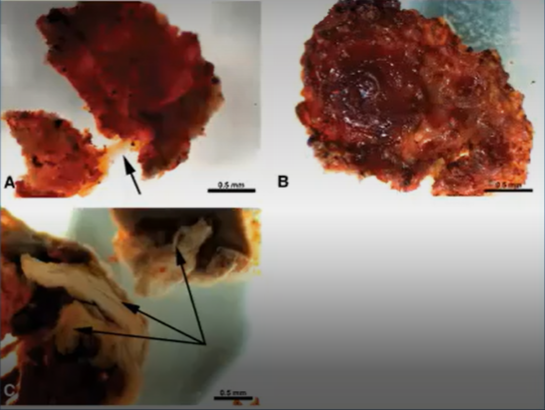
Primineralized
Original hard parts (and sometimes firm parts) still present, but pore space filled up by minerals from ground water
Exactly comparable to — and happens at the same time as — cementation of the sediment
Most common mode for wood, bone, teeth
Replacement
original hard parts replaced in some part with another mineral
Carbonization
organic material compressed between layers of sediment, leaving a film or stain of carbon behind
Impressions
original material lost, but impression of the original (or filled in impression) is left in the sediment
Fully Articulated
a fossil in which bones are preserved in their original positions and still connected to each other
Lagerstatten
Sedimentary deposit that exhibits extraordinary fossils with exceptional preservation
Soft tissues preserved (sometimes)
Preserved at several times through geological time
Extinction
Permanent disappearance of species from the Earth
Extinctions have occurred on a global scale at certain times in the past, resulting in the phenomenon known as mass extinctions
What caused extinctions?
Sea level changes (lowering)
Loss of food source
Changes in the temperature/climate
Metero impacts
Competition
Predation
Tectonic shifts
Volcanism
Disease
How many extinctions have occurred and when?
Ordovician (445-443 million years ago)
Devonian (372-359 million years ago)
Permian (252 million years ago)
Triassic (201 million years ago)
Cretaceous (66 million years ago)
Biases against fossilization
Animal size bias — larger animals are more likely to fossilize and be discovered than smaller animals
Element (bone) bias — some bones are more likely to survive fossilization than others because they are more durable
Environmental bias — some environments are more likely to preserve fossils than others
Human bias — humans are more likely to find, study, and preserve certain fossils than other fossils
Bias in the Fossil Record
There is very strong bias against fossilization that leads to gaps in our understanding of ancient life
Most organisms do NOT become fossils!
Different Fossilization Potentials
Big animals in articulation need:
very rapid rates of sedimentation (streams at flood; desert sandstorms)
or special circumstances (died at watering hole near end of dry season & covered over quickly afterwards)
Small animals in articulation need:
quiet environments that are not disturbed (lake beds, lagoons, etc.)
What rock types preserve bones the best?
Conglomerates
Sandstones
Mudstone
Conglomerates
good for large isolated bones; bad for articulation or small bones
Sandstones
good for most size fossils, and articulated skeletons
Mudstones
good for most size fossils, but especially small bones
What are Death Pits?
places where animals became trapped in soft, muddy sediment, died, and were buried together, creating a concentration of fossils
Deep Time
Most of time is the geological past
thousands, millions, even billions of years
Analogy to “deep space”: the immensity of space outside the Earth-Moon system
Relative Time
Sequence of events
A came before B, B came before C, etc.
Numerical Time
Dates or durations measured in years (or other unit)
Sometimes called “absolute time”
Principles of Original Horizontally
sediment forms horizontal layers (strata) when deposited
Principle of Superstition
Strata at the bottom of a stack of sediment were deposited first (oldest), the ones on top of those are younger, and so on
NOTE: only tells you RELATIVE older or younger
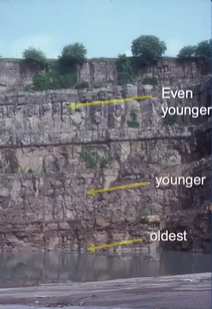
Principles of Cross-Cutting Relationships
Any structure (fold, fault, weathering service, igneous intrusion, etc.) that cuts across or deforms strata is younger than the rocks and structures it cuts across or deforms
i.e. new rocks cut through old rocks

The physical relationships between bodies of rocks allow you to reconstruct the sequence in relative time in which they formed

Correlation Beyond One Location: How can you determine which events at region A took place at the same time (or before or after) particular events at region B?
Biostratigraphy
What is biostratigraphy?
using fossils in rock layers to determine their relative ages and correlate timing of events between different locations (and to determine relative position with rocks or strata)
Geological Timescale
A system used to divide Earth’s history into different periods of time based on major geological and biological events
Neogene
Paleogene
Cretaceous
Jurassic
Triassic
Permian
Pennsylvanian
Mississippian
Devonian
Silurian
Ordovician
Cambrian
New Professors Can Just Teach People Properly, Making Difficult Subjects Obviously Clear
Plate Tectonics
Plate Boundary types
Continental Drift: the theory that Earth’s continents have moved over time from their original positions
Pangea: a supercontinent that existed millions of years ago when most of Earth’s continents were joined together
Unconformities
Erosional or weathering surfaces = what causes/creates the unconformity
Gaps in the record = what an unconformity represents in the rock record
An erosional or weathering surface that creates a gap in the rock record and represents missing geological time
Plate Boundary Types
Divergent: two tectonic plates move apart from each other
Convergent: two tectonic plates move toward each other
Transform: two tectonic plates slide past each other horizontally
Radiometric Dating
works for igneous rocks (composition locked in at time of crystallization)
Isotopic Dating
A method used to determine the age of rocks or fossils by measuring the radioactive decay of isotopes
Half-life
Half-Life
The amount of time it takes for half of a radioactive isotope to decay
Ex. If you start with 100 radioactive atoms and one half-life passes, about 50 remain; after another half-life, about 25 remain
In isotopic dating, scientists use the known half-life of an isotope to calculate how old a rock or fossil is

Diagenesis
post-depositional alteration of sediment
What are the different layers of the Earth?
Inner Core
Outer Core
Mantle
Crust
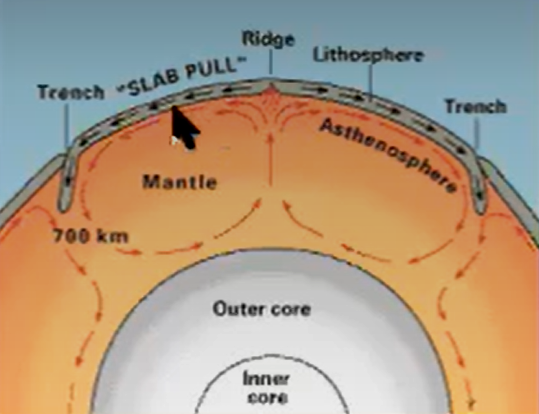
Lithosphere
the rigid outer layer of Earth made up of the crust and uppermost mantle, which is broken into tectonic plates
Asthenosphere
the soft, weak layer of the upper mantle beneath the lithosphere that allows tectonic plates to move
Mineral
a naturally occurring, inorganic solid with a specified chemical composition and crystal structure
Axial Skeleton
the skull, vertebral column, and ribs
Appendicular Skeleton
everything else, i.e., the limbs and limb girdles
Homologous
Same structure found repeated in different organisms
Same “body parts”
Analogous
different structure with similar functions
Comparative Anatomy
scientific study to describe the bodies of organisms in terms of their homologous structures
Functions of the Skeleton
Support mass
Protection of internal organs
Mechanical structures
Putting a Skeleton Together
Bones connected at mobile joints
Individual bones connected at sutures
In life, suture and joint surfaces covered by cartilage and bones connected by ligaments
Joints
connection where bones are moveable