Neck & Additional Chest Projections
 Call Kai
 Learn
 Practice Test
 Spaced Repetition
 Match
 Flashcards
 Knowt Play
1/67

There's no tags or description
Looks like no tags are added yet.
68 Terms

what is A in this image?
soft palate

what is B in this image?
pharyngeal tonsil

what is C in this image?
nasopharynx
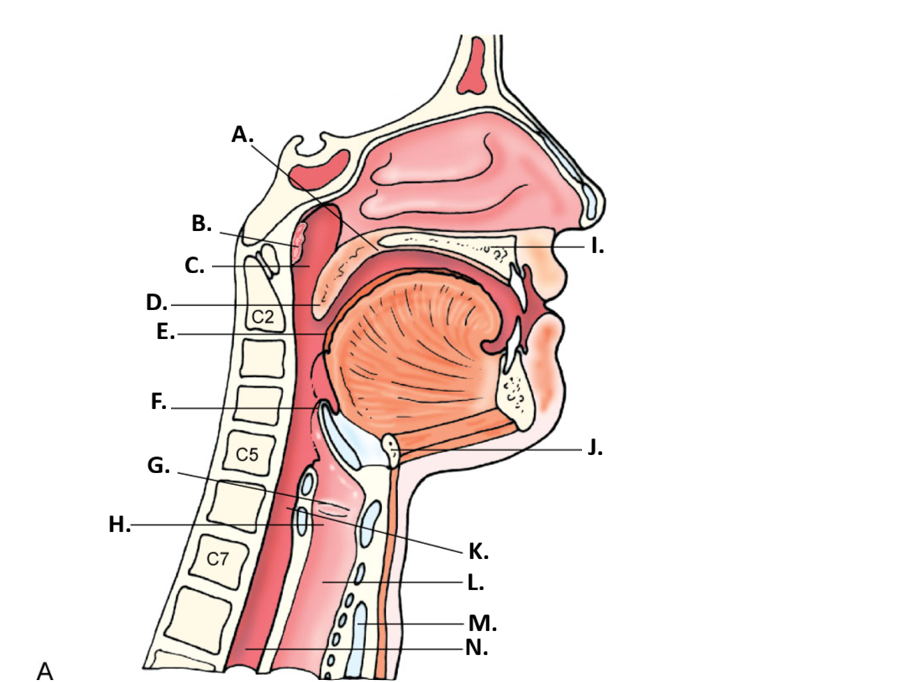
what is D in this image?
uvula

what is E in this image?
oropharynx

what is F in this image?
epiglottis

what is G in this image?
vocal cords

what is H in this image?
larynx
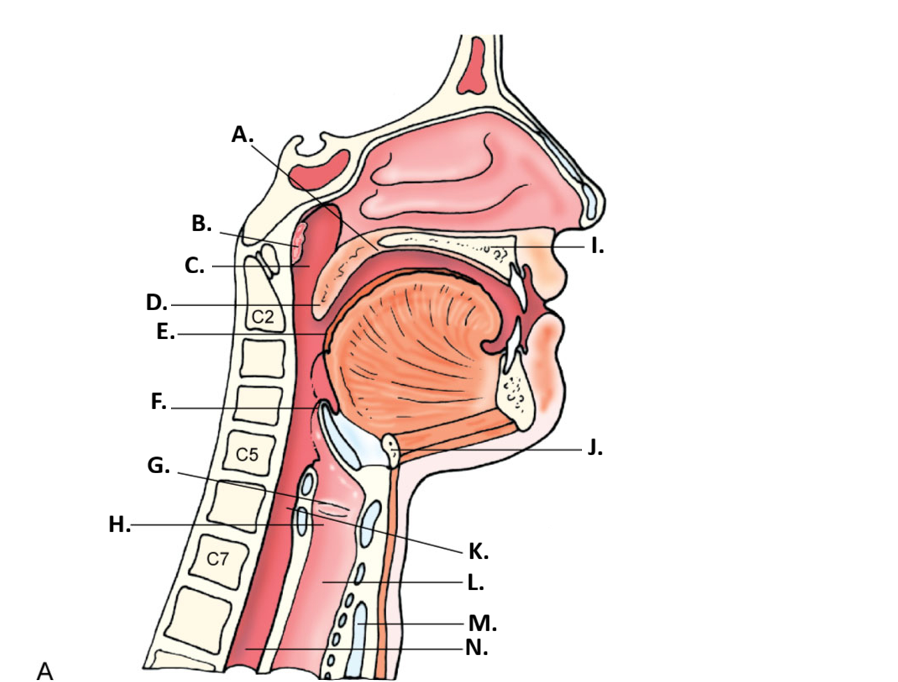
what is I in this image?
hard palate

what is J in this image?
hyoid bone

what is K in this image?
laryngeal pharynx
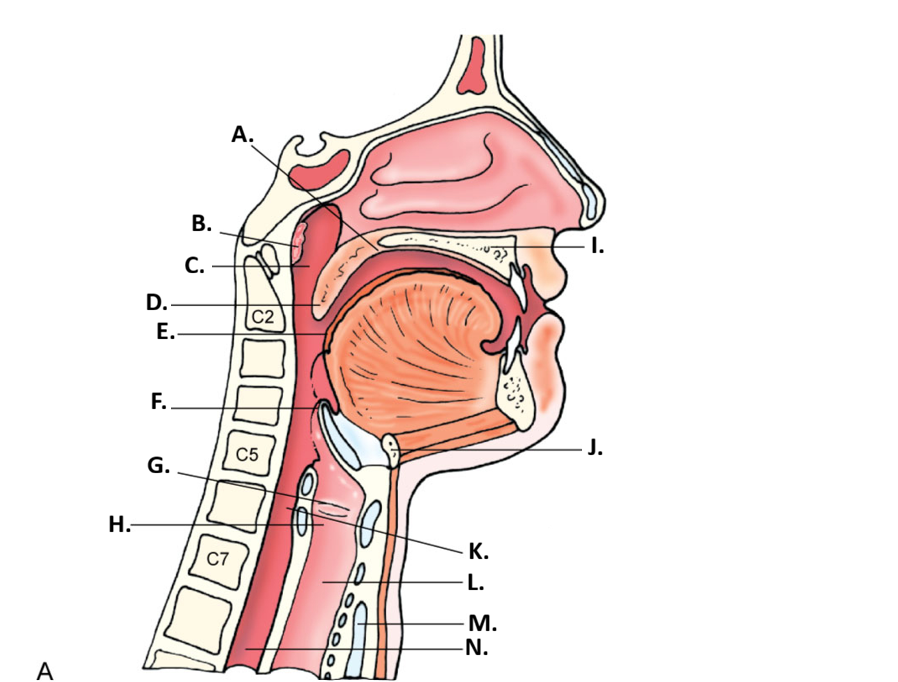
what is L in this image?
trachea

what is M in this image?
thyroid cartilage

what is N in this image?
esophagus
in what position (s) can an AP trachea be performed?
supine or upright
where do you center for an AP/Lateral trachea that’s only meant to show the upper airway?
laryngeal prominence
where do you center for an AP/Lateral trachea in order to capture the entire trachea?
manubrium
SID for AP/Lateral trachea?
40 in
why would an upper airway/soft tissue xray typically be ordered?
to demonstrate foreign bodies, swelling, masses, and fractures of the larynx/hyoid bone
when is exposure made during an AP/lateral trachea projection?
slow inspiration
how are shoulders position for a lateral trachea?
flexed/ rotated posteriorly
where is the side of interest placed in relation to the IR for a PA Oblique Chest?
farthest from the IR (elevated side)
a _____ degree oblique position is used for barium cardiac series
55 to 60
how is the part position for a PA Oblique Chest?
45 degree LAO or RAO
where is the IR centered for the PA Oblique Chest?
top of IR 1.5 to 22 inches above vertebra prominens
how are arms placed for the PA Oblique Chest?
positioned out of collimated field
how is the CR lined up for a PA oblique chest?
CR enters at level of T7
when is the exposure made for the PA oblique chest?
second full expiration
how are PA Oblique chest position for a barium cardiac series?
left anterior w/ oblique 55-60 degrees of rotation
how is the side of interest placed for an AP Oblique Chest?
closer to IR (dependent side)
how is the part position for a AP Oblique Chest?
45 degree LPO or RPO
how are arms/shoulders placed for an AP Oblique Chest?
arms out of field and shoulders in the same transverse plane
how is the CR centered for an AP Oblique chest?
perpendicular to IR and enters 3 inches below jugular notch
when is exposure made for the AP Oblique Chest?
second full inspiration
when is the supine AP chest typically used?
when the patient is too ill for upright positions
how is the IR positioned during an AP chest?
1.5 to 2 inches above shoulders
how should the patient’s arms be placed for an AP Chest?
flex elbows, pronate and places hands on hips to draw scapular laterally
how is the CR centered for an AP chest?
perpendicular to long axis of sternum and enters 3 inches below the jugular notch
when is exposure made for an AP chest?
second full inspiration
how is the patient positioned for an AP axial chest lordotic position?
upright, facing the tube and approximately 1 foot in front of grid
how is the IR position for an AP chest in the lordotic position?
3 inches above patient’s shoulder when they are in lordotic position
how should the patient’s shoulders be placed for the AP chest in lordotic positon?
with their shoulder resting on the grid
how is the CR lined up for an AP Axial Chest (lordotic)
perpendicular to IR and enters MSP at midsternum
when is exposure made for the AP axial chest (lordotic)
second full inspiration
in a gravitation field, liquids always flow ___
downstream
in a gravitation field, air will always move to the ____ position
highest
when are decubitus chest exams typically ordered?
for air and fluid based manifestations
for an AP or PA projection what type of decubitus position would be used?
right or left lateral decubitus
for a lateral chest projection, what type of decubitus position could be used?
ventral or dorsal decubitus position
to demonstrate fluid in a patient, what side should be down for a lateral decubitus chest?
affected side
to demonstrate free air in a patient, what side should be down for a lateral decubitus chest?
unaffected side
when should the exposure be taken for a lateral decubitus chest position?
5 minutes after the patient has been positioned
why should the radiographer wait before exposing for a lateral decubitus chest?
to allow fluid to settle or air to rise
how is the IR positioned for a lateral decubitus chest?
1.5 to 2 inches beyond the shoulders
when should you elevate the patient 2 to 3 inches up for a lateral decubitus position
when patient is lying on affected side
how is the CR lined up for a lateral decubitus chest?
horizontal/perpendicular to the IR
for an AP lateral decubitus chest, where does the CR enter the patient’s MSP?
3 inches below jugular notch
for a PA lateral decubitus chest, where does the CR enter the patient’s MSP?
at T7( sternal angle of the scapulae)
when is exposure made during a lateral decubitus chest?
second full inspiration
what is a lateral decubitus chest used to show in a patient?
changes in fluid position and/or presence of free air
how is the patient position for a ventral/dorsal decubitus chest?
prone/supine with the body elevated 2 to 3 inches
how is the IR position for a ventral or dorsal decubitus chest?
top of IR is at C5 (level of thyroid cartilage)
the patient lies in position for ____ to allow fluid to settle/air to rise for a ventral/dorsal decubitus
5 minutes
which side is placed against the IR for the ventral/dorsal decubitus chest?
affected side
where does the CR enter a patient for a ventral decubitus chest?
enters MCP at T7
where does the CR enter a patient for a dorsal decubitus chest?
enters MCP 3 to 4 inches below jugular notch
when is the exposure made during a ventral/dorsal decubitus chest?
second full inspiration
what structures are shown in a ventral/decubitus chest?
changes in fluid position