L3 - Postcranial Morphology

0.0(0)
Studied by 0 people
call kaiCall Kai
learnLearn
examPractice Test
spaced repetitionSpaced Repetition
heart puzzleMatch
flashcardsFlashcards
GameKnowt Play
Card Sorting

1/64

encourage image

There's no tags or description

Looks like no tags are added yet.

65 Terms

1
New cards
term image

Fusiform, tapers from the midpoint, strong swimming

2
New cards
term image

Compressiform, laterally compressed,  vertical disc, trick question these include flatfish

3
New cards
term image

Depressiform, dorsoventrally depressed

4
New cards
term image

Anguilliform, eel like/elongated bodies

5
New cards
term image

Filiform,extreme eel like/elongated

6
New cards
term image

Globiform, opposite of elongation, basketball/globe shape

7
New cards

stuff in Postcranial Skeleton

Vertebral column, Caudal complex

8
New cards

stuff in Vertebral Column

Precaudal vertebrae, Caudal vertebrae

<p><span style="background-color: transparent;">Precaudal vertebrae, Caudal vertebrae</span></p>
9
New cards

Precaudal vertebrae

Vertebral column:  first set behind head all the way to the edge of body wall (majority of internal organs)

<p><span style="background-color: transparent;">Vertebral column: &nbsp;first set behind head all the way to the edge of body wall (majority of internal organs)</span></p>
10
New cards

Caudal vertebrae

Vertebral column: all the way to the caudal fin, single spin called the haemal spine

<p><span style="background-color: transparent;">Vertebral column: all the way to the caudal fin, single spin called the haemal spine</span></p>
11
New cards

Features of individual vertebra

Centrum, Neural spine, Pleural ribs (precaudal), Haemal spine (caudal)

<p><span style="background-color: transparent;">Centrum, Neural spine, Pleural ribs (precaudal), Haemal spine (caudal)</span></p>
12
New cards

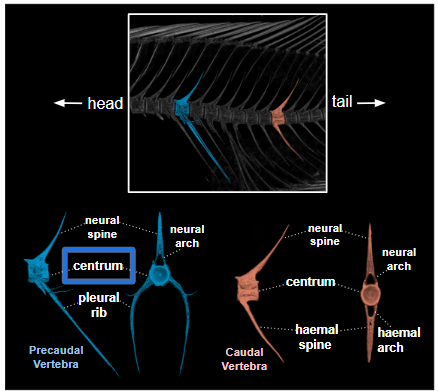
Centrum

individual vertebra: Disc-shaped central part of vertebra
<p><span style="background-color: transparent;">individual vertebra: Disc-shaped central part of vertebra</span></p>
13
New cards

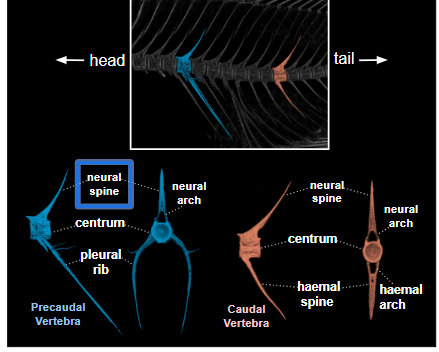
Neural spine

individual vertebra: Projects dorsally/top from centrum, Neural arch at base (houses the spinal cord)
<p><span style="background-color: transparent;">individual vertebra: Projects dorsally/top from centrum, Neural arch at base (houses the spinal cord)</span></p>
14
New cards

Pleural ribs

individual vertebra: precaudal, Paired, ventral/bottom projections, Protect body cavity

<p><span style="background-color: transparent;">individual vertebra: precaudal, Paired, ventral/bottom projections, Protect body cavity</span></p>
15
New cards

Haemal spine

individual vertebra: caudal, Single, ventral/bottom projection, Haemal arch at base (contains caudal artery, in caudal/tail end section)

<p><span style="background-color: transparent;">individual vertebra: caudal, Single, ventral/bottom projection, Haemal arch at base (contains caudal artery, in caudal/tail end section)</span></p>
16
New cards

bones for Caudal Fin Complex

modified vertebral elements and fin rays, Urostyle, Epurals, Hypurals

<p><span style="background-color: transparent;">modified vertebral elements and fin rays, Urostyle, Epurals, Hypurals</span></p>
17
New cards

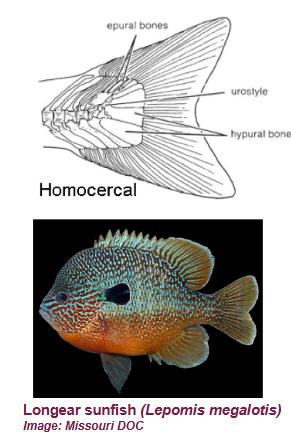
Urostyle

Caudal Fin Complex: final part to vertebrate, made of fused vertebrae

<p><span style="background-color: transparent;">Caudal Fin Complex: final part to vertebrate, made of fused vertebrae</span></p>
18
New cards

Epurals

Caudal Fin Complex: Modified neural spines

<p><span style="background-color: transparent;">Caudal Fin Complex: Modified neural spines</span></p>
19
New cards

Hypurals

Caudal Fin Complex: Flattened haemal spines associated with the urostyle

<p><span style="background-color: transparent;">Caudal Fin Complex: Flattened haemal spines <em>associated with the urostyle</em></span></p>
20
New cards

Principal caudal fin rays

 from base of caudal fin to posterial/end

<p><span style="background-color: transparent;">&nbsp;from base of caudal fin to posterial/end</span></p>
21
New cards

Procurrent fin rays

 do not reach the very end, the very tiny short ones that fall at the edge of the tails

<p><span style="background-color: transparent;">&nbsp;do not reach the very end, the very tiny short ones that fall at the edge of the tails</span></p>
22
New cards

Main Caudal Fin Types

Protocercal, Heterocercal, Homocercal

23
New cards

Protocercal

“Primitive”, undifferentiated fin, in ancient lineage lampreys and larvae fishes

<p><span style="background-color: transparent;">“Primitive”, undifferentiated fin, in ancient lineage lampreys and larvae fishes</span></p>
24
New cards

Heterocercal

 unequally sized lobes, upper lobe larger, like sharks

<p><span style="background-color: transparent;">&nbsp;unequally sized lobes, upper lobe larger, like sharks</span></p>
25
New cards

Homocercal

most common,equal lobe

<p><span style="background-color: transparent;">most common,equal lobe</span></p>
26
New cards
<p><span style="background-color: transparent;">homocercal tails variants</span></p>

homocercal tails variants

knowt flashcard image
27
New cards

Less Common Caudal Fin Types

Diphycercal/Leptocercal, Isocercal, Hypocercal, Gephyrocercal

28
New cards

Diphycercal/Leptocercal

three lobed appearance, coelacanths
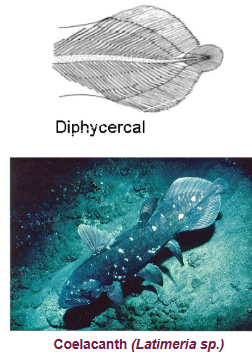
<p><span style="background-color: transparent;">three lobed appearance, coelacanths</span></p>
29
New cards

Isocercal

 flattened plate is a flattened vertebrae instead of spine, in cod

<p><span style="background-color: transparent;">&nbsp;flattened plate is a flattened vertebrae instead of spine</span>, in cod</p>
30
New cards

Hypocercal

opposite of heterocercal, lower lobe larger than upper

<p><span style="background-color: transparent;">opposite of heterocercal, lower lobe larger than upper</span></p>
31
New cards

Gephyrocercal

sunfish only, not true caudal fins, Dorsal and anal fin form a bridge tail

<p><span style="background-color: transparent;">sunfish only, not true caudal fins, Dorsal and anal fin form a bridge tail</span></p>
32
New cards

Appendicular Skeleton: Pectoral Girdle & Fin from skull

Posttemporal, Supracleithrum, Cleithrum, Radials, Fin Rays

<p><span style="background-color: transparent;">Posttemporal, Supracleithrum, Cleithrum, Radials, Fin Rays</span></p>
33
New cards

Posttemporal

 for skull articulation, two prongs/processes (any structure with elongated pointed end, sticks out from main structure
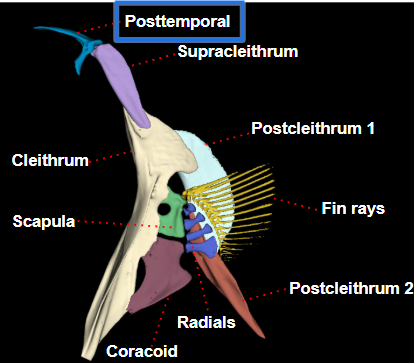
<p><span style="background-color: transparent;">&nbsp;for skull articulation, two prongs/<u>processes</u> (any structure with elongated pointed end, sticks out from main structure</span></p>
34
New cards

Supracleithrum

Forms joint with posttemporal for cranial rotation during feeding
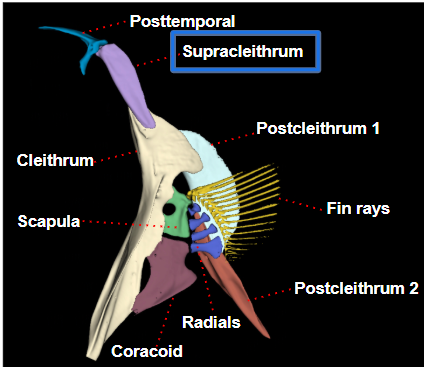
<p><span style="background-color: transparent;">Forms joint with posttemporal for cranial rotation during feeding</span></p>
35
New cards

Cleithrum

largest bone in pectoral girdle

<p><span style="background-color: transparent;">largest bone in pectoral girdle</span></p>
36
New cards

Radials

at base of fin, support fin ray

<p>at base of fin, support fin ray</p>
37
New cards

Fin Rays

Flexible supports for pectoral fins (fins on side)

<p><span style="background-color: transparent;">Flexible supports for pectoral fins (fins on side)</span></p>
38
New cards

Pelvic Girdle Bones

Basipterygium (bpt)

39
New cards

Basipterygium (bpt)

large structure at back of fin where pelvic fin attaches, for modern fishes basipterygia and radials become fused or lost

<p><span style="background-color: transparent;">large structure at back of fin where pelvic fin attaches, for modern fishes basipterygia and radials become fused or lost </span></p>
40
New cards

Shark and Skates

male shark, modified pelvic structures (claspers)

Skates use modified pelvic fins to walk

41
New cards

Appendicular Skeleton evolutionary trends

pelvic fins (purple) move from back to front, pectoral fins (blue) move ventral/bottom of body to up and to the side

<p>pelvic fins (purple) move from back to front, pectoral fins (blue) move ventral/bottom of body to up and to the side</p>
42
New cards

how clingfish work

Pelvic & Pectoral girdles work together as a suction disc (hair for friction)

43
New cards

Median Fins: Dorsal & Anal

Dorsal & Anal Fin, Pterygiophores (Pt), Lepidotrichia

<p><span style="background-color: transparent;">Dorsal &amp; Anal Fin, Pterygiophores (Pt), Lepidotrichia</span></p>
44
New cards

Dorsal & Anal Fin

can have spines (rigid, unsegment), soft rays (soft, segment) or combo, vary in number of dorsal fin

<p>can have spines (rigid, unsegment), soft rays (soft, segment) or combo, vary in number of dorsal fin</p>
45
New cards

Pterygiophores (Pt)

Internal supports of dorsal & anal fins

 base for spine/ray for muscle to attach to and raise fin up/down


Pterygio- (wing) -phores (carry)

<p><span style="background-color: transparent;">Internal supports of dorsal &amp; anal fins</span></p><p><span style="background-color: transparent;">&nbsp;base for spine/ray for muscle to attach to and raise fin up/down</span></p><p></p><p><span style="background-color: transparent;">Pterygio- (wing) -phores (carry)</span></p>
46
New cards

Lepidotrichia

Bony elements of fin rays in bony fishes, “ceratotrichia” when made of cartilage, part of the soft rays (the individual segments)


Lepido- (scale) -trichia (hair)

<p><span style="background-color: transparent;">Bony elements of fin rays in bony fishes, “ceratotrichia” when made of cartilage, part of the soft rays (the individual segments)</span></p><p></p><p><span>Lepido- (scale) -trichia (hair)</span></p>
47
New cards

Finlet

in tuna, between dorsal and anal fin, for open water control

<p>in tuna, <span style="background-color: transparent;">between dorsal and anal fin, for open water control</span></p>
48
New cards

Adipose fin

Small fin behind dorsal fin supported by cartilage (not really fatty), seen in salmon

<p><span style="background-color: transparent;">Small fin behind dorsal fin&nbsp;supported by cartilage (not really fatty), seen in salmon</span></p>
49
New cards

Parts of muscles

Myomeres, Epaxial muscles, Hypaxial muscles

50
New cards

Myomeres

how muscles are organized in segments, w shaped, allows body to sway back and forth

51
New cards

Epaxial muscles

Located dorsally/up

e-(above)

<p><span style="background-color: transparent;">Located dorsally/up</span></p><p><span style="background-color: transparent;">e-(above)</span></p>
52
New cards

Hypaxial muscles

Located ventrally/bottom

hy-underneath
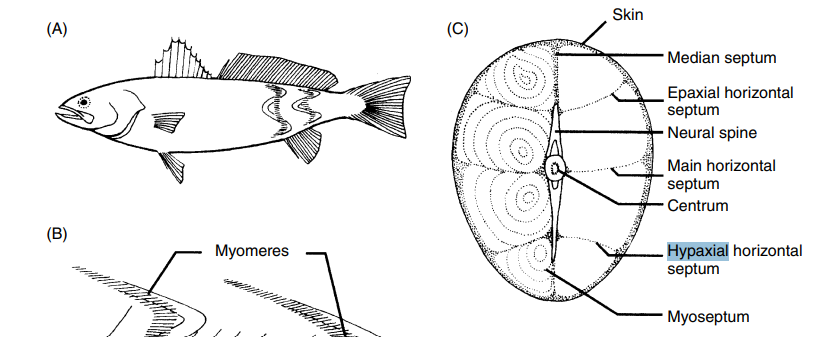
<p><span style="background-color: transparent;">Located ventrally/bottom</span></p><p><span style="background-color: transparent;">hy-underneath</span></p>
53
New cards

Flexors - Extensors

 main muscles, contract/relax to sway body left/right for tail

54
New cards

Protractors - Retractors

individual rays and spines to protect up, retract down in body, spread/close median fins (unpaired dorsal/bottom fin)

55
New cards

Adductors - Abductors

for paired fins, movement towards (Add d for move limb down)/away body (like take away)

56
New cards

Placoid Scales

sharks and relatives, teeth like and small, don't grow in size

<p><span style="background-color: transparent;">sharks and relatives, teeth like and small, don't grow in size</span></p>
57
New cards

Cosmoid Scales

 extinct and fossil and lungfishes/coelacanths, thick plating

<p><span style="background-color: transparent;">&nbsp;extinct and fossil and lungfishes/coelacanths, thick plating</span></p>
58
New cards

Ganoid Scales

 highly ridged, armor like with enamel coating so looks shiny, sturgeons and gar

<p><span style="background-color: transparent;">&nbsp;highly ridged, armor like with enamel coating so looks shiny, sturgeons and gar</span></p>
59
New cards

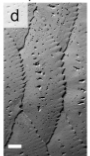
Leptoid Scales

 most fishes, thinnest on average, single thin layer of bone, four types

<p><span style="background-color: transparent;">&nbsp;most fishes, thinnest on average, single thin layer of bone, four types</span></p>
60
New cards
term image

Leptoid: cycloid

61
New cards
term image

Leptoid: crenate

like a crater

62
New cards
term image

Leptoid: ctenoid

k/cten- (comb)

63
New cards
term image

Leptoid: spinoid

spines

64
New cards

Lateral Line

Lateral line scales are modified to allow water to flow past internal sensory structures (neuromasts)
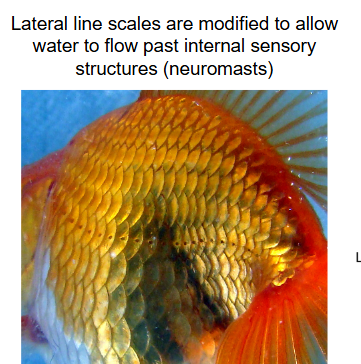
<p><span style="background-color: transparent;">Lateral line scales are modified to allow water to flow past internal sensory structures (neuromasts)</span></p>
65
New cards

Scales: Scutes

modfieid into scutes or spines

<p>modfieid into scutes or spines</p>