History of Buddhism
 Call Kai
 Learn
 Practice Test
 Spaced Repetition
 Match
 Flashcards
 Knowt Play
1/65

There's no tags or description
Looks like no tags are added yet.
66 Terms
What are the important sites/ pilgrim locations
Lumbini (Birthplace), Bodhgaya (Enlightenment), Sarnath (First sermon), Kusinagara (Death)
What is the middle way
The way of living that is neither poverty or richness
What is the first noble truth
Dukka - diagnosis - suffering or unsatisfactoriness - innate characteristic of existence
What is the second noble truth
Samudaya - Cause Trsna/Tanha - craving or attachment
What is the third noble truth
Nirodha - Cure - Letting go of Trsna/Tanha
What is the fourth noble truth
Magga - Treatment - Enlightenment to treat Trsna/Tanha
What is physical Dukkha
Birth, decay, disease, death
What is Dukkha of change
United with the unpleasant and being separated from the pleasant
What is the Dukkha of conditions
five aggregates - form, sensations (body and mental), perceptions, consciousness (or the nature of knowing)
What are the 8 ways (magga)
Right view, Right intention, Right speech, Right conduct or action, Right livelihood, Right effort, Right mindfulness, Right meditative consciousness
what is Pancasila
The right actions - no killing, no theft, no sexual misconduct, no lies, no intoxication alcohol drugs or other means
What was the first council (Pan-Samgha)
after the parinirvana at Rajagrha 500 disciples gathered to discuss the buddhas teachings
what is Parinivana
the death of the buddha
Who where the main figures in the councils
Ananda who recited the Sutras and Upalin who recited the Vinaya
What was the second council (Pan-Samgha)
Held 100 years after the parinirvana, and discussed the 10 points of how monks should behave
What was the third council (Pan-Samgha)
Non canonical - took place at pataliputra - defined the split between the Mahasamghika (large community) and Sthavira (elders)
What was the fourth council (Pan-Samgha)
Took place in pataliputra
What was the fifth council (Pan-Samgha)
Held in Kashmir or Gandhara and the advancment of the buddhist school Sarvastivadin
What is Hinayana
Any school that is not Mahayana with Arhat at the spiritual goal (ONE IS FOCOUSED ON THEIR OWN LIBERATION) - more conservative and found in the north of india, china and central asia
Mahayana
A culmination of the earlier schools, Compassion faith and wisdom - The idea of the Bodhisattva postponing his enlightenment to help others reach enlightenment - devotion to the Bodhisattva and buddha
when does the anthropomorphic personification of the buddha become more present
During the Mahayana - but one style does not take over another
Vajrayana
Appeared later, Siddha is the reference (the perfect model) - esoteric in that it needs initiation - based on rituals - new types of meditations eg. on corpses in cemeteries - inclusion of sex and women into rituals (could go against the Pancasila) - RITUALS HELP YOU SHORTCUT TO ENLIGHTENMENT
What are each of the Varnas Hierarchy highest to lowest
Brahmana (Priests white) Ksatriya (Warriors/ rulers red) Vaisya (Craftsmen farmers ect yellow) Sundra (Labour class serving others black)
What is Brahmanism
Polytheism with 33 gods for concepts and natural phenomena with sacrificial rituals - Entered India in 1500BCE with different waves of indo-arya speakers - BEGAN TO DEVELOP INTO HINDUISM - gods don’t have a hierarchy; each area picks one to be their main god
What Vedic gods have interacted with the buddha
Indra and Brahma - the birth of the buddha and after the enlightenment asking him to teach
How are Indra and Brahma usually depicted
Indra - rich male with a turbin and Brahma - semi naked
What social thing started the shift from Vedic to Buddhism
The second Urbanization phase as new political classes emerged like merchants and tax collectors and can have social mobility (against the Vedic hierarchy)
How did Buddhism support the new world order
Self improvment and individual paths to enlightenment complimented new found social mobility - inclusiveness (vs exclusiveness of Vedic) complimented the multiethnic society
What are Sramanas
religious groups that renounced their place in the social order, homeless other than monsoon season
What are the different Sramanas
Jains, Ajivikas, Charvakas/lokayatas and Ajnana
Jains
extreme self mortification (buddhism doesnt agree)
Ajivikas
Fatalism - we cannot control out lives and cant control the next life - regconsie the idea of samsara (cycle of life) but dont believe in karma - liberation will come when it comes - no agency - buddhists not a fan -
Charvakas/lokayatas
There is no future life or rebirth - materialists
Ajnana
Agnostics - don’t have any view - skepticism
How do we know about the Sramanas
Strabo, Kleitarchos Historians (after alexander invasion of india) buddhist and jaina texts tell us about these alternative religions
What is a Stupas
Means Heap, a monument that holds buddhist relics

what is this
Stupa
What kind of relics are seen in a stupa
Bodily relics (teeth ashes ect), contact relics (Objects like begging bowl or staff) and Relics of commemoration (sacred spots of episodes in the buddhas life)
What are the main components of the Stupa
Anda (mound), Vedika (railing which defines the sacred space), Torana (Gate) Chhatri (series of umbrellas that covers the mound a symbol of kingship and darma)
What is Pradaksina
The act of going clockwise around a stupa - symbolizes the movement of the son
What is the Mahaparinirvana-sutra
The buddha’s instructions for the care of his body - wrapped in linin and cremated
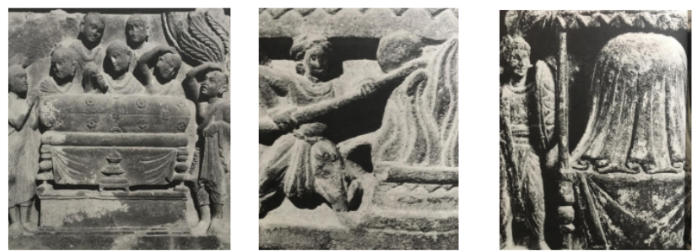
What do these reliefs show
The Buddha being place in a coffin, burnt then placed in a Stupa - treated like Chakravartin
What is Chakravartin
That the Buddha’s body should be treated like a king cremated and buried
Tell me about the War of the Relics
The mallas came to worship the relics, out of pride an devotion they didnt want to part with them they started to fight each other - the Brahmin Drona made a speech asking to stop and follow the path of the buddha
What was the result of the war of the relics
The ashes where split into 7 parts for each of the Mallas - they were placed in 7 Stupas

Tell me about this relief
The 7 Mallas or kings sharing out the 7 pieces of the buddhas ashes
Tell me about the piprahwa
Had 3 phases - 1. original division of the relics 2. reopening and enlarging phase under Asoka 3. possibly Kushan phase
who was Chandragupta
The king of the Magadha after defeating the previous king, ally to seleucos (after alexander) they signed a treaty giving indian territories to Chandragupta - married one of his daughters
Who was Bindusara
The son of Chandragupta who took the throne after he abdicated and became a monk
When and how did Ashoka come to the throne
Killed his brother who was the crown prince after being sent to quell a rebellion 268-260BCE
What is the Ashakavadona
A Sanskrit text that tells the story of Ashoka
Why is Ashoka important
In the 18th year of his reign converted to buddhism - he has written many edicts
What is interesting about Ashokas ideas for behavior
It is a code of behaviour that is based on buddhism - it is called the Ashoka Darma
What languages was Asokas edicts
Greek, Aramaic, Prakrit (written in Brahmi and Kharosthi)
What are Brahmi and Karosthi
Forms of Prakrit writing: Brahmi (left to right used in most of india) Karosthi (derived from aramaic written right to left used in northwestern part bc near greece)
What are the 3 types of Edicts
MRE - Major rock inscriptions (2 further inscriptions)
MRI - Minor rock inscriptions (4 individual inscriptions)
PE - Pillar Edicts ( 4 MRI are added)
What languages was the first edict written in
Greek and Aramaic - found in afgansitan
What are each of the Edicts used for
MRE - Usually at gates - meant to be read
MRI - caves - places of gathering, connected to ritual activities
PE - all located in the north and north eastern - core of the buddhist religion - on Pillars
What is important about the 13th rock edict
he recounts historical events - Bold there is a reference to the 2 religious groups the sramanas and the brahman - both are worthy of respect - there is no country where these do not exist except for the greeks (ionians/ Yona)
makes reference to his norms of behaviour
send people out on missions to spread buddhism
enscribed 5times
What are Mahamatras
Officers of the Darma

Tell me about this
This is the Kandahar - Talks about the expectations of the king and of good behaviour - bilingual the top is greek the bottom is arimatic
What is important about Minor rock edict no. 1
It is the most ancient and is the first time he makes a reference to the buddhist religiojn
What does Asoka tell us
Most royal edicts (RE or MRE) refer to the administration and dissemination of Dharma (a civil moral law)
Most royal edicts (RE or MRE) refer to the administration of Dharma through a set of principles that could be regognised by most if not all religious communitites of the time
Brahmans and Sramanas are the 2 caterogies regonised and they are both worthy of gifts
The professions of faith by Asoka are not in the group of royal edits instead they are in a small series of short personal inscriptions located in the northern area of india
What are the basic tenants of Ashokas Darma
Dont kill men or animals (nonviolence)
Truthfulness
Generosity to friends and all religious groups (Sramanas and Brahmanas)
proper regard to slaves
Obedience to mother father and elders
A modest life
What is important about asokas dharma
Fostering a sense of unity and moral code that while takes the ideas presented in the buddhist religion is accepted by most if not all religious groups
What is the difference between Asokas dharma and the Buddhist one
Ashokas while taking inspo from the buddhist religon is supposed to be applicable to most if not all religions