Neurotransmitters
 Call Kai
 Learn
Learn Practice Test
 Spaced Repetition
 Match
Match Flashcards
 Knowt Play
1/15

There's no tags or description
Looks like no tags are added yet.
Name | Mastery | Learn | Test | Matching | Spaced | Call with Kai | Chat |
|---|
No analytics yet
Send a link to your students to track their progress
16 Terms
Levels of Organization of Nervous System
• Cell: individual neurons
• Tissue: nerves, ganglia
• Organ: brain and spinal cord
• System: nervous system
Soma or cell body
The cell body of a neuron, which contains the nucleus
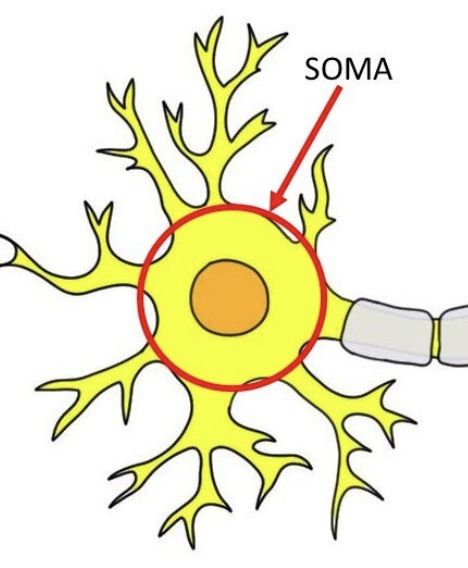
Dendrite
The branched, treelike extensions attached to the soma of a neuron;
receives information from neurotransmitters released from terminal button
of other neurons

Axon
The extension of a neuron, ending in branching terminal fibers, through
which messages are sent to other neurons or to muscles or glands

Terminal Button
The bud at the end of a branch of an axon; forms synapses with other
neurons; sends information to those neurons via neurotransmitters

Neurotransmitter
A chemical that is released by a terminal button; has an excitatory or
inhibitory effect on other neurons

Myelin Sheath
A layer of fatty cells segmentally encasing the fibers of many neurons; prevents messages from sending to adjacent neurons
Resting membrane potential
occurs because various ions are located in different concentrations in fluid inside and
outside the cell(-70mV)
Action Potential
the brief electrical impulse that provides the basis for conduction of information along an axon
Sodium Channels open, Na+ rushes in
Because of balance change, sodium chanells close
Potassium Gates opes, K+ moves outside

Synapse
Junction between terminal button of one neuron and membrane – usually the somatic or dendritic membrane – of another
Communication across synaptic gap
When an action potential reaches a terminal button, the vesicles fuse with the presynaptic membrane of the terminal button, break open, and release their neurotransmitter into the synaptic cleft
Neurotransmitter communication
Travel across the synaptic gap, bind to receptor sites to influence the impulse that will be generated
Either excitatory or inhibitory effect
Ligands that bind to the postsynaptic membrane at binding sites can be
A chemical naturally produced by the body like a neurotransmitter or
A chemical from the outside like a medication or a poison
Reuptake
transporters located in the pre-synaptic membrane transport the molecules of neurotransmitter back into the cytoplasm – most common method
Enzymatic deactivation
destruction of a neurotransmitter by an enzyme after its release
Neurogenesis
Production of new neurons
Adult brain has stem cells that can divide and produce new neurons