(13) H1 Antagonists
 Call Kai
 Learn
Learn Practice Test
 Spaced Repetition
 Match
Match Flashcards
 Knowt Play
1/28

There's no tags or description
Looks like no tags are added yet.
Name | Mastery | Learn | Test | Matching | Spaced | Call with Kai | Chat |
|---|
No analytics yet
Send a link to your students to track their progress
29 Terms
Where the aromatic rings bind?
Ring | Why an aromatic ring is needed | |
|---|---|---|
Cis (same side as the amine) | TRP/W158 | Big-Makes van der Waals interactions. |
Trans (opposite side) | PHE432 | Small-Fits the pocket’s flat shape. |
Where the aromatic rings bind? - draw it
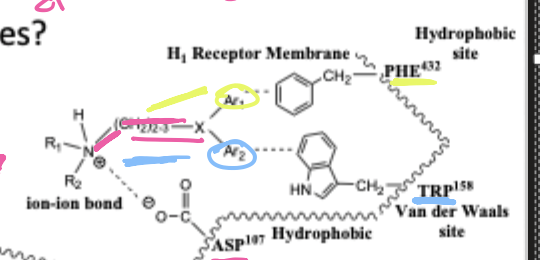
What role does the substituent on the aromatic ring play here?”
A substituent such as para-Cl makes a ring bulkier.
That ring must enter the larger TRP pocket; the smaller PHE pocket cannot fit it.
What are effects of adding para-Cl to the drug’s structure?
Longer action: It blocks a para position where the drug could be broken down.
Cl → less breakdown + better access to the receptor.
Greater potency: It is lipophilic, helping more drug reach H₁ receptors in the cell membrane.
What antihistamines are non-sedative?
Zwitterions
Fexofenadine (Allegra)
Cetirizine (Zyrtec)
Zwitterions
topics
structure
sedation
how they bind to H₁
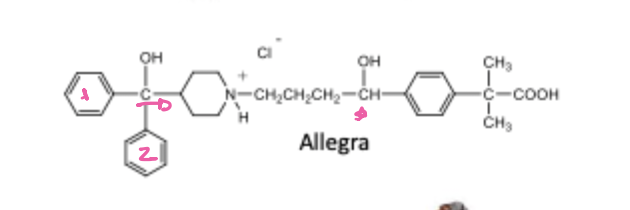
What makes Fexofenadine and Cetirizine a Zwitterion? (aka structure)
each has a positive amine and a negative carboxylate.
Look for the carboxylic acid tail to recognize them.
What makes Fexofenadine and Cetirizine a Zwitterion? - draw it

Tell me about fexofenadine and cetirizine sedation?
fexofenadine and cetirizine cause little sedation. reason:
They act mainly outside the CNS because they have:
Strong plasma protein binding
Little active transport into the CNS
P-gp efflux, which pumps them out if they enter
Tell me about fexofenadine and cetirizine binding to H₁
They bind to H₁ strongly:
Amine binds ASP + aromatic rings enter their pockets + carboxylate binds LYS
That second ion–ion bond with LYS makes binding very strong.
The professor called it pseudoirreversible: the drug does not come off the receptor easily.
fexofenadine and cetirizine binding to H₁ - draw it

Antihistamine drugs overview
Non-Sedative/Zwitterionic
Fexofenadine (Allegra)
Cetirizine (Zyrtec)
Aminoalkyl Ethers (Structural Class)
Diphenhydramine (Benadryl)
Carbinoxamine
Analogs
Doxylamine and clemastine
Alkylamines (Structural Class)
Chlorpheniramine
Brompheniramine
Fexofenadine - zwitterionic
Non-tertiary amine
Loratadine (Claritin)
Desloratadine (Clarinex)
Azelastine (NEXT FC)
Triprolidine (NEXT FC)
Dippy’s CAR drove DOXY and CLEM to bed
CHLOR and BROM follow FEXO. LORA and DES take AZ TRIP
Aminoalkyl ethers
Main Point
Among the most sedating;
Small groups on the amine also favor sedation and CNS entry.
Aminoalkyl ethers drugs
Drugs
Drug | Main points |
|---|---|
Diphenhydramine (Benadryl) |
|
Carbinoxamine |
|
Carbinoxamine Analogs: Doxylamine and clemastine |
|
Diphenhydramine (Benadryl) - draw

Carbinoxamine - draw

Doxylamine - draw

Clemastine - draw

Alkylamines
Main Points
Among the most potent first generation agents
less sedation.
Alkylamines
Drugs
Drug | Main points |
|---|---|
Chlorpheniramine |
|
Brompheniramine |
|
Fexofenadine |
|
Additional Drugs
Non-tertiary amine
Loratadine (Claritin)
Desloratadine (Clarinex)
Azelastine (NEXT FC)
Triprolidine (NEXT FC)
Chlorpheniramine - draw

Brompheniramine - draw
Chlorpheniramine with Br instead of Cl.
Fexofenadine - draw
Non-tertiary amine
Main Point
Both drugs have two linked aromatic rings
Their chlorinated ring enters TRP.
Loratadine → desloratadine
Non-tertiary amine
Drugs
Drug | Nitrogen | Result |
|---|---|---|
Loratadine (Claritin) |
|
|
Desloratadine (Clarinex) |
|
|
Loratadine (Claritin) - draw

Desloratadine (Clarinex) - draw

Describe Conversion:
Loratadine → desloratadine
Loratadine →
(CYP 3A4 metabolism)→
unstable hemiacetal →
unstable carbamic acid →
(CO₂ leaves) →
desloratadine
Draw Conversion:
Loratadine → desloratadine
