L11: Respiratory II
 Call Kai
 Learn
Learn Practice Test
 Spaced Repetition
 Match
Match Flashcards
 Knowt Play
1/18

There's no tags or description
Looks like no tags are added yet.
Name | Mastery | Learn | Test | Matching | Spaced | Call with Kai | Chat |
|---|
No analytics yet
Send a link to your students to track their progress
19 Terms
Properties of gases
Gas molecules constantly moving (collide) = exert pressure on the container
Total pressure: determined by the total number of gas molecule per volume unit
Partial pressure of gases: in a mixture = total pressure x % of that gas
Independent of other gases present in the mixture

Air (dry) P =
PN2 + PO2 + PCO2 = 760 mm Hg
Is the air in lungs dry?
NOT dry
Inspired air is 100% saturated with water when it reaches the respiratory zone
Some of the gas molecules colliding with water dissolve in water (slightly different than for dry air)
At equilibrium the relative amount of dissolved gas is..
CONSTANT
Depends of the solubility of the gas
Partial pressure of the gas
Presence of water ___ gas content
DILUTES
At 37 C, water vapor pressure is 47 mm Hg
PO2 = (0.21 x 760)-(0.21x47) = 150 mm Hg
PO2 = (amount present in dry air) – (amount dissolved in water)
Gas exchange is done by
Diffusion- passive movement of gas molecules from regions of high concentration (partial pressure) to regions of low concentration (partial pressure)
Air velocity in the alveoli
In alveoli the air velocity = 0 (due to large cross-sectional area)
Movement from alveoli to alveolar-capillary membrane by diffusion only
Factors affecting diffusion of gases in the alveoli
At constant atmospheric partial pressures diffusion of gases will depend on the alveolar and blood partial pressures:
Depends on ventilation for alveoli (how much air replaced in the alveoli)
Depends on the tissue consumption for blood
At higher altitude pO2 in atmosphere ↓; significant impact on diffusion
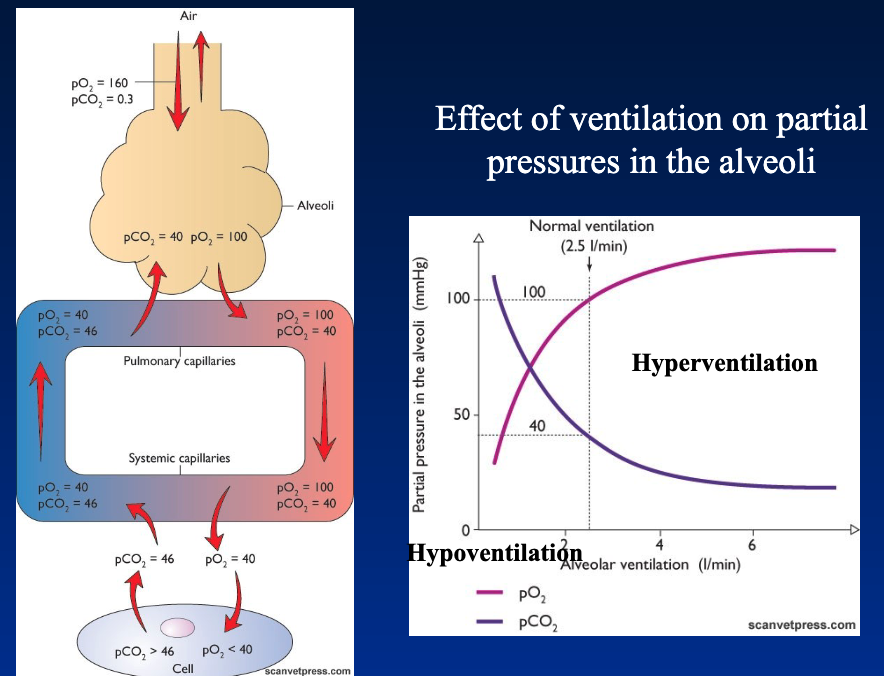
Atmospheric pCO2 affect on alveoli
pCO2 in atmosphere is way lower than in alveoli and blood
changes in atmospheric pressure does not impact CO2 diffusion dramatically (except in enclosed spaced)
How does gas exchange occur in the lungs
Gas exchange occurs between alveoli and blood capillary network
Blood from right ventricle flows in capillaries; lungs also have some capillaries from the left side of the heart to bring oxygen to lung tissue
Blood entering alveolar capillaries has low pO2
O2 diffuses from alveoli to the blood
At the end of capillary, pO2 is the same in blood and alveoli
For CO2: pCO2 higher in blood entering capillary then diffuses out toward alveoli
Main determinants affecting gas exchange in the lungs
Driving partial pressure gradient
PalveoO2 – PcapO2
Surface area available for diffusion (A)
Increased area = more exchange
Capillaries can open during exercises to increase exchange
Thickness of the air-blood barrier (X)
Deep inspiration during exercises reduces the distance
between alveoli and capillary epitheliums
Physical properties of the gas (D)
VO2 = D x A x (PAO2 – PcapO2)/X
Perfusion and its requirements
Perfusion correspond to the blood entering the lung
Need to match ventilation with the blood flow for optimum gas exchange
Perfusion for bipeds (humans) and quadrupeds
For bipeds (human) at rest: not optimum
Gravity = perfusion (blood flow) lowest at the top of the lung (capillaries can collapse)
Not so pronounced for ventilation
Not so bad for quadrupeds
V/Q
term used for ventilation/perfusion (0.8 in humans)
becomes more uniform during exercise (more blood pump throughout the lung)
V/Q inequality
Certain diseases can affect either the ventilation or perfusion of certain alveol
Natural mechanism to minimize the impact of V/Q inequality
Hypoxic vasoconstriction
closing of the poorly ventilated alveoli
redirecting blood towards the well ventilated
How is Hypoxic vasoconstriction initiated
Mechanism initiated by a reduction of pO2 and/or increase in pCO2 in the interstitial fluid of affected areas
How can impaired pulmonary gas exchange occur
Thickening of alveolar-capillary membrane
Increases the time for diffusion across the membrane and decreases rate of diffusion
High altitude or low air pO2
Decrease alveolar oxygen pressure, hence decrease driving pressure
Hypoventilation
Inadequate ventilation of lung
Ventilation-perfusion inequality
Ventilated alveoli with no blood supply or vice versa
How does gas exchange in tissues occur
Follows the same principle as in the alveoli
Diffusion driven by difference in partial pressure
Cells consume O2 and produce CO2
Blood from the left heart loaded with O2
Diffusion of O2 will occur from blood to interstitial fluid to the cells
Diffusion of CO2 will occur from the cell to the interstitial fluid to the blood