NEUR30080 L18/L3 NOS ER functions in CNS
 Call Kai
 Learn
 Practice Test
 Spaced Repetition
 Match
 Flashcards
 Knowt Play
1/16

There's no tags or description
Looks like no tags are added yet.
17 Terms
rough ER (RER)
flat sheet-like structure
ribosome studded
localised largely in the cell body
FUNCTIONS:
protein syn
protein quality control
protein transport
smooth ER (SER)
highly curved tubules
ribosomes free
extends to the periphery of the cell
FUNCTIONS:
calcium homeostasis
lipid biosynthesis
mitochondrial organisation
cytoplasm compartmentilisation
cytoplasm compartmentalised into memb bound organelles allowing specialised functions within, or on the memb surfaces
ER = continuous membrane system
endoplasmic reticulum (ER)
continuous membrane system, including:
nuclear envelope
ribosome-studded ER sheets
interconnected network of smooth tubules extending throughout the cell
a bilayer (like lipids)
ER image
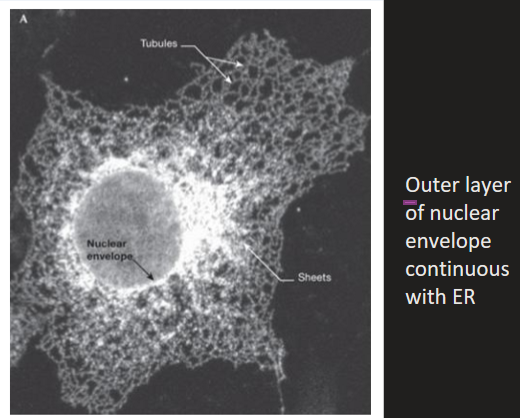
compartmental specialisation within the ER network
ER is dynamic with tubules continuously moving, changing shape and fusing with other tubules
observation of fluorescently labelled ER in living cells reveals that most ER movement is driven by sliding of ER tubules by kinesin and/or dynein along microtubules from the cell body to the periphery
ER-shaping proteins regulate ER organisation
much of the morphological variation exhibited by ER domains is the result of differences in the curvature of the membranes
lipid bilayers (found in ER and plasma memb) tend to remain rel. flat because generating curvature requires energy
therefore, ER-shaping proteins exist to generate and stabilise membrane curvature
families of ER-shaping proteins that are currently known
all posses reticulon homology domains (RHDs)
localise to the outer leaflet of the ER bilayer via the RHD
oligomers of these proteins increases the curvature of the ER
mutations in any ER-shaping protein causes neurodegenerative disease
image of known ER-shaping protein families
if you have a mutation of ANY of these, you will get motor neurone disease

ER-shaping proteins are required for tubular ER formation
SER tubules extend the length of neuronal axons
microtubules are pointed to in bottom right (regular size)
ER are irregular size

hereditary spastic paraplegias (HSPs)
progressive retrograde degeneration of long upper motor neurons with the spinal cord, resulting in progressive spasticity and weakness of the lower limbs
late devel, 20-30 yrs old
no treatment to reverse, stop or slow the disability
over 80 causative genetic loci (SPGs)
disease mechanism poorly understood
umbrella term for many diseases
most neurons are actually fine, it is specifically the longest upper motor neurons affected
mutations genes encoding ER-shaping proteins are leading cause of HSP

how to loss of ER-shaping prots give rise to axonopathy?
we have SER functioning in every cell in our body, so how are mutations in these proteins causing ND in such a specific neuron group?
drosophila allows the study of individual neurons similar to human

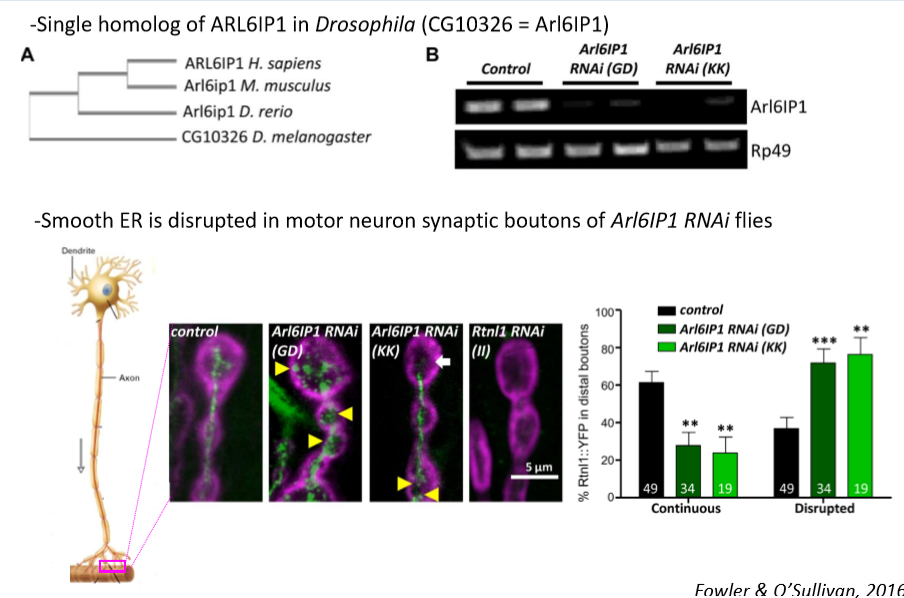
studying HSP-causing ER-shaping proteins in Drosophila
knockdown of the gene
still see green but more disrupted
knocking down the gene had ER phenotype
knockdown flies have progressing climbing deficit
flies with knockdown gene show progressive issues with motor neuron function
SER has active role in neuronal calcium signalling
Ca used to regulate cellular functions
entry of Ca from outside the neuron is regulated by voltage-operate channels (VOCs) or by receptor-operated channels (ROCs) controlled by the ionotropic NTs
the ER is Ca sink and activation of 1,4,5-triphosphate (InsP3) receptors ± ryanodine receptor (RYR) causes the release of Ca from this internal store
……………..!!!!!!!!!!!!!!!!!!