Brig Physiology Final
 Call Kai
 Learn
 Practice Test
 Spaced Repetition
 Match
 Flashcards
 Knowt Play
1/393

There's no tags or description
Looks like no tags are added yet.
394 Terms
What is physiology
study of how organisms work using a metric to measure success
extracellular fluid
33%
26% interstitial fluid
7% plasma
intracellular fluid
67%
Who is considered the 'Father of Modern Physiology' for his work on the mechanisms involved in maintenance of a constant internal environment?
Water Cannon
Claude Bernard
first to recognize homeostasis as 'milieu interieur'
Cannon's 3 aspects of homeostatic mechanisms
All homeostatic mechanisms must have 3 components:
1. sensors
2. integration center
3. effectors
Negative feedback
Something takes body away from homeostasis
-nerves send afferents to brain
-brain makes solution
-efferents act on organs
examples of negative feedback
body temperature
glucose
positive feedback
stimulus occurs and brain takes body further from homeostasis
stops when stimulus is removed
child birth
fluid-mosaic model of cell wall
Fluid: cell wall is not rigid, has motion and composition always is changing based on lipids, proteins, etc.
Mosaic: cell wall made of many different molecule types; is heterogenous
phospholipid heads
polar
hydrophilic
phospholipid tails
nonpolar
hydrophobic
because phospholipids have polar and non-polar parts they are:
amphipathic
saturated fatty acids
no 2x bonds
tightly packed with high membrane rigidity
unsaturated fatty acids
2x bonds
bent = looser packing = more fluid membranes
what is membrane fluidity
how well phospholipids move in a membrane.
unsaturated fatty acids are more fluid than saturated
what is homeoviscous adaptation
maintenance of constant level of membrane fluidity
-changes compensate for temperature or saturation
diffusion
passive movement of a solute down its concentration gradient
-no ATP
when does movement stop in diffusion
at equilibrium
what solutes use diffusion
small, lipid soluble like oxygen, CO2, and steroids
diffusion via ion channels
NO CLASSIFICATION
-passive, but moves through open ion channel
-no ATP, moves w/ gradient
-can be ligand-gated
example of ion channel diffusion
ACH binds to open Na channels in neurons allowing Na to enter
facilitated diffusion
moves with the concentration gradient but requires solute binding to protein
-has a threshold consistent with the number of ion channels
active transport
Can go against the concentration gradient but requires ATP
-solute must bind transport protein
example of active transport
Na/K pump
3 Na to already high ECF
2 K to already high ICF
Secondary active transport
Hitch hiking
-against the concentration gradient w/o direct ATP use
-cotransport or countertransport
endocytosis
phagocytosis
-ligand binds membrane receptor
-membrane folds in to form pocket around molecule
-pinched off with molecule inside making it intracellular vesicle
exocytosis
intracellular vesicles around a molecule fuse w/ membrane to release contents into extracellular space
exocytosis example
Nerve cells
-AP depolarizes terminal
-voltage-gated Ca channels open, Ca enters cell
-Ca entry triggers exocytosis
-NT released into synaptic cleft and binds receptors
intracellular vs extracellular Na
extracellular: 140
intracellular: 12
intracellular vs. extracellular K
extracellular: 5
intracellular: 150
intracellular vs. extracellular Ca
extracellular: 1
intracellular: 0.0001
intracellular vs. extracellular Cl
extracellular: 100
intracellular: 7
intracellular vs. extracellular HCO3-
extracellular: 24
intracellular: 10
water-soluble messengers
must interact with cell surface receptors, will not pass freely
are water or lipid soluble messengers more common?
water
integrin
protein with a direct link to cells cytoskeleton
GPCR
linked to G-protein to help alter enzyme activity
receptor enzyme
activates intracellular enzyme
lipid-soluble messengers
slow (mins-hrs)
-must bind a carrier protein
-moves easily thru cell wall
what is the role of lipid-soluble messengers in cells?
function as transcription factor to regulate gene expression
-steroid hormones like testosterone and cortisol
first messenger
OG extracellular signal
-binds receptor
second messenger
relays signal from plasma membrane to biochemical activity
Protein kinase
enzyme that transfers phosphate to another molecules
-activates response by adding phosphate
Phosphatase
enzyme removes Pi from molecule to terminate action
G-proteins
membrane proteins that couple membrane receptors to ion channels or enzymes
steps of G-protein action
1. binding of 1st messenger increases GTP affinity
2. alpha subunit dissociates and links w/ membrane protein
3. alpha activates effector protein
4. cleaves GTP -> GDP+P and recombines w/ beta and gamma to turn off pathway
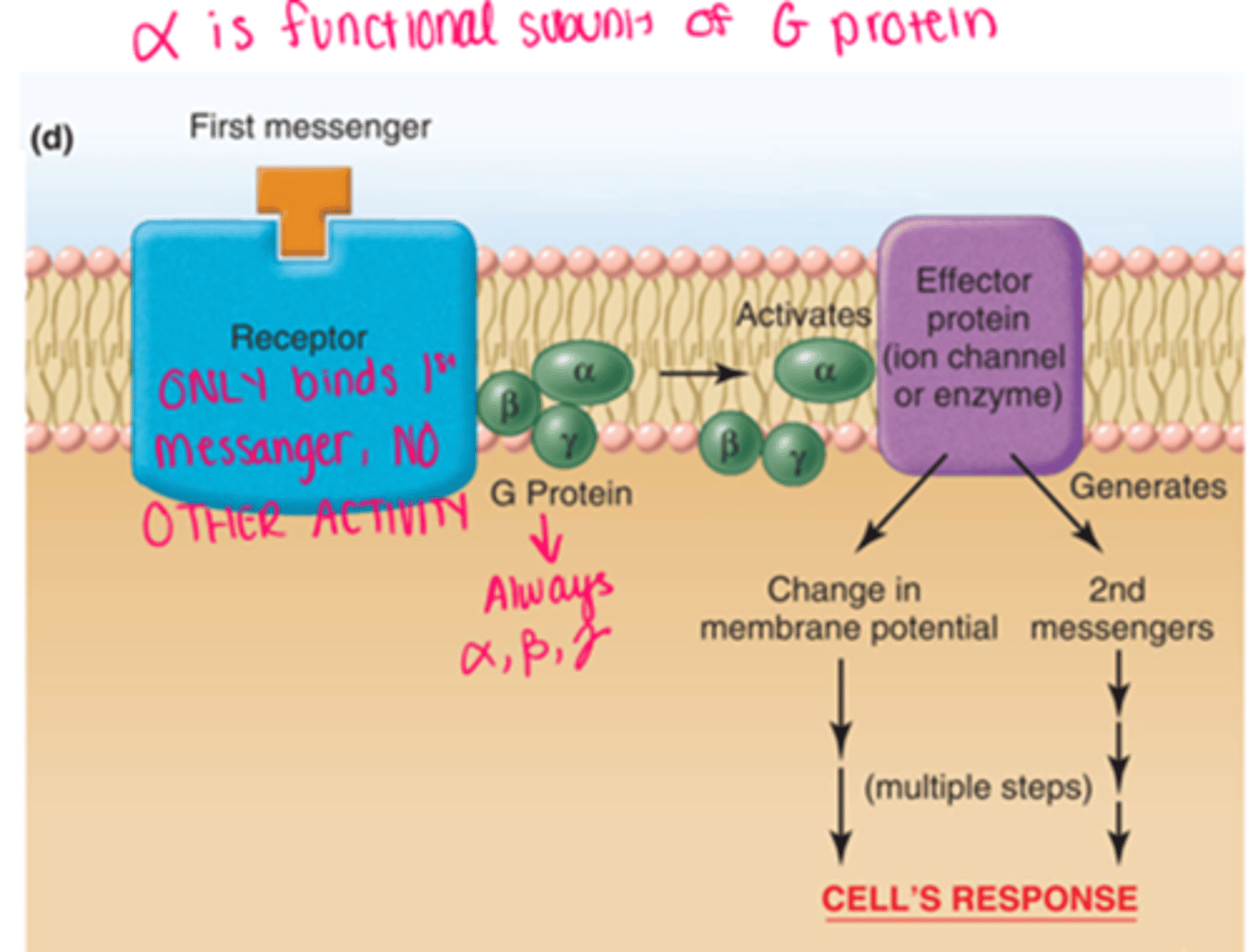
what pathway involves adenylyl cyclase?
cAMP
steps of adenylyl cyclase-cAMP pathway
1. G-protein process activates adenylyl cyclase
2. adenylyl cyclase converts ATP to cAMP
3. cAMP activates protein kinase A
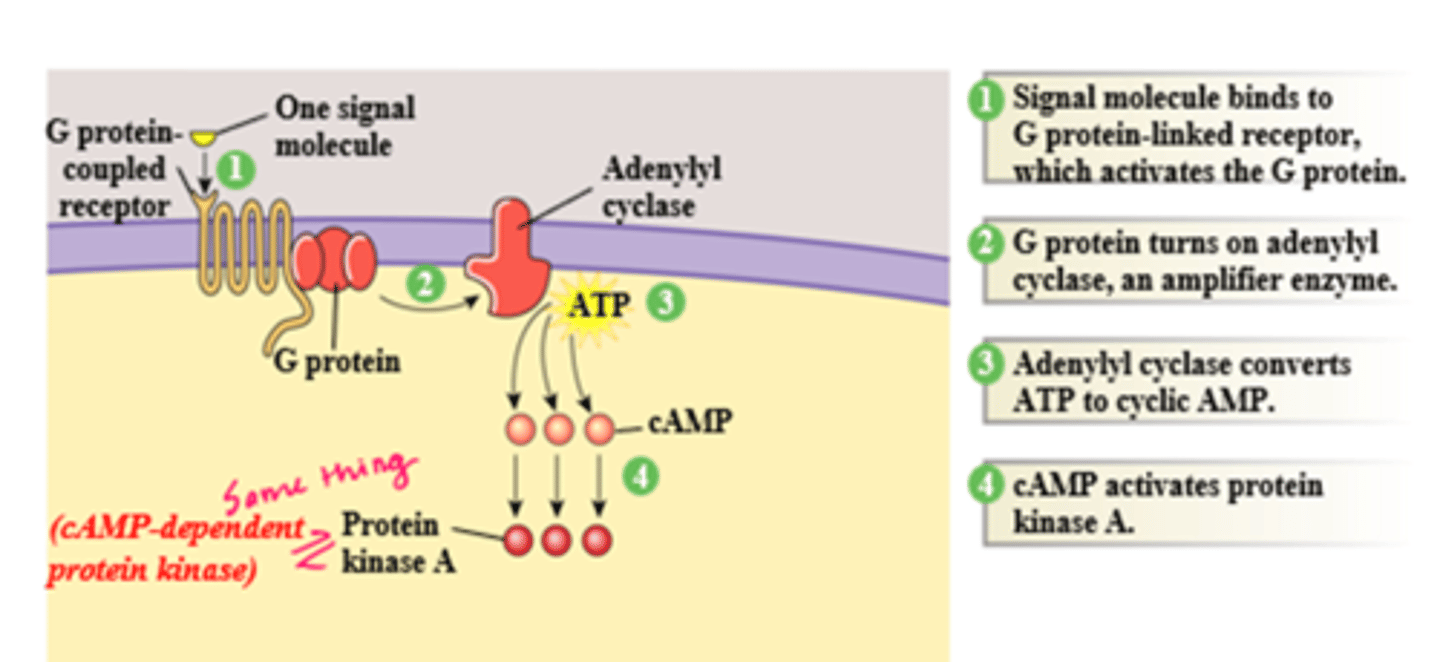
second messenger in adenylyl cyclase-pathways
cAMP
phosphodiesterase in adenylyl-cyclase pathway
inactivates cAMP by breaking it down to AMP
phospholipase C pathway products
PL-C will make either DAG or IP3
IP3 = Ca release
DAG = PK-C = phosphorylated protein
Calcium as a signaling molecule
-alteration of protein pathways (calcomodulin-dependent protein kinase)
-exocytosis (NT release)
-movement (muscle contraction)
dendrites
receive information
soma
contains major organelles
produces NT
axon hillock
trigger zone where AP is generated
Axon
propagates AP
axon terminal
released NT made by soma
schwann cells
makes myelin sheath in PNS
oligodendrocytes
makes myelin sheath in CNS
RMP
-70 mV
what is RMP
separation of charge between ICF and ECF
2 mechanisms to alter RMP
Na/K pump
Leak channels
how does Na/K pump maintain RMP
Pushes 3 positive Na out, brings 2 positive K in =
Net of -1
Helps get ICF to -70
Leak channels in maintaining RMP
Constant Na/K exchange
-leave 1 at a time, but there's 2 Na and 1 K
-1K in, 2Na out = net -1
helps get ICF to -70
graded potential channels
ligand-gated
strength with GP
can have varying strengths
-charges stronger close to stimulus
-charges weaker further from stimulus
ICF voltage to induce AP
-55 mV
IPSP
suppress cell electroactivity by hyperpolarizing the molecule
-requires stronger stimuli to cause APs
EPSP
Combine to help increase chances of reaching threshold (-55 mV)
ion channel type of APs
voltage-gated
voltage-gated sodium channels
-at rest, closed by activation gate
-when threshold is met, activation gate opens super quick
+at the same time, inactivation gate begins to slowly close
-Na rushes into cell
-inactivation gate closes, finally stopping Na
-activation gate comes back up, inactivation gate moves away
-resting state
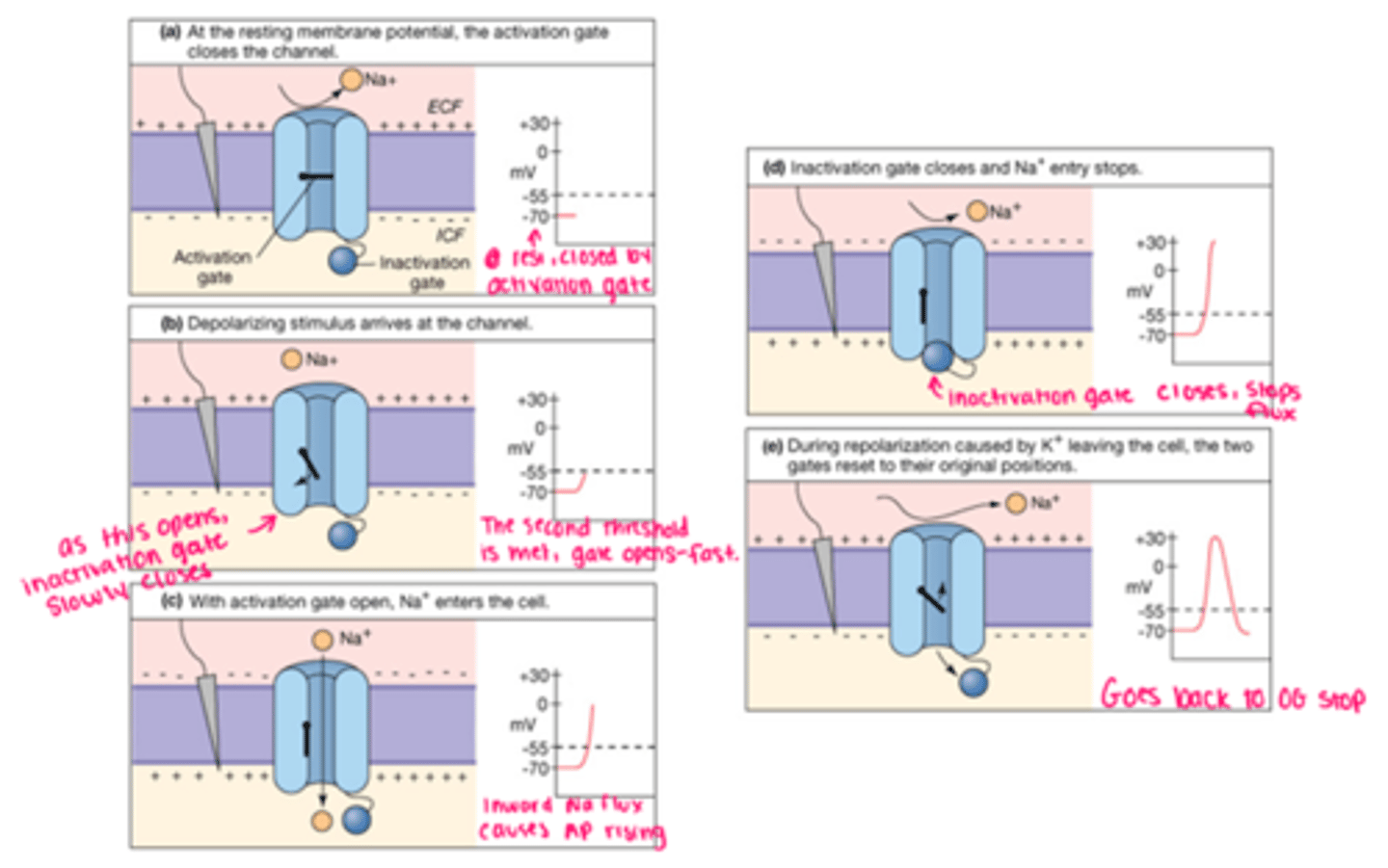
how is RMP restored?
K loss
How is AP reached?
Na gain
why does refractory period occur
K channels are slower than Na channels
-when trying to repolarize by pushing K out, they close slow causing extra negative charge
absolute refractory
No second AP can be generated b/c Na inactivation gate is closed
relative refractory
second AP can be generated, but still hyperpolarized so it needs to be a strong stimulus
saltatorial conduction
in myelinated neurons
-faster to move APs b/c they jump node-to-node rather than chunk-to-chunk which is slower in unmyelinated
electrical synapse (gap junction)
very fast
-2 neurons physically connected
-ions flow pre to post-synaptic neurons via gap junctions
+formed by connexins that connect cytoplasm of 2 cells
chemical synapse (synaptic cleft)
Mostly neural circuits, slower - is a NT release from pre-synaptic neuron
chemical synapse steps
-AP depolarizes axon terminal
-depolarization causes voltage-gated channels to open on pre-synaptic
-Ca enters pre-synaptic cell
-Exocytosis of NT contents triggered
-NT released across synaptic cleft, binds post-synaptic receptors
-NT binding initiates GP in post-synaptic cell
2 ACH receptors
nicotinic and muscarinic
Nicotine
Stimulant
Higher affinity for ACH in BBB, crosses 20-30 sec
Activates epi and norepi to heighten alertness
Activates dopamine (reward)
Activates endorphins to lower anxiety
ACH importance
Major NT at the NM junction
2 Biogenic amine categories
catecholamines (tyrosine)
serotonin (5-HT)
Catecholamines
Tyrosine
-Dopamine
-Norepinephrine
-Epinephrine
MAOs
Breakdown product of catecholamines
-MAOIs break these down to treat depression
Serotonin
Can be slowed w/ MAOIs
-SSRIs directly target serotonin uptake, making it stay in synapse longer
SSRIs
treat depression
prozac, zoloft
much more targeted than MAOIs
Amino acid NT
Glutamate: major excitatory CNS NT
GABA: major inhibitor CNS NT
Glycine: major inhibitory NT of brain and spinal cord
GABA drugs
Benzodiazepams
-bind GABA receptor
-Increase Cl flux into cells
-Allosteric modulators bind a diff. location than GABA
-Induces IPSP to make it harder to make AP
-causes sleepiness = less anxiety
-xanax, valium, ambien
Neuropeptides (proteins)
bulk of NTs
endogenous opioids like beta-endorphin, dynorphins, and substance P
Miscellaneous NT
Purines like ATP
Gases like CO and NO
Lipids like prostaglandins
Cannabinoids - receptors w/ high THC affinity
Sympathetic NT
Smooth muscle activation with ACH then norepinephrine
thoracic and lumbar regions
parasympathetic NT
only every ACH for smooth muscles
sacral and cervical regions
long-term potentiation
long-lasting enhancement of synaptic transmission following stimulation
changes on post-synaptic neurons
AMPA receptors
when theyre open, use EPSP to induce AP
NMDA receptors
blocked by Mg at rest, post-synaptic cell needs to be depolarized to 0 mV to function, then allow Ca to enter
Long term potentiation steps
-Works once Na enters cell w/ AMPA
-AMPA MUST HAPPEN FOR NDMA TO OCCUR
-Depolarization of post-synaptic cell occurs via AMPA receptors
-Mg removed from NDMA receptor
-Ca into neuron
-Phosphorylation and insertion of more AMPA receptors to membrane
-Next time Na enters cell, stronger potentiation occurs and AP is more likely
sympathetic plasticity
growth and decay of dendritic spines
-Ca flux into neurons induces gene expression and protein synthesis
=growth or decay of dendritic spines = modified synapses