LO 1 LS 1 - Identify Restorative Hand Instruments DNTL 169
 Call Kai
 Learn
 Practice Test
 Spaced Repetition
 Match
 Flashcards
 Knowt Play
1/101

There's no tags or description
Looks like no tags are added yet.
102 Terms
What are the three main components of a dental instrument?
Handle
Shank
Working End

What is the handle of an instrument?
The handle is the part of the instrument that is held in your hand and can vary in size.
What is the function of the shank?
The shank connects the working end to the handle.
What does the thickness of the shank indicate?
The thickness of the shank indicates how much pressure can be applied during use.
What is the working end of an instrument?
the portion of the instrument that performs a specific function.
Can instruments have more than one working end?
yes
Which component connects the handle to the working end?
The shank.
What are the three most commonly used examination instruments?
1. Mirror
2. Explorer
3. Cotton Pliers
What are examination instruments used for?
Examination instruments are used for:
- Dental checkups
- Specific examinations
- Evaluating restorations

What are the four uses of a mouth mirror?
Light reflection, Retraction, Indirect vision, Tissue protection
How is a mouth mirror used for light reflection?
It reflects light into areas of the mouth that are difficult to see directly.
How is a mouth mirror used for retraction?
holds soft tissues such as the cheeks, lips, and tongue out of the way.
How is a mouth mirror used for indirect vision?
allows the operator to view areas of the mouth that cannot be seen directly.
How is a mouth mirror used for tissue protection?
protects soft tissues from accidental injury during procedures.
What are the three common types of explorers?
Pig Tail Explorer
Shepherd's Hook Explorer
Orban Explorer

What is the purpose of an explorer?
An explorer is used to detect and distinguish areas of calculus and decay on tooth surfaces.
What are cotton pliers used for?
Cotton pliers are used to place and remove items in the mouth.

Why are cotton pliers used when transferring items?
help transfer items without contamination.
How many sets of cotton pliers are typically found on a restorative tray?
Two sets:
One for intraoral use
One marked for retrieval of supplies
What is a periodontal probe used to measure?
- Pocket depths of the sulcus
- Tooth widths
- Cavity preparation depths

What are cutting instruments used for?
Remove decay; modify tooth structure before restoration; remove decay without a handpiece.
What characteristic do all cutting instruments have?
They have working ends that cut.
What is another name for an excavator?
Spoon or Black Spoon.
What is an excavator used for?
Removing soft dentin, debris, and decay from the tooth.
What is the purpose of a chisel in restorative dentistry?
Form sharp lines and point angles, and create retention grooves.
What are the characteristics of a chisel?
A straight or angled shank and a single beveled cutting edge.
What is a chisel used for on the enamel margin?
Breaking down the enamel margin of the tooth preparation.
What are the four types of chisels?
Straight, Bin-angle, Wedelstaedt, and Angle-formed chisels.
Which chisel is designed for use in the posterior region of the mouth?
The Bin-angle Chisel.
Which chisel is designed for use in the anterior region of the mouth?
The Wedelstaedt Chisel.
What is a hatchet used for?
Cutting enamel and smoothing the walls and floors of tooth preparations.
What tool resembles a wood hatchet?
The dental hatchet.
What is a gingival margin trimmer (GMT)?
A modified chisel with a slightly curved blade.
Why is the blade of a gingival margin trimmer curved?
To allow easier mesial and distal access within the preparation.
What is a gingival margin trimmer used for?
Cutting enamel and placing bevels along gingival enamel margins.
Which cutting instrument is used to remove soft dentin and decay?
The excavator.
Which cutting instrument is used to create retention grooves?
The chisel.
Which cutting instrument is used to smooth the walls and floors of a preparation?
The hatchet.
Which cutting instrument is specially designed for mesial and distal access?
The gingival margin trimmer (GMT).
What are restorative instruments used for?
Placing, condensing, and carving dental materials to restore tooth anatomy and place fillings.
What factors determine the restorative instruments included on a tray setup?
Operator preference and the type of filling being placed.
What does PFI stand for?
Plastic Filling Instrument.
What does a Plastic Filling Instrument (PFI) look like?
A hockey stick.

What is a Plastic Filling Instrument (PFI) used for?
Inverting the dental dam placement.
What are composite instruments designed for?
Placing composite filling material.

What materials are composite instruments commonly made from?
Aluminum, Teflon, and gold.
Why are special composite instruments used instead of stainless steel instruments?
They prevent scratching and do not discolor composite filling material.
What may happen if stainless steel instruments are used with composite materials?
They may discolor the composite filling.
What is a ball burnisher?
A restorative instrument with a smooth working end used to smooth restorative material.

What is the function of a ball burnisher?
It smooths restorative material into the walls of the cavity preparation.
When placing amalgam, when is the ball burnisher typically used?
It is typically the second instrument used.
What is the purpose of a Hollenback carver?
Contouring restorative material and removing excess material interproximally.
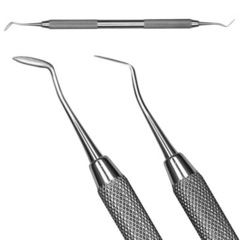
What type of restoration is the Hollenback carver commonly used to carve?
Amalgam fillings.
What is the Discoid-Cleoid Carver primarily used for?
Carving occlusal surfaces of amalgam fillings.

How many working ends does a Discoid-Cleoid Carver have?
Two different working ends.
What is the discoid end of the Discoid-Cleoid Carver?
The round, disc-shaped end.
What is the cleoid end of the Discoid-Cleoid Carver?
The eye-shaped end.
What is an amalgam carrier designed to do?
Pack freshly mixed amalgam and carry it to the prepared tooth.
What is a scaler used for during restorative procedures?
Removing floss ligatures used for a dental dam.
What else can a scaler be used for after a filling has been placed?
Removing calculus and residual bonding material.
Which instruments are commonly associated with amalgam restorations?
Ball burnisher, Hollenback carver, Discoid-Cleoid carver, and amalgam carrier.
What must be memorized when placing an amalgam restoration?
The sequence in which instruments are passed to the operator.
After the tooth has been prepared and a matrix band placed, what is the first instrument used for an amalgam restoration?
An amalgam carrier containing freshly mixed amalgam.
What instrument is passed immediately after the amalgam carrier?
The condenser.

Why is a condenser used during amalgam placement?
It pushes and condenses amalgam into the cavity preparation.
What may be passed after the first condensation if the restoration is large?
Another amalgam carrier with additional amalgam.
What instrument follows the second amalgam carrier?
The condenser again.
Once all amalgam has been placed and condensed, what instrument is passed next?
The ball burnisher.
What is the function of the ball burnisher during an amalgam restoration?
It smooths amalgam into interproximal areas and preparation walls.
Which instrument is typically passed after the ball burnisher?
The explorer.
What is the purpose of the explorer during amalgam restoration?
It removes excess amalgam from the matrix band.
Which instrument is passed after the explorer?
A carver chosen according to operator preference.
What is the function of a carver during amalgam restoration?
It carves anatomical features into the amalgam restoration.
After carving, what instrument may be requested again depending on operator preference?
The explorer.
What happens after the explorer and carving stages?
The matrix band is removed.
What instrument may be requested again after the matrix band is removed?
The carver.
What is the complete amalgam placement sequence?
Carrier → condenser → optional carrier and condenser → burnisher → explorer → carver → optional explorer → remove matrix → carver.
What are the four main instruments to remember in the amalgam sequence?
Condenser, ball burnisher, explorer, and carver.
What is the easiest way to remember the core amalgam instrument sequence?
Condenser → ball burnisher → explorer → carver.
Which instrument pushes amalgam into the preparation?
The condenser.
Which instrument smooths amalgam into interproximal areas and cavity walls?
The ball burnisher.
Which instrument removes excess amalgam from the matrix band?
The explorer.
Which instrument carves anatomy into the amalgam restoration?
The carver.
What are accessory restorative instruments?
Frequently used restorative instruments not always included on trays because of space limitations.
What is an articulating paper holder used for?
Holding articulating paper used to check a restoration's bite.
How does articulating paper help identify a high restoration?
Colored markings appear on the high spots of the filling.
What are Howe Pliers (110) used for?
Removing matrix bands and placing or removing wedges.
What is a spatula used for in restorative dentistry?
Mixing liners, bases, and cements.
What is a spatula with a lining applicator?
A double-ended instrument with a spatula on one end and lining applicator on the other.
What is an amalgam well used for?
Holding newly mixed amalgam.
What is included in dental dam armamentarium?
Frame, scissors, clamps, and forceps.
What types of scissors are commonly included in dental dam armamentarium?
Small curved- or straight-bladed scissors, often called Crown and Bridge scissors.
What is a composite applicator used for?
Placing composite filling material into a cavity preparation.
Where is composite material typically stored before placement?
In a cartridge.
Which accessory instrument holds articulating paper?
The articulating paper holder.
Which accessory instrument is used to remove matrix bands?
Howe Pliers (110).
Which accessory instrument is used to mix cements, liners, and bases?
The spatula.
Which accessory instrument holds freshly mixed amalgam?
The amalgam well.
Which accessory instrument places composite material into a preparation?
The composite applicator.
Match the accessory instrument with its function.
Holder: bite; pliers: bands and wedges; spatula: mixing; well: amalgam; dam: isolation; applicator: composite.