BS1050- transmission genetics l5/6
 Call Kai
 Learn
 Practice Test
 Spaced Repetition
 Match
 Flashcards
 Knowt Play
1/40

There's no tags or description
Looks like no tags are added yet.
Name | Mastery | Learn | Test | Matching | Spaced | Call with Kai | Chat |
|---|
No analytics yet
Send a link to your students to track their progress
41 Terms
Lecture 5- transmission genetics
What is dominance
When 2 alleles of the same gene interact and one masks the efect o the other
complimentation test
Mutations are in different genes and each gene provides what the other lacks- both genes are expressed (uses 2 genes each with 2 alleles)
(Complementation occurs when two genomes with mutations in different genes restore normal function when combined, as each provides a functional copy of the gene the other lacks.)
Recombination frequency
Counts of offspring phenotypes used to calculate RF
RF= Recombinant offspring/total offspring x 100
What a a recombinant and parental
Offspring with new allele combinations produced by crossing over during meiosis
So parental: offspring with the same combination of alleles as the parents (no new combinations)
Recombinant types are offspring with new combinations of alleles
• Formed due to crossing over during meiosis (prophase I)
• Usually less frequent (if genes are linked)
Linkage
-alleles of different loci on the same chromosome, consecrate at meiosis, do not assort independantly
RF of loci
Genes on the same chromosome tend to be inherited together → linkage
RF of less than 50% indicates linkage
Why 50%
Why 50% is the cutoff
• Genes on different chromosomes (or very far apart on the same one) assort independently
• Independent assortment produces:
• 50% parental types
• 50% recombinant types
➡️ RF = 50%
So:
• RF < 50% → genes travel together more often → linked
• RF = 50% → genes behave as unlinked
What does RF show
RF tells you how strongly two loci are linked.
• Low RF (e.g. 5%) → genes are very close together
• Higher RF (e.g. 30%) → genes are further apart
• RF approaches 50% → weak or no linkage
Crossing over is more likely between genes that are far apart
• Genes close together are rarely separated
Loci can be ordered on a genetic map based on RF
By comparing RF values between multiple gene pairs, you can work out:
• Which genes are closest
• Which are further apart
• The order of genes on the chromosome
• Smallest RF → closest genes
• Largest RF → genes furthest apart
• Middle RFs help place genes in between
One centiMorgan represents a 1% probability of recombination between two loci.
Sex linked inheritance X
X-linked inheritance
• Genes on X chromosome
• Males (XY) express recessive alleles immediately
• Females (XX) can be carriers
Classic pattern
• More males affected
• No father-to-son transmission
Sex linked inheritance Y
• Genes on Y chromosome
• Passed father → son only
• Rare, but very distinctive inheritance pattern
Mitochondrial DNA
• Mitochondrial DNA inherited from mother only (only the egg contributes mitochondria to the embryo)
Key rules
• Mothers pass it to all children
• Fathers pass it to n
Lecture 6- medical genetics
Hemizygous
means having only one copy of a gene instead of the usual two.
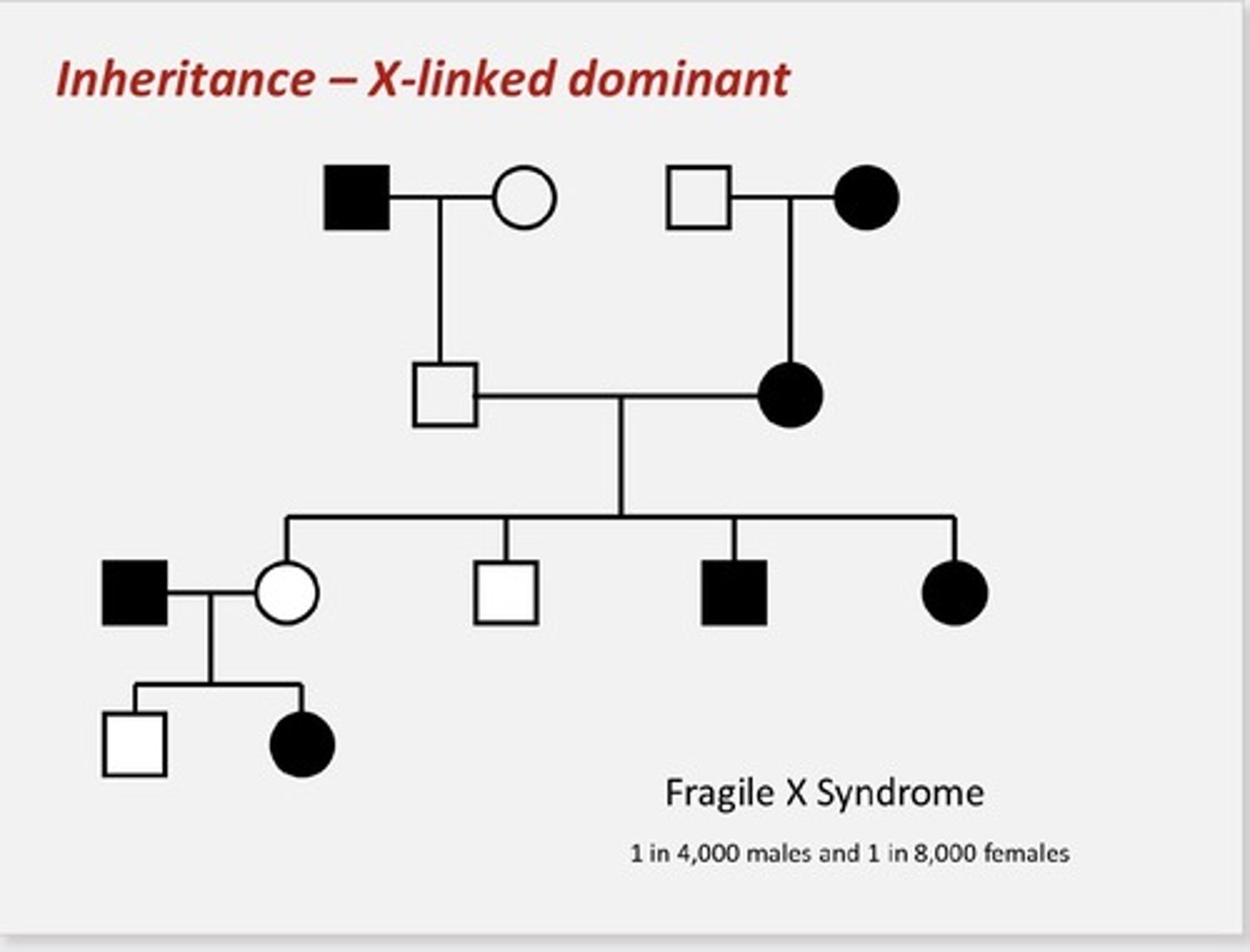
What type of things to mention when analysing a pedigree
-Hemizygous males and
heterozygous females equally
affected
• Heterozygous 'affected'
females have 50% chance of
having affected offspring
• Affected males cannot give
trait to sons, but will give it to
all their daughters
Chromosomal abnormalities - numerical
Polyploidy
Multiple of haploid number (e.g. triploidy 3n=69
Aneuploidy
Abnormal number of chromosomes (e.g. monosomy 2n-1=45
or trisomy 2n+1=47)
structural
• Unbalanced
e.g. deletion, insertion/duplication, ring chromosome
• Balanced (in many but not all cases)
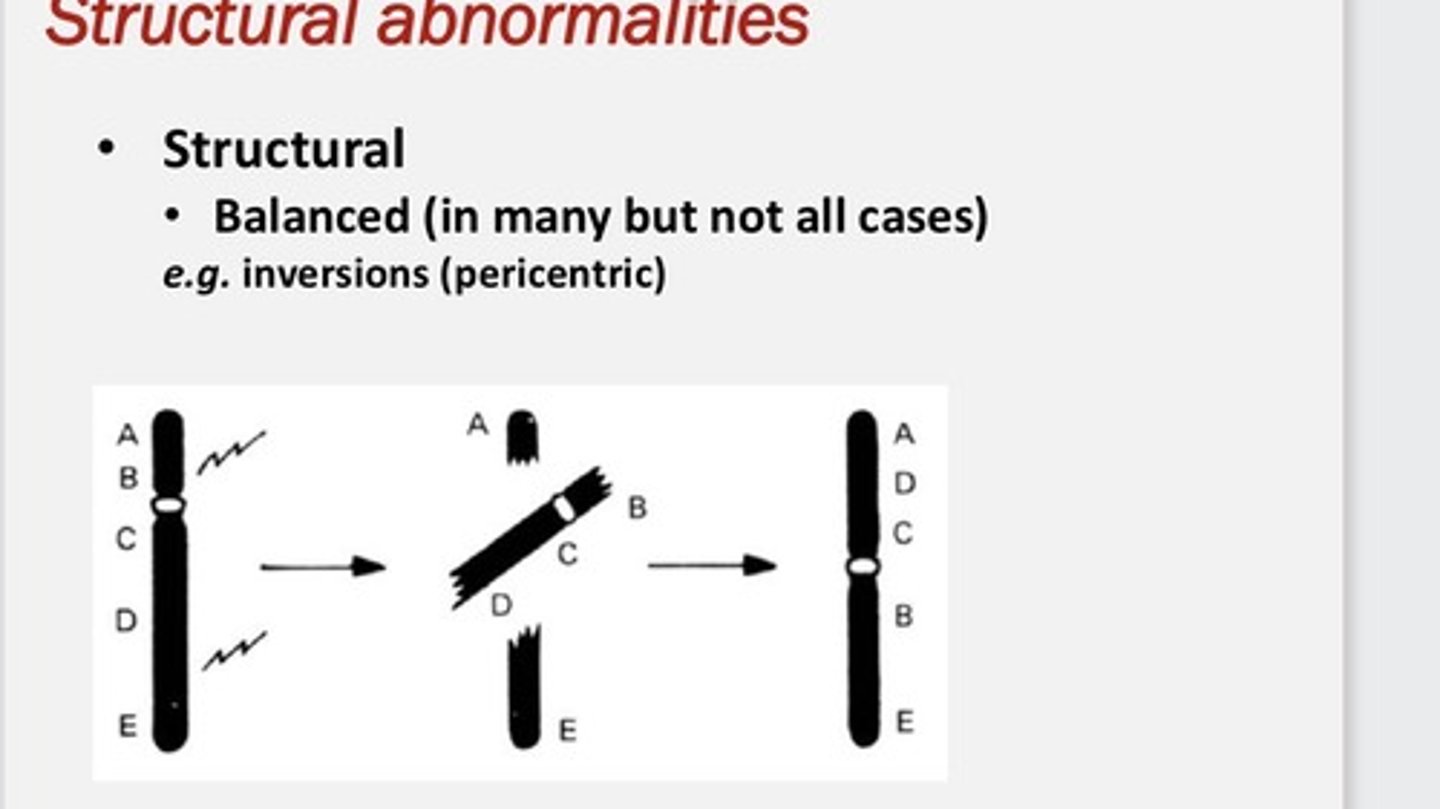
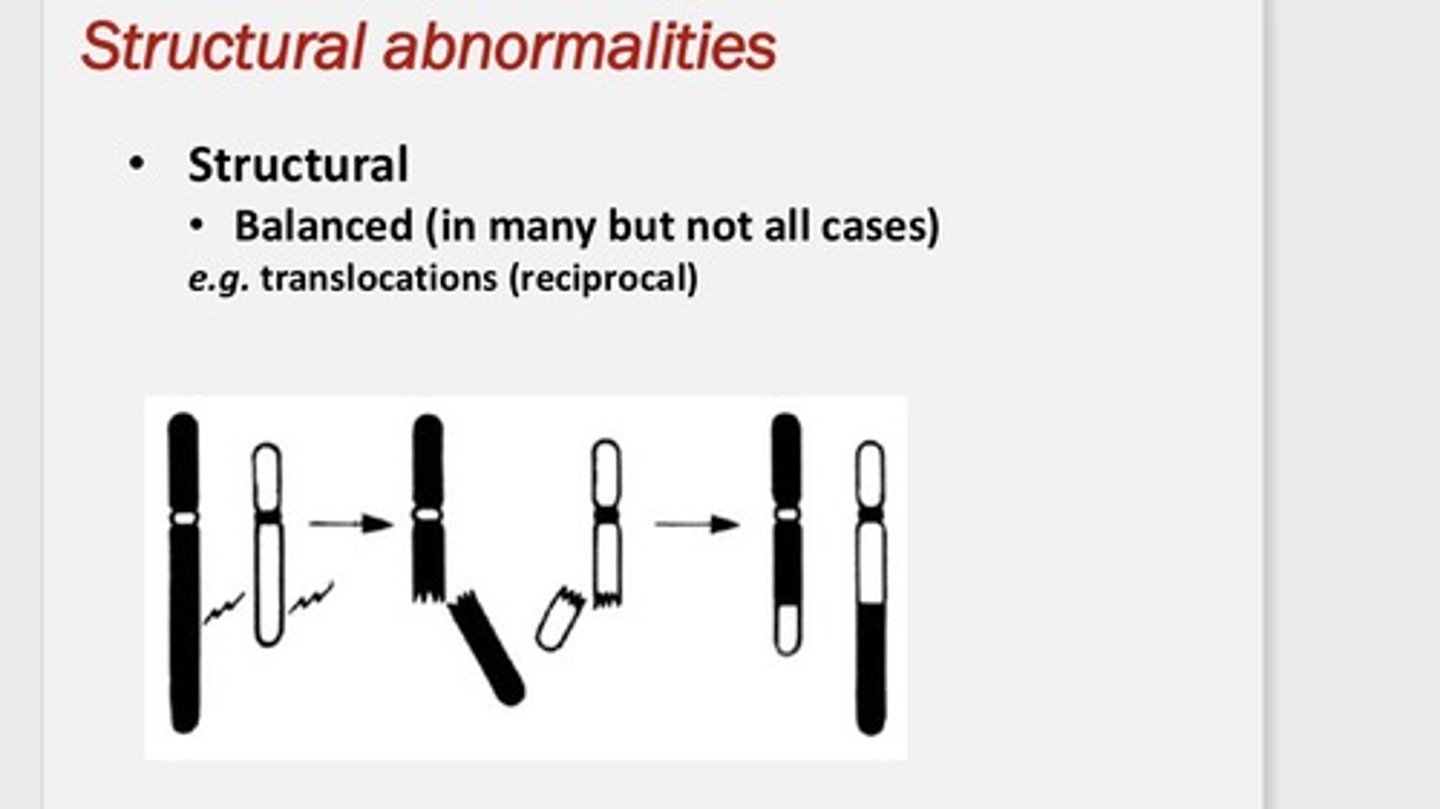
e.g. inversions (An inversion is when a section of a chromosome breaks off, flips, and reattaches in reverse order) translocations (segment of one chromosome moves to another chromosome)
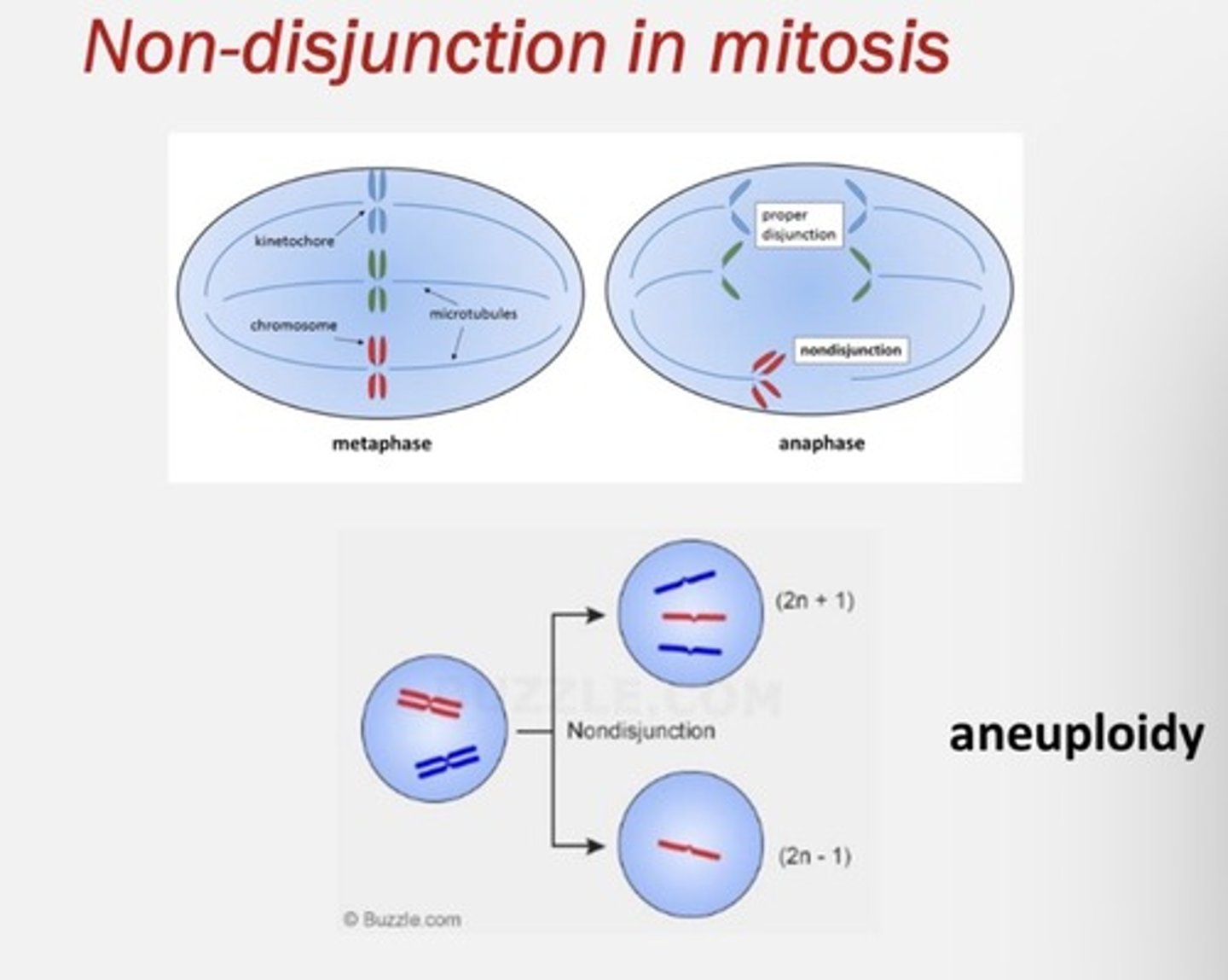
How does aneuploidy occur
The presence of extra of missing individual chromosomes due to errors in chromosome segregation
Usually caused by nondisjunction during meiosis:
• Homologous chromosomes (meiosis I) or
• Sister chromatids (meiosis II) fail to separate
Trisomy (2n + 1) → one extra chromosome
Example: Down syndrome (trisomy 21)
• Monosomy (2n − 1) → one missing chromosome
Example: Turner syndrome (45,X)
(Non disjunction means chromosomes fail to separate properly during cell division)
Difference between aneuploidy and polyploidy
How it's different from polyploidy
• Aneuploidy → gain/loss of individual chromosomes
• Polyploidy → gain of entire chromosome sets (e.g. 3n, 4n)
Rate of non-disjunction
aneuploidy = 10-30% of human fertilized eggs
• ~95% of gametic aneuploidy originates during
oogenesis (the process by which female gametes are produced in the ovaries)
• frequency of errors increases with female age
-vulnerability of chiasmata, cohesion's and segregation machinerary increase with age
Non-disjunction diagram in mitosis
Conditions from trisomy
trisomy 13 - Patau syndrome
trisomy 18 - Edwards syndrome
trisomy 21 - Down syndrome
Sex determination in mammals
SRY (Sex-determining region Y) is a sex-determining gene on the Y chromosome of mammals
This intronless gene encodes a transcription factor that is the testis determining factor (TDF). The SRY (or TDF) protein initiates male sex determination. Mutations in this gene give rise to XY females with gonadal dysgenesis (Swyer syndrome). Translocation of part of the Y chromosome containing this gene
to the X chromosome causes XX male syndrome
SRY purpose
SRY (Sex-determining Region Y) is:
• A gene located on the Y chromosome
• Intronless (no introns)
• Encodes a transcription factor called TDF
Whaat is SRY
SRY is the master switch for male development
• When expressed in the embryo:
• It activates genes that cause testis formation
• The testes then produce:
• Testosterone → male internal/external genitalia
• AMH → regression of female ducts
Female development
XY females occur because SRY is absent or non-functional.
• Individual has XY chromosomes
• SRY gene is mutated or non-functional
• No functional TDF produced
Development follows the default female pathway
• Gonads are streak gonads (gonadal dysgenesis)
XX males
• During meiosis in the father:
• The SRY gene is mistakenly moved (translocated) from Y → X chromosome
XX but one X chromosome carries SRY so still develops as a make
Chromosomal dosage
because the X chromosomes has many genes that are not present on Y (because Y is smaller and cannot carry as much) , unequal gene dosage can occur between XX female and XY male, which is corrected through X-chromosomeinactivationd
What is dosage compensation
Make sure there is an equal X-linked gene expression, between X chromosomes as females have 2 X chromosomes, there is X inactivation, so only one X chromosomes is functioning and in males there is no inactivation as there is only one X chromosome.
Key features
X inactivation is random, permanent and occurs early (in embryonic development), inactive X becomes a 'Barr body'. All cells will have that same X chromosome deactivated
Why does X need to obe balanced
Unbalanced X = unbalanced proteins = diseas
X codes for many protiens, having too much/little can cause problems. So in females one X is randomly inactivated Barr body
Barr body
A Barr body is a highly condensed inactive X chromosomes found in the nucleoli of somatic cells
Structural abnormalities
Deletion, insertion, duplication, ring chromosome, isochromosome formation check lecture 6 slides)
Ring
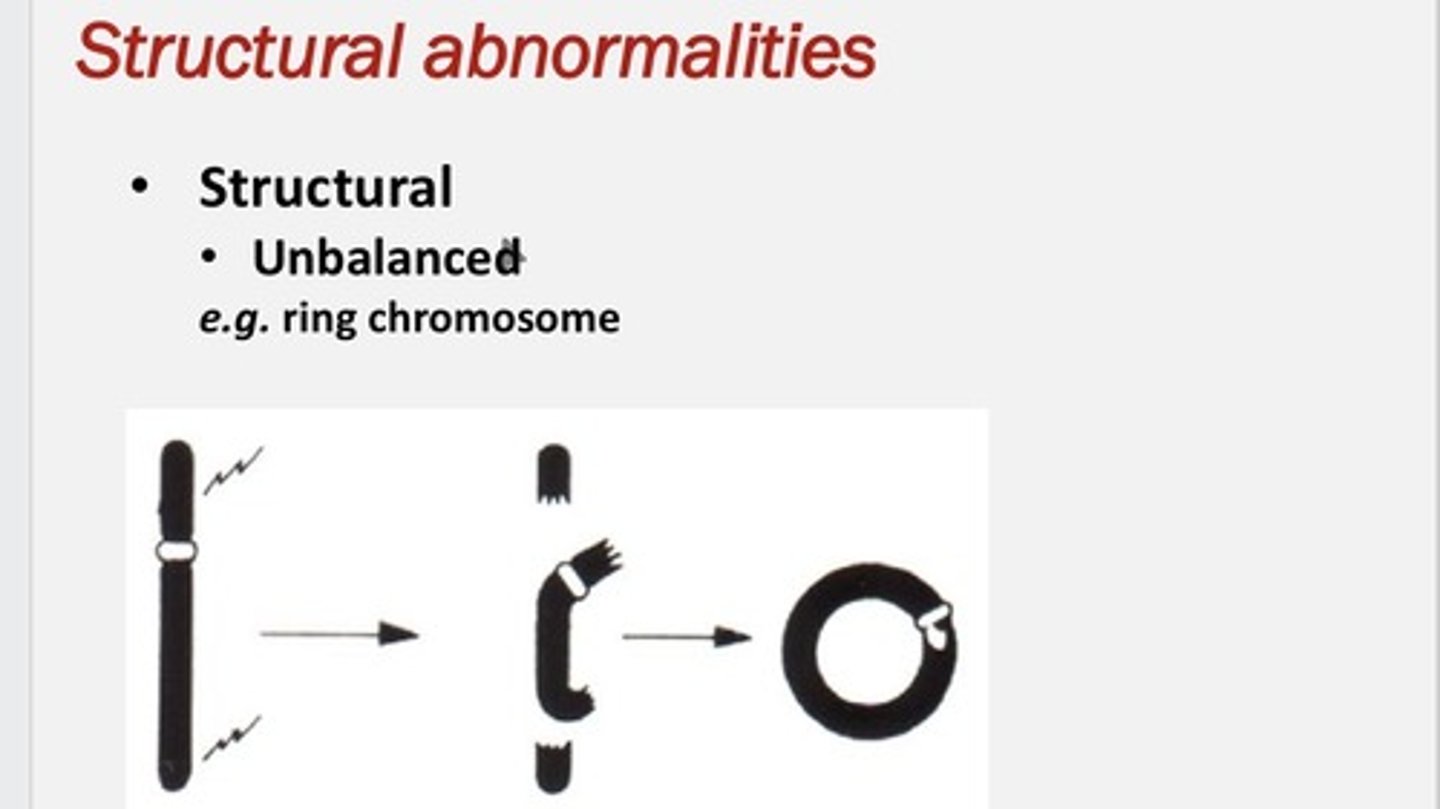
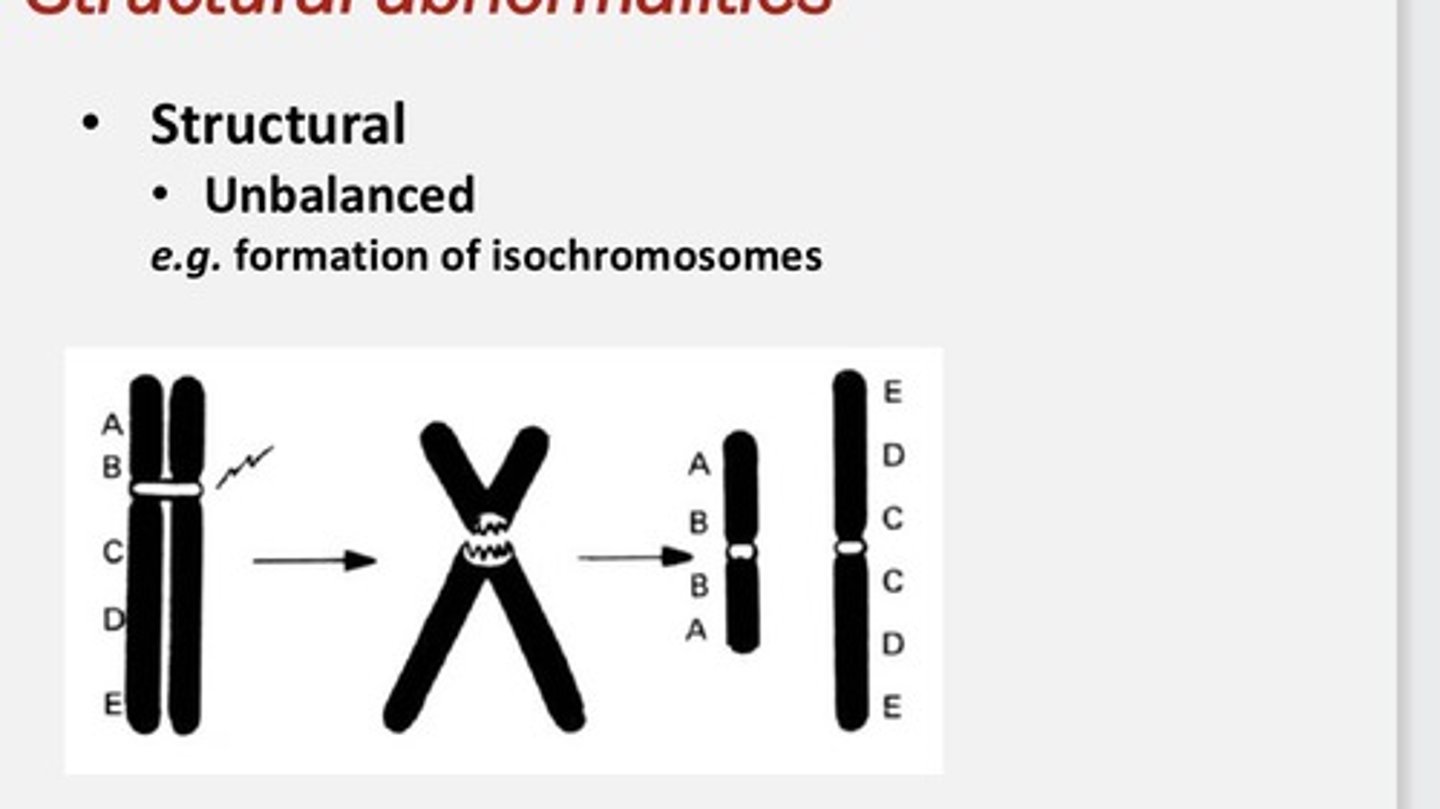
isochromosomes
The centromere divides HORIZONTALLY instead of vertically
magine splitting a book:
• One copy gets only chapters 1-5 twice
• Another gets only chapters 6-10 twice
👉 Each copy is missing half the information, even though nothing was "lost overall"
sochromosomes cause duplication of one arm and loss of the other because each resulting chromosome contains only one arm, and cells inherit only one of these abnormal chromosomes.
Inversions
Translocation
Two chromosomes swap segments, chromosomes number usually doesnt change it is rearranged, is no DNA lost then its called a BALANCED translocation
Philadelphia chromosome
Sometimes even if DNA is not lost genes can be distrusted or FUSED the Philadelphia chromosome is reciprocal translocation between chromosomes 9 and 22 that creates the BCR-ABL fusion gene, producing an overactive tyrosine kinase and leading to chronic myeloid leukaemia, no DNA is lost it is functionally unbalanced
if only one X chromosome is active and the Y
chromosome is largely depleted of genes, how can be that
aneuploidy for the sex chromosomes results in any
phenotype at all?
On the X and Y chromosomes there are still PAR regions, the genes are are NOT inactivated and there aree a few other genes on teh non recombining regions of X that are also on the Y. This makes these genes candidates for having gene dosage effects in sex chromosomes
(Although one X chromosome is inactivated, some genes escape inactivation and genes in the pseudoautosomal regions remain active; therefore, changes in sex chromosome number alter gene dosage and result in a phenotype)
Robertsonian translation
A Robertsonian translocation is a special type of translocation involving two acrocentric chromosomes (chromosomes with very short p arms, e.g. 13, 14, 15, 21, 22)
- The long arms (q arms) of two chromosomes fuse at the centromere
• The short arms (p arms) are lost
Because the p arms contain very few important genes (mostly repetitive rRNA gene that exist in multiple copies. No essential genetic information is lost. Problems can arise during meiosis, chromosomes dont separate evenly can produce unbalanced gametes, can make unablanced gametes