Exam 1
 Call Kai
 Learn
Learn Practice Test
 Spaced Repetition
 Match
Match Flashcards
 Knowt Play
1/164

There's no tags or description
Looks like no tags are added yet.
Name | Mastery | Learn | Test | Matching | Spaced | Call with Kai | Chat |
|---|
No analytics yet
Send a link to your students to track their progress
165 Terms
spinal cord
the vertebral column protects the —
33
there are — total vertebrae
7
there are — cervical vertebrae
12
there are — thoracic vertebrae
5
there are — cervical vertebrae
5
there are — sacral vertebrae
4
there are — coccygeal vertebrae
sacral, coccygeal
the — and — vertebrae are fused

kyphoses
concave ventrally

lordoses
concave dorsally

thoracic, sacral
the — and — regions are kyphoses

cervical, lumbar
the — and — regions are kyphoses
ventrally
kyphoses are concave —
dorsally
lordoses are concave —

primary, thoracic, sacral
— curvatures are present in the fetus, and they are the — and — curves
vertebral body
primary curvatures are determined by the shape of the —
IV disc
secondary curvatures are determined by the shape of the —

lumbosacral angle
The — is the angle formed between the 5th lumbar vertebra (L5) and the sacrum.

kyphosis, lordosis
— and — are exaggerations of the normal spine curvatures

thoracic kyphosis
hunchback; erosion of the ventral vertebral body; loss of height

Lordosis
hollow back; weak musculature of abdominal wall; pregnancy

scoliosis
— is lateral curvature of the spine ± vertebral rotation

muscle weakness, vertebral, lower limb
scoliosis can develop from asymmetric —, abnormal — development, or asymmetric — length
ventral
the centrum is (ventral/dorsal)
inferiorly
the size of the vertebrae increases (superiorly/inferiorly)
dorsal
the vertebral arch is — to the body
lamina, pedicles
the vertebral arch is composed of the — and the —
7
a typical vertebrae has — processes projecting from the arch
inferiorly
the spinous process tends to angle (superiorly/inferiorly)
lamina
the spinous process is the junction of the —
pedicles, lamina
the transverse process is the junction of the — and —
dorsolaterally
the transverse processes project —
zygapophysial joint
the articular processes on the vertebrae form the —
pedicles, lamina
the articular processes on the vertebrae are the junction of the — and the —
facet
A — is a small, smooth, flat surface on a bone where it forms a joint with another bone.
facet
the zygapophysial joint is a — joint
process
projection or bump that sticks out from a bone; attachment point for muscles and ligaments
superior notch, inferior notch
the — and the — form the intervertebral foramen
intervertebral foramen
the superior notch and the inferior notch form the —
intervertebral foramen
An — is an opening between two adjacent vertebrae that allows a spinal nerve to exit the spinal column.
spinal nerves, vessels
the intervertebral foramen allows for a passageway for — and —

intervertebral foramen
the — houses the dorsal rot ganglion

body
the (part of vertebrae) functions to support body weight
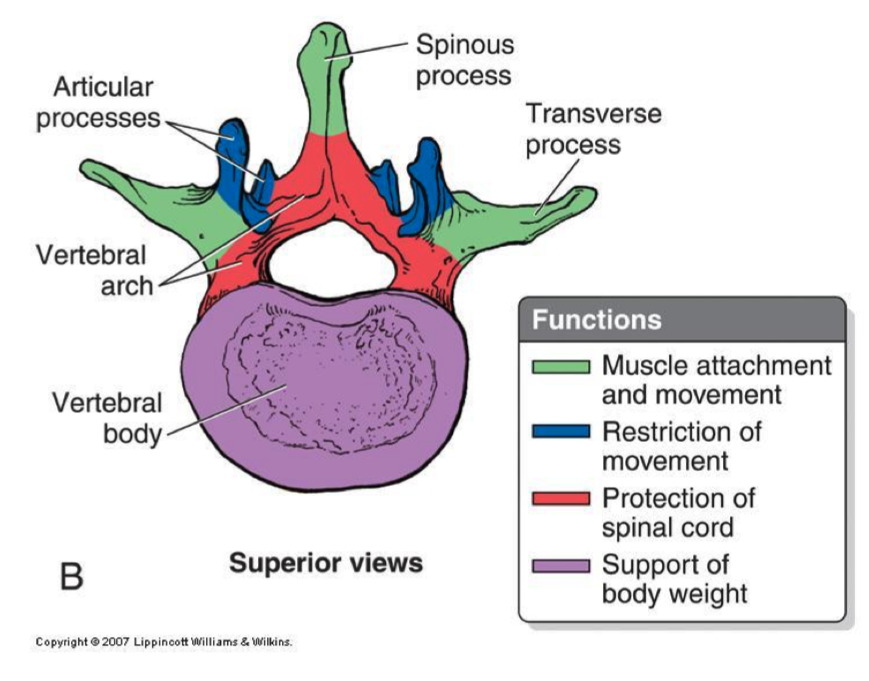
transverse processes, spinous processes
the (part of vertebrae x 2) functions to allow muscle attachment and movement
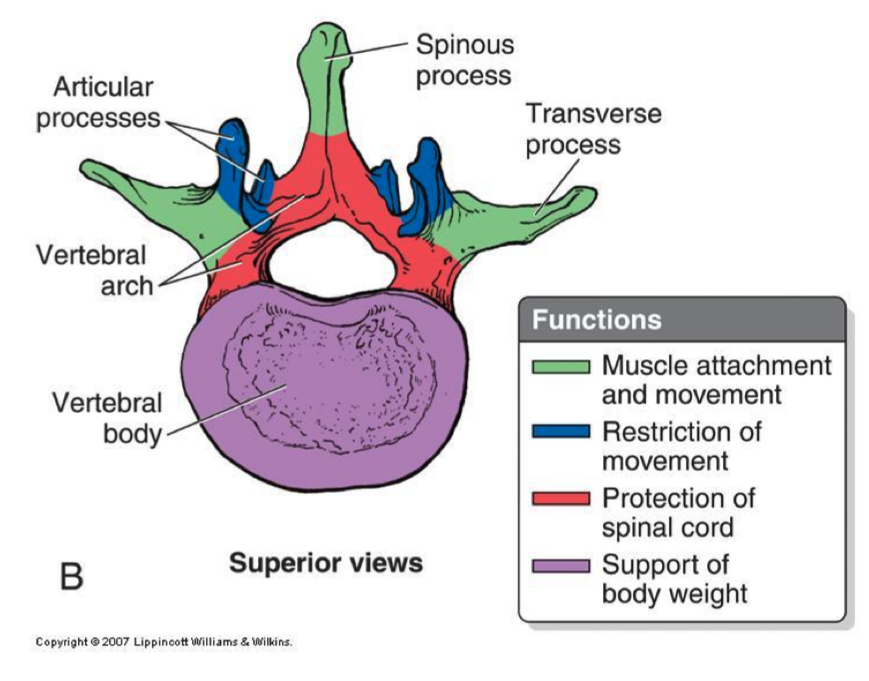
articular processes
the (part of vertebrae) functions to restrict movement
vertebral arch
the (part of vertebrae) functions protect the spinal cord
uncus
The — is a small hook-shaped projection on the upper surface of the body of a cervical vertebra, specifically C3–C7
superiorly
the uncus on a cervical vertebra projects (superiorly/inferiorly)
cervical
the — vertebrae have transverse foramen
transverse foramen
the — allow for vertebral arteries to pass up to the brain
inferiorly
the cervical vertebrae’s spinous processes grow longer as we progress (superiorly/inferiorly)
superior articular facets
the — of the atlas articulate with the occipital condyles
atlas
C1 is known as the —
atlas
the — has no spinous process (allows for greater range of motion)
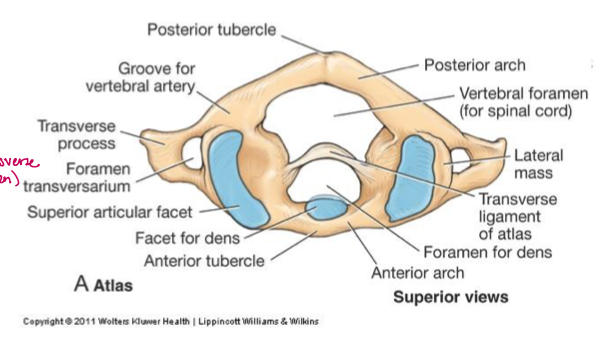
spinous process, body
the atlas has no — or —

lateral masses
instead of the body. the atlas has 2 —
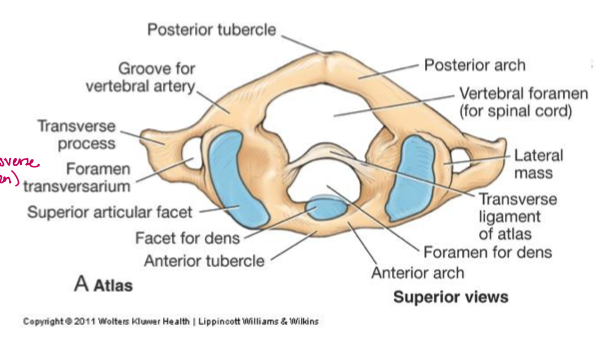
dens
there is a facet on the anterior arch of the atlas for articulation with the —
axis
the dens is on the —
superiorly
the dens on the atlas projects (superiorly/inferiorly) from the body

anterior
the dens is on the — side of the axis
atlanto-axial
The function of the — joints is to allow you to rotate your head from side to side

median atlanto-axial
the — joint is found between the dens (odontoid process) of C2 and the anterior arch of C1

lateral atlanto-axial
The — joint is found between the inferior articular facets of C1 and the superior articular facets of C2
thoracic
the — vertebrae have articular facets for ribs on transverse processes

costal facets
the heart shaped body of the thoracic vertebrae has — for ribs
body, transverse process
the head of the rib articulates with the costal facet on the — of the vertebrae, whereas the tubercle of the rib articulates with the facet on the —
larger, smaller
the lumbar vertebrae have a — foramen than the thoracic vertebrae, but a — foramen than the cervical vertebrae
lumbar
the spinous process of the — vertebrae is short and hatchet-like to support more robust musculature
spinous processes
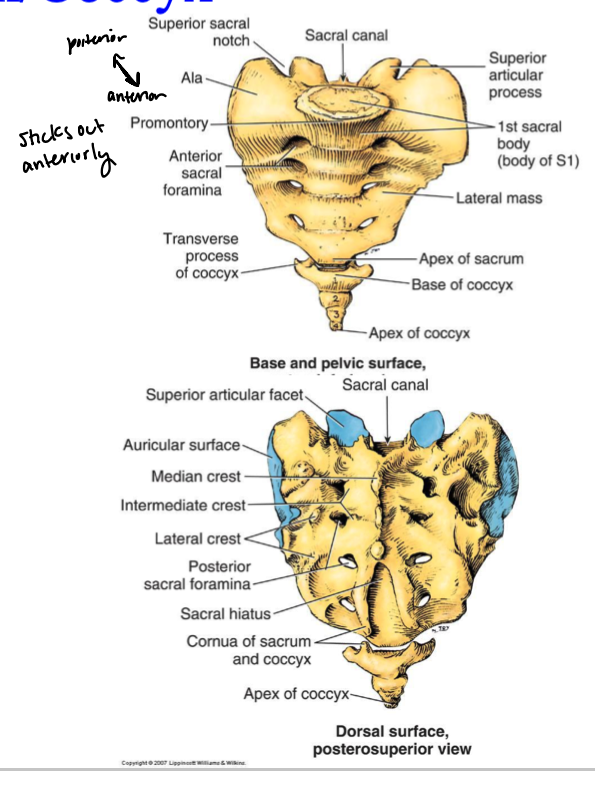
the median sacral crest is formed from fused —

vertebral foramen
the sacral canal is formed from fused —
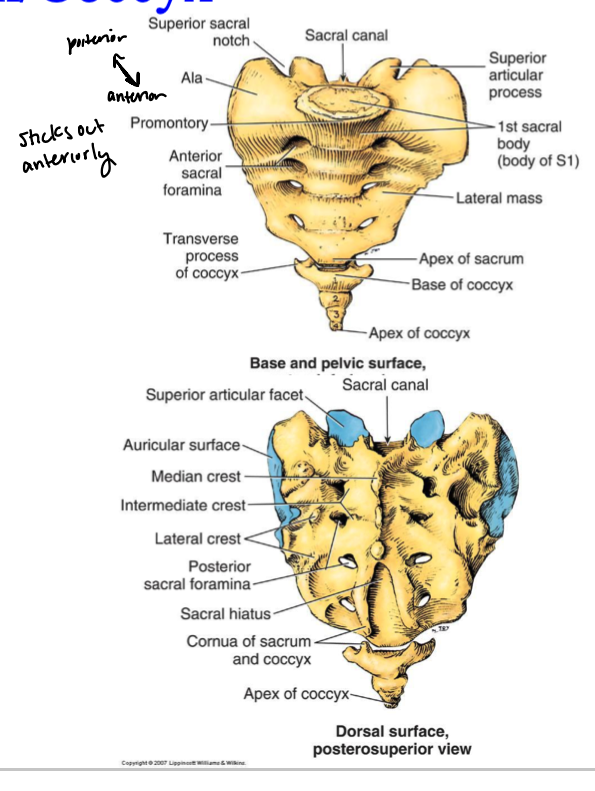
S4, S5, spinous processes
the sacral hiatus is formed from — and — with no —

transverse processes
the lateral mass/crests are formed largely by the fused —


ala
the sacral — is a broad, flat craniolateral process that is the auricular surface for articulation with the ilium
lamina
the intermediate crest of the sacrum is formed by the fused —
anulus fibrosis
outer, fibrous ring of intervertebral disc made mainly of collagen fibers arranged in multiple concentric layers
nucleus pulposis
soft, gel-like center of intervertebral disc that helps absorb and distribute loads

right
the fibers of cartilage in intervertebral discs run at — angles
posterior
the nucleus pulposis is more (anterior/posterior)
atlas, axis
there is no intervertebral disc betwen the — and —
the last functional intervertebral disc is in
the thicknesses of the intervertebral discs vary relative to the

uncovertebral, synovial
— joints are found between certival vertebrae at the uncus and are similar to a — joint
anterior longitudinal ligament
The — is a broad, strong band of connective tissue that runs along the anterior surfaces of the vertebral bodies and intervertebral discs, from the skull to the sacrum.
stability
the main function of the anterior longitudinal ligament is —
posterior longitudinal ligament
The — is a long, relatively narrow ligament that runs along the posterior surfaces of the vertebral bodies and intervertebral discs, inside the vertebral canal.
posterior longitudinal ligament
the — prevents herniation of vertebral discs and hyperflexion
synovial planar
between the superior and inferior facets of the vertebrae, there are — joints
ligamentum flavum
the — is the ligament found between adjacent vertebral arches
interspinous
the — ligament is found between spinous processes
supraspinous
the — ligament connects the posterior tip of the spinous processes
intertransverse
the — ligament connects the tips of the transverse processes
weak, strong
the interspinous ligaments are (weak/strong) and the supraspinous ligaments are (weak/strong)
nuchal, supraspinous
above T1 is the — ligament and below T1 is the — ligament
occipital protuberance
the nuchal ligament extends from the —
atlanto-occipital
The —- joints are the paired joints between the atlas (C1) and the occipital bone of the skull.
atlanto-occipital membranes
The anterior and posterior — are ligaments that connect the atlas (C1) to the occipital bone and help stabilize the atlanto-occipital joint.
cruciate ligament
The — is a strong ligament in the upper cervical spine that stabilizes the dens (odontoid process) of C2 against the anterior arch of C1.
atlas, occipital bone
the atlanto-occipital joints are between the — and the —
atlas, axis
the atlanto-axial joints are between the — and the —