Gross Pathology Descriptions
 Call Kai
 Learn
Learn Practice Test
 Spaced Repetition
 Match
Match Flashcards
 Knowt Play
1/25

Earn XP
Description and Tags
Name | Mastery | Learn | Test | Matching | Spaced | Call with Kai | Chat |
|---|
No analytics yet
Send a link to your students to track their progress
26 Terms
Describe generalized
Present in all parts of an organ, either affecting the organ entirely (diffuse), or with some remaining tissue (zonal, multifocal)
Describe diffuse
Uniform throughout the tissue
Differentiate generalized from diffuse
A diffuse lesion can be generalized if it affects the entire organ (ex. entire liver); diffuse lesions can also be localized if they affects all of one area of the organ (ex. entire middle lobe of the liver)
Differentiate focal from localized or locally extensive
All mean that they are a single lesion; focal is usually smaller than localized and locally extensive
Zonal is typically used to describe lesions
in the liver
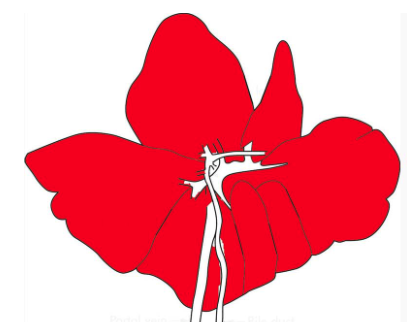
Describe this distribution
Generalized diffuse
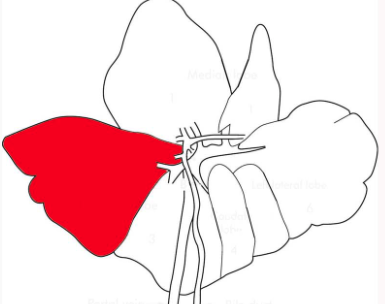
Describe this distribution
Localized diffuse; lobar
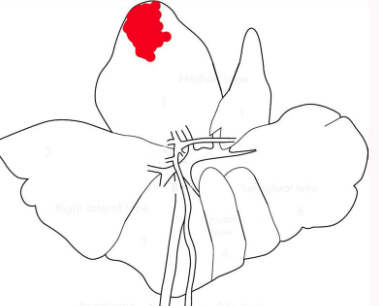
Describe this distribution
Focal
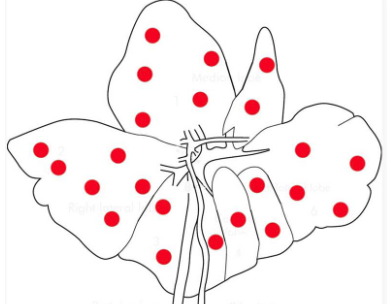
Describe this distribution
Generalized multifocal
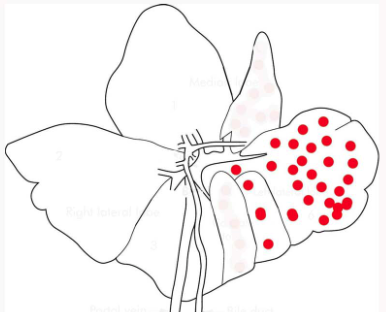
Describe this distribution
Localized multifocal
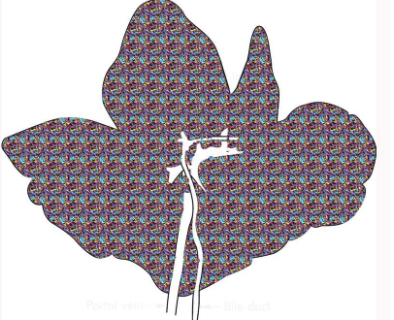
Describe this distribution
Zonal
What is a segmental lesion
Impacts a segment or length of a tubular organ
What is the opposite of generalized
localized
what is the opposite of diffuse
multifocal
what is important when describing size and extent of multifocal lesions
minimum and maximum size, uniformity, number (if high, say innumerable)
list some common terms to describe the shape of a lesion
circular, rectangular, triangular, geographic, diamond, ovoid, elliptical, linear, serpentine
raised areas imply
inflammation, hyperplasia, neoplasia, edema, hyperemia, gas
depressed lesions imply
fibrosis, necrosis or atrophy
white lesions indicate
inflammation, neoplasia, necrosis, fibrosis, mineral deposition
yellow lesions indicate
inflammation (pus), fat, fibrin, bilirubin
green lesions indicate
bile pigment, eosinophilic inflammation, gangrene, fungal infection, hemosiderin, putrefaction
black lesions indicate
melanin, blood exposed to acid, necrosis, exogenous carbon
soft =
lips
firm =
nose
hard =
forehead
what are the 5 key descriptive terms
location/distribution, size/extent, shape/demarcation/contour, colour, texture/strength