Earth Science
 Call Kai
 Learn
Learn Practice Test
 Spaced Repetition
 Match
Match Flashcards
1/44

There's no tags or description
Looks like no tags are added yet.
Name | Mastery | Learn | Test | Matching | Spaced | Call with Kai | Chat |
|---|
No analytics yet
Send a link to your students to track their progress
45 Terms
asthenosphere
mechanically weak, ductile region of Earth's upper mantle lying directly beneath the rigid lithosphere
constructive force
any natural or geological process that builds up, raises, or creates new landforms and features on the Earth's surface
continental crust
thick, buoyant, and chemically evolved outermost layer of Earth's lithosphere
continental drift
the scientific concept that Earth's continents move relative to each other over geologic time
convection
the transfer of heat through the physical movement of fluids like liquids or gases resulting in circulation patterns.
convection current
circular movement patterns that occur in liquids or gases when uneven heating causes a transfer of thermal energy
convergent boundary
a place where two of Earth's massive puzzle pieces—called tectonic plates—crash and push into each other
craton
an ancient, very old and super-stable piece of the Earth's continental crust that has survived millions or billions of years without breaking or changing much
crust
the outermost layer of the Earth, composed of solid rock, that makes up the continents and ocean floors.
deep ocean trench
a long, narrow, steep-sided depression on the ocean floor formed by tectonic subduction
destructive force science
which refers to natural processes that break down or wear away geological features, such as erosion and weathering.
differentiation
the process by which Earth and other planetary bodies separate into distinct layers based on density, primarily into core, mantle, and crust.
divergent boundary
a tectonic plate boundary where two plates move away from each other, resulting in the formation of new oceanic crust.
fold mountain
A type of mountain formed when two tectonic plates collide and compress, causing layers of rock to fold upwards.
folding
the geological process where rock layers are bent or curved due to tectonic forces, often resulting in the formation of fold mountains.
hot spot
A location on the Earth's surface that has experienced active volcanism due to a plume of hot material rising from the mantle, independent of tectonic plate boundaries.
igneous
rock formed from the cooling and solidification of molten magma or lava.
inner core
the innermost layer of the Earth, composed primarily of iron and nickel, and is solid due to the immense pressure.
inorganic
referring to substances that are not derived from living organisms, typically characterized by mineral composition and lacking carbon-hydrogen bonds.
island arc
a curved chain of volcanic islands that form along a tectonic plate boundary, usually from subduction of one plate beneath another.
lava lithosphere
the rigid outer layer of the Earth, which includes the crust and the upper mantle, extending to a depth of about 100 kilometers.
magma
molten rock located beneath the Earth's surface that can form igneous rocks when solidified.
mantle
the layer of the Earth located between the crust and the core, composed of solid rock that flows slowly over geological timescales.
metamorphic
rocks formed from the alteration of existing rocks due to heat, pressure, or chemically-active fluids.
mid-ocean ridge
an underwater mountain range formed by plate tectonics, where new oceanic crust is created.
mineral
a naturally occurring inorganic substance with a definite chemical composition and crystal structure.
normal polarity
a magnetic orientation in which the magnetic field aligns in the same direction as the Earth's magnetic field today.
oceanic crust
the layer of the Earth's crust that underlies the ocean basins, composed primarily of basalt.
outer core
the liquid layer of the Earth's core located beneath the mantle, composed mainly of iron and nickel, and responsible for generating the Earth's magnetic field.
pangaea
a supercontinent that existed during the late Paleozoic and early Mesozoic eras, where the continents were joined together.
plate tectonics
the scientific theory that describes the large-scale movement of the Earth's lithosphere, which is divided into tectonic plates that float on the semi-fluid asthenosphere beneath.
plateau
an elevated flat area of land that rises sharply above the surrounding area, often with steep sides, formed by geological processes such as erosion or volcanic activity.
reverse polarity
a phenomenon where the Earth's magnetic field changes direction, causing the magnetic north and south poles to swap places.
ridge push
a gravity-driven force that causes newly formed, hot, and elevated oceanic crust to slide downhill away from a mid-ocean ridge and push the rest of the tectonic plate outward.
rift zone
a linear fracture system in the Earth's crust where the lithosphere is pulled apart
seafloor spreading
a geological process where tectonic plates pull apart at divergent boundaries, allowing molten magma from the mantle to rise, cool, and form brand-new oceanic crust
seamount
a large underwater mountain that rises at least 1,000 meters (3,281 feet) above the surrounding ocean floor without reaching the sea surface.
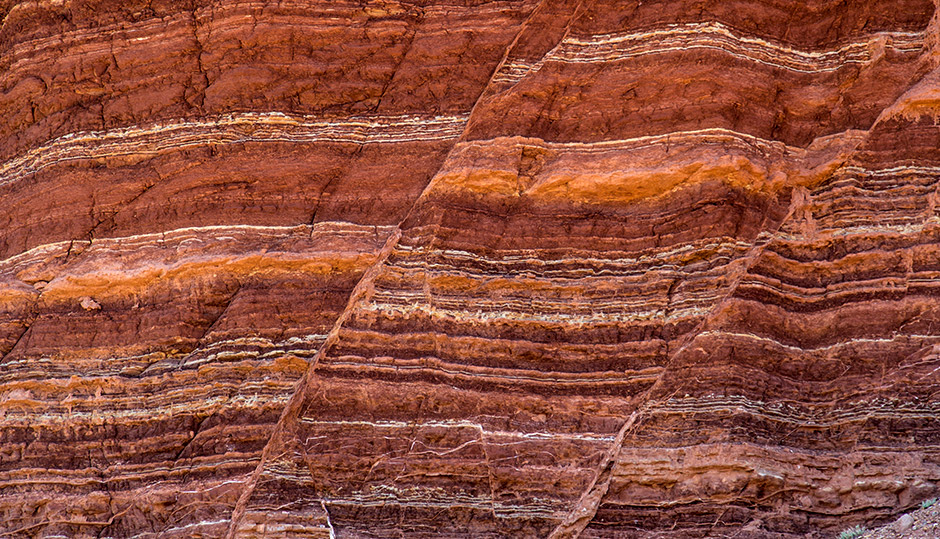
sedimentary
things formed from sediment—particles of rock, minerals, or organic matter that settle out of water, wind, or ice
slab pull
the pulling force created when a cold, heavy section of an Earth plate (called a slab) sinks down into the hot mantle at a subduction zone, dragging the rest of the plate behind it.
spatial
the ability to understand where your body and objects are in the space around you
subduction
a geological process where one of Earth's giant puzzle pieces—called tectonic plates—slides underneath another plate and sinks down into the hot, gooey middle layer of the Earth called the mantle
tectonic plate
large, solid pieces of Earth's outer shell—called the lithosphere—that float and slowly move over the hot, semi-fluid layer of the upper mantle called the asthenosphere
tectonic uplift
the rising of Earth's surface caused by movements and forces within the planet's lithospheric plates
temporal
the study of time, how things happen in order, and how fast or slow events occur
transform boundary
occur where two tectonic plates slide horizontally past one another.