Pediatrics test 4 (GI, GU, Skin, Endocrine) Part I
 Call Kai
 Learn
 Practice Test
 Spaced Repetition
 Match
 Flashcards
 Knowt Play
1/427

There's no tags or description
Looks like no tags are added yet.
428 Terms
Skin starting
Ok
Characteristics of newborn skin:
Skin is very thin
Epidermis is loosely bound to the dermis, friction can cause separation
Eccrine sweat glands function
Apocrine sweat glands are small and non functional
Less melanin is present at birth so skin is light colored
Characteristics of adolescent skin:
Skin thickens
Epidermis and dermis are tightly bound increasing resistance to infection and irritation
Eccrine sweat glands achieve full function
Males sweat more than females
Apocrine glands mature during puberty
Melanin is at adult levels
Burrow:
A narrow, raised irregular channel caused by a parasite
Ex: scabies

Comedone:
A plug os sebaceous and keratin material in a hair follice
Ex: acne

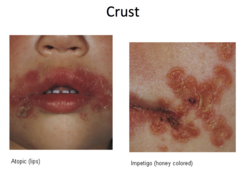
Crust:
Dried residue of serum, pus, or blood
Ex: Impetigo
Erosion:
Loss of superficial epidermis; moist but does not bleed
Ex: Ruptured chicken pox vesicle

Excoriation:
Abrasion or scratch mark
Ex: Scratched insect bite

Fissure:
Linear crack in skin
Ex: Tinea pedis (athletes foot)

Keloid:
Overdevelopment or hypertrophy of scar that extends beyond wound edges and above the skin line due to excess collagen
Ex: Healed skin area following traumatic injury

Lichenification:
Thickening of skin with increased viability of normal skin furrows
Ex: Eczema

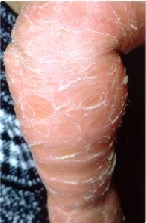
Scale:
Thin flake of exfoliated epidermis
Ex: Dandruff
Scar:
Replacement of destroyed tissue with fibrous tissue
Ex: Healed surgical incision

Telagiectasia:
Dilated, superficial blood vessels
Ex: Birth mark

Ulcer:
Deeper loss of skin surface; bleeding or scarring may ensue
Ex: Chancre

What is dermatitis?
Condition when skin changes in response to external stimuli

What are the four most common types of dermatitis?
Contact
Diaper
Seborrheic
Eczema (atopic)
What is known as chronic dermatitis?
Eczema
What is contact dermatitis?
Inflammation of the skin in response to direct contact with allergen or irritant
What is an irritant reaction with contact dermatitis?
Inflammatory response but no immune response
What are examples of an irritant reaction?
Soaps
Detergent
Fabric softeners
Lotions
Urine
Feces
What is an allergen reaction?
An antigen absorbed into the skin during the first encounter and immune memory is created
What are examples of allergen reactions?
Poison ivy or oak
Lanolin
Neomycin
Rubber
Latex
Nickel
Fragrances
What are the signs and symptoms of contact dermatitis?
Erythema
Edema
Pruritis
Vesciles
Bullae
How do we treat contact dermatitis? (5)
Remove offending agent
Apply calamine lotion
Apply cool compress
Apply wet dressings
Take oatmeal bath
Dermatitis with poison ivy is caused by what?
Urushiol, the plant's resin (direct or indirect contact)
How can we remove resin from poison ivy from the body?
Wash with soap and water (Blue Dawn)
What does early washing off of poison ivy do for the skin?
Early washing lessens of the extent of the blisters
What are treatment options for poison ivy? (6)
Zanfel wash (OTC)
Topical or oral corticosteroids (prednisone)
Calamine lotion
Burrow solution (drys up rash)
Oatmeal baths
Antihistamines
What is the most common causes of irritant contact dermatitis?
Diaper dermatitis
Diaper dermatitis is common at what ages?
Infants 9 to 12 months
Diaper dermatitis is a primary reaction from what?
Urine
Feces
Moisture
Friction
What is treatment for diaper dermatitis?
Barrier or protective sealant
Ex: Zinc oxide
What is treatment for moderate to severe diaper dermatitis?
1% hydrocortisone for 3 to 5 days
Topical antifungal (nystatin) until 3 days after the rash disappears
What should we not do when using topical corticosteroids?
Use stronger than 1% for more than 3 - 5 days
What does prednisone do to the body?
Shunts growth
Increases blood sugar
Increases blood pressure
Causes weight gain
Can cause early puberty
What education should be given for prednisone therapy?
Do not stop abruptly
Take in the morning
Do not give to immunocompromised
What are nursing considerations for diaper dermatitis?
Change the infant every two hours during the day
Change at least once at night
Inform parents to wash the peri-anal area only after a bowel movement
Encourage parents to allow diaper area to be exposed to air when at home
Don't use wipes on rash that is severe, wash with water

What does a Candida diaper rash look like?
Creases are affected
Satellite lesions

How do we treat a yeast diaper rash?
Treat with nystatin
If we have a very severe diaper dermatitis, what is made in the drugstores to be put on it?
Triple paste ointment
1) zinc oxide
2) Maalox liquid
If it is yeast, Nystatin
If it is not yeast AND ointment
What is seborrheic dermatitis?
Recurrent inflamed skin condition thought caused by overgrowth of pityrosporum yeast (cradle cap)

Where is seborrheic dermatitis typically found?
In areas with sebaceous gland activity
Ex: scalp, forehead, postauricular and peri-orbital areas, intertriginous (skinfolds, neck, axillae, and antecubital fossa)
What are signs and symptoms of seborrheic dermatitis?
Pruritis
Mild erythema
Waxy scaling of scalp
What is treatment for seborrheic dermatitis? (3)
Daily scalp shampooing with medicated shampoo (selenium sulfide)
Apply emollients of baby oil or petroleum jelly on skinfolds
Topical corticosteroids are used on seborrhea if not on scalp
What is impetigo?
Highly contagious superficial bacterial skin infection with group a strep or staph

When does impetigo occur more frequently?
In mid to late summer and hot humid climates
How is impetigo spread?
Direct contact
What do the lesions look like with impetigo?
Begin as a red macules and progressed to distinct vesicles that fill with fluid (honey-colored crusts)

How long is impetigo contagious?
Remains contagious until all lesions are completely dry
What is nursing management for impetigo?
Isolate child until all lesions are dry
Clean lesions with soap and water and remove crusts
Apply socks to hands bilaterally to prevent spreading
Ensure thorough education on importance of med application and skin care
What is treatment for impetigo?
Administer topical antibacterial ointment for 5 to 7 days, if there is no improvement PO antibiotics should be prescribed
What is cellulitis?
Bacterial infection involving dermis and sub-q tissue

What are physical characteristics of cellulitis?
Painful area of erythema and edema
What are systemic symptoms of cellulitis?
Fever
Chills
Malaise
Lymphadenopathy
If cellulitis progresses, what can it lead to?
Abscess formation
What is treatment of cellulitis?
Antibiotics
How should we manage cellulitis?
Warm compresses over affected area
Elevate extremity
Rest involved body parts
Administer antibiotics as ordered
What is candidiasis more commonly known as?
Thrush

When can candidiasis occur?
Neonate infected from vaginal canal at birth
After taking antibiotics
Immunocompromised patients
If mom is breast-feeding and baby has thrush, thrush can get on nipple
What are signs and symptoms of candidiasis?
White lesions on the tongue and/or mouth
Bright red rash on the perineal area can occur if fungus travels through the G.I. tract
How do we diagnose candidiasis?
Gram stain slide-fungal culture
White lesion will bleed if attempt to remove
What medications are given for treatment of candidiasis?
Nystatin
Clotrimazole - PO or topical (Lotrimin)
Fluconazole if immune suppressed (PO or IV)- Diflucan
What is Tinea Capitus?
Ringworm of the head

What is Tinea corporis?
Ringworm of the body

What is Tinea Cruris?
Ringworm of the groin (jock itch)

What is tinea pedis?
Ringworm of feet (athletes foot)

Tinea infections are most commonly seen in what children?
School age children and African-Americans
How are tinea infections transmitted?
Direct or indirect contact
Tinea infections are also known as what?
Dermatophytoses
What are symptoms of tinea infections on the scalp?
With and without alopecia
With and without erythema
Scaly
Crusty
Pustules
Lymphadenopathy
Kerion lesions (Moist, boggy scalp nodules)
When are we more concerned about the location of tinea infections?
If on the face, near eye, or in mouth
What are the symptoms of tinea infections on the body?
Lesions in an asymmetric pattern
- annular and expanding with raised erythematous border and scaly clearing center
- pruritic
What medication is given for tinea infections?
Antifungal agents or PO griseofulvin
Selenium shampoo
If close to the eye or scalp, take oral corticosteroids
Instructions for griseofulvin medication:
For lesions on the scalp:
Take 8 to 12 weeks
Give with fatty foods for absorption
Instructions for selenium sulfide shampoo with tinea capitis:
Shampoo 2 to 3 times weekly
Leave shampoo on scalp for 10 minutes before rinsing
Family members may also use shampoo to reduce fungus spores in the household
What would be taken for kerions on the scalp with tinea capitis?
Oral antifungal or oral corticosteroids, but must be taken for two weeks with tapering doses
What medications are given for tinea corporis?
Topical cream (-azole) if older than 12 years old twice a day for 4 to 6 weeks
Selenium shampoo wash two times a week on the child's body to help reduce the number of spores
Oral antifungal have no response to topical therapy
What medication is given for tinea cruris (jock itch)?
Topical antifungal agents for ages 12 and older for 4 to 6 weeks
Wash body with selenium sulfide shampoo
What medications are given for tinea pedis (athletes foot)?
Broad Spectrum topical antifungal agents with antibacterial properties
Allow feet to air dry
Use 100% cotton socks, change twice daily
Put socks on before other clothing to reduce the transmission of fungus
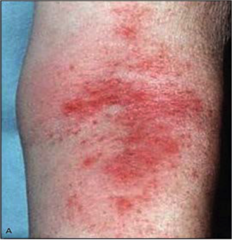
What is eczema (atopic dermatitis)?
Chronic superficial inflammatory skin disorder, characterized by intense pruritis
When do most children develop eczema?
Within their first year of life
Children that develop eczema may also develop what two things?
Asthma or food allergies
What are signs and symptoms of acute eczema?
Pruritis and erythematous patches with vesicles, exudate, and crusts
What are signs and symptoms of subacute eczema?
Scaling with erythema and excoriation
What are signs and symptoms of chronic eczema?
Pruritis, dryness, scaling, and lichenification
What are the signs and symptoms of xerosis eczema?
Dry cracks and fissures of skin from increased epidermal water loss
What is the treatment for eczema?
Although there is no cure, we may use topical steroids two times daily for two weeks and topical emollients to hydrate and lubricate the skin
If there are oozing lesions with eczema, what should be done with them?
Use wet on wet principal
What is acne?
Chronic inflammatory disorder of pilosebaceous hair follicles on the face and trunk

What is treatment for acne?
Treatment is based on severity
Topical retinoids, Accutane, oral contraceptives, antibiotics
What acne medication requires patient to be on contraceptives?
Accutane, may cause severe malformations
What supplement may you need when on Accutane?
Vitamin A derivative
What is psoriasis?
Chronic, pruritic, papulosquamous skin condition that causes the epidermis and dermis to thicken

What does psoriasis look like?
Thick silvery scaly erythema plaque with irregular border
Is psoriasis contagious?
No
What should we apply to a patient with psoriasis? (4)
Topical steroids and vitamin D
Tar shampoo
Ultraviolet B phototherapy
Systemic drug therapy (Humira, Methotrexate)
What are infestations?
Result of a mite infestation
What are signs and symptoms of infestations?
Intense pruritis
Papular, pustular, and vesicular lesions
What is pediculosis capitis?
Head lice