Geriatric MSK Disorders
 Call Kai
 Learn
 Practice Test
 Spaced Repetition
 Match
 Flashcards
 Knowt Play
1/74

There's no tags or description
Looks like no tags are added yet.
75 Terms
Describe connective tissue changes as we age.
Elastin, collagen, water --> increased stiffness, decreased water content, strength, CSA, and volume
Describe joint structure changes as we age.
1. Chondroid structures (articular cartilage, meniscus, labrum, fibrocartilaginous discs) affected w/ OA or calcification
2. Fibrous types (ligaments, tendons, joint capsule) - increased stiffness, reduced elasticity
3. Bony structures - susceptible to fractures, decreased BMD, inability to absorb forces adequately
Describe whole joint changes as we age.
Decreased joint space, increased laxity, altered dispersion of loads, altered joint movements of force, changes in osteokinematics and arthrokinematics, AROM deficits > PROM deficits (due to neuromuscular changes, structural changes), changes in force transmission --> articular cartilage breakdown, changes in torque
What kind of influence can changes in joint mobility (connective tissue, joint structure, whole joint) have on activity and participation in older adults?
Postural control deficits during walking, transfers, reaching; ankle mobility deficits --> balance impairments, walking limitations; decreased hip extension and decreased gait speed --> increased falls; pain
________: age-related loss of muscle mass, strength/power, and functional quality due to imbalance b/w muscle protein breakdown and synthesis
Sarcopenia
As we age, what declines MORE strength or muscle mass?
STRENGTH!!
List muscle changes as we age.
Muscle atrophy and weakness (increased fat mass), decreased motor neurons and innervation, slowing of contractile properties and rate of force development, alterations in excitation and contraction coupling, increased compliance of musculotendinous attachments
List changes in metabolic function linked to sarcopenia.
Endocrine function (increased insulin resistance, decreased estrogen and testosterone), obesity and inflammation, mitochondrial dysfunction and apoptosis
List diseases and conditions, common in older adults, associated w/ skeletal muscle decline.
Diabetes, metabolic syndrome, COPD, cancer, CHF, arthritis, kidney disease, stroke, PD
Impaired muscle performance is associated with which conditions?
Reduced strength, mobility, and increased risk of falls, frailty, and other conditions like T2D; depletes protein reserves --> making recovery from illness/injury harder
List risk factors for impaired muscle performance.
Reduced activity, poor protein intake, inflammation can contribute to the loss of strength
Loss of alpha motor neurons in satellite cells leads to what?
Decreased muscle size and strength --> remaining neurons will enlarge their motor units --> decreased coordination, decreased strength, and mobility issues
List the logic model of change in physical activity behavior (a method to address pain & function post surgery to improve PT and health outcomes).
1. Physical therapy intervention -->
2. Patient-level determinants -->
3. Behaviors -->
4. Outcomes
List PT interventions to target change in physical activity behavior.
MI and personalization, setting priorities using a clinical reasoning algorithm, shared decision making, coaching on self-mgmt., focus on meaningful activities, stratifying tx to match condition severity, monitoring and feedback
List patient-level determinants that contribute to change in physical activity behavior.
Knowledge, skills, motivation, self-efficacy, behavior regulation
List behaviors that contribute to change in physical activity behavior.
PA, self-mgmt.
List outcomes in the process of changing physical activity behavior.
Physical health, mental health, QOL
Internal vs. external fixation more common? Hip vs. humeral vs. ankle fractures.
Hip - internal
Humeral - internal
Ankle - internal best BUT external also common
Which surgeries are commonly performed to address spinal stenosis w/o spinal deformity? Spinal stenosis w/ spondy? Scoliosis or kyphosis?
Spinal stenosis w/o spinal deformity - decompression/laminectomy
Spinal stenosis w/ spondy - simple fusion and laminectomy
Scoliosis or kyphosis - complex fusion
What is the difference b/w a fragility fracture any other fracture?
Fragility fractures are any fracture that is from standing height or less (ex: older adult was walking and tripped over the oxygen cord, fell, and fractured their hip OR older adult rotated their trunk while lifting the laundry basket --> compression fracture in their spine)
How do we typically treat compression fractures?
CONSERVATIVELY!! (pain meds + minimization of bending, twisting + bracing w/ TLO)
________: no clear definition; decreased reserve and resistance to stressors from declines in MULTIPLE systems --> adverse outcomes (decline >30% --> functional declines or illness)
Frailty (biological syndrome)
________ is the most common initial manifestation of frailty
Weakness
What is the MOST common model of frailty? List the 5 clinical attributes.
Phenotype of Frailty
1. Unintentional weight loss
2. Self-reported exhaustion
3. Muscle weakness
4. Slow walking speed
5. Low physical activity
How do you interpret the Phenotype of Frailty?
Not frail = 0
Prefrail = 1-2
Frail = 3+
________: model of frailty that examines the cumulative effects of age-related disorders, functional conditions, and psychosocial issues
Frailty Index (70 clinical indcators)
How do you interpret the Frailty Index?
# of deficits/# of considered deficits
- Score of 0 = robust (not frail)
- Score of 1 = advanced frailty
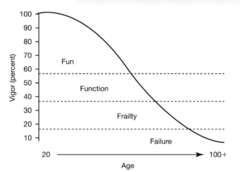
Place the following components of the slippery slope of aging in order: fun, frailty, function, failure.
Fun --> function --> frailty --> failure
How likely is it that a person will transition from pre-frail to non-frail? Frail?
Older adults who are pre-frail have the ability to improve to non-frail status (11.9%) BUT will often stay in the pre-frail category (58.3%) or sometimes decline to the frailty category (24.9%)
How likely is it that a person will transition from frail to pre-frail? Non-frail?
Older adults who are frail will often remain frail (63.9%) or occasionally improve to pre-frail (23%) BUT they'll NEVER improve enough to reach the non-frail category.
How likely is it that a person will transition from non-frail to pre-frail? Frail?
Non-frail = non-frail (51.5%), non-frail --> pre-frail (40.1%), non-frail --> frail (4.2%)
________: degree of frailty; few long-term conditions and those are well controlled. Physically active, no functional limitations.
Fit (not frail)
List functional characteristics: fit (not frail)
Gait speed >1.2 m/s
TUG
________: degree of frailty; slowing, may need help w/ IADLs, making adaptation to functional mobility. Beginning to restrict life space mobility. Vulnerable and often makes a poor recovery from illness or injury.
Mild frailty (prefrail)
List functional characteristics: mild frailty (prefrail)
Gait speed 0.8-1.2 m/s
TUG 10-15 s
6MWT 400-548 m
30STS 8-15
May modify getting up from floor
Frailty Index of ~0.25
________: degree of frailty; demonstrates difficulty w/ outdoor mobility and may need some help w/ ADLs. Life space is increasingly restricted and loss of independence is apparent.
Moderate frailty
List functional characteristics: moderate frailty
Gait 0.5-0.8 m/s
TUG 15-20 s
6MWT >400 m
30STS
________: degree of frailty; dependent in ADLs, activity or inactively dying. Life expectancy 6-12 months.
Severe frailty (end stage)
List functional characteristics: severe frailty (end stage)
Gait
Which interventions are involved in the management of frailty?
Physical activity, exercise, nutrition, meds, hormonal mgmt., self-mgmt. programs, others, palliative care
List exercise prescription for pre-frail individuals.
Aerobic: 2-3x/week, 3-4/10 RPE, 10 min
RT: 2-3x/week, 80% 1-RM, 20 min
Balance: 2-3x/week, 3-4 RPE, 20 min
Flexibility: 2-3x/week, 3-4 RPE, 10 min
List exercise prescription for frail individuals.
Aerobic: 2-3x/week, 3-4 RPE, 20 min
RT: 2-3x/week, 80% 1-RM, 10 min
Balance: 2-3x/week, 3-4 RPE, 8 min
Flexibility: 2-3x/week, 3-4 RPE, 7 min
"Meals on Wheels": mnemonic for common treatable causes of unintentional weight loss in the elderly
M = medication effects
E = emotional problems, esp. depression
A = anorexia nervosa, alcoholism
L = late-life paranoia
S = swallowing disorders
O = oral factors (e.g., poorly fitting dentures, caries)
N = no money
W = wandering and other dementia-related behaviors
H = hyperthyroidism, hypothyroidism, hyperparathyroidism, hypoadrenalism
E = enteric problems
E = eating problems (e.g., inability to feed self)
L = low-salt, low-cholesterol diet
S = stones, social problems (e.g., isolation, inability to obtain preferred foods)
What are examples of step-management programs?
Chronic disease self-mgmt. program (CDSMP), Stepping On, Enhanced Medical Rehab, Grip on Life, Embraced
What encompasses the Chronic Disease Self-Management Program?
Helps participants build confidence in managing their chronic conditions, symptom mgmt., medication use, exercise, communication, nutrition, decision-making, evaluating new treatments
What are reversible causes of fatigue?
Anemia (tests: capillary refill, conjunctival pallor), sleep apnea, depression (PHQ-9), hypotension (BP), hyperthyroidism, B12 vitamin deficiency
What does palliative care focus on?
Focus on patient-centered holistic care to improve QOL while optimizing independence and function through appropriate exercise, PA, and reducing the risk of falls
True or false: falls are common but NOT a normal part of aging, they CAN be prevented
TRUE!!
What are FALLS?
Unintentional LOB leading to failure of postural stability; sudden and unexpected change in position (usually landing on the floor)
NOTE: FALL WITHOUT INJURY IS STILL A FALL!!
What classifies "recurrent falls"?
2+ falls within a 6-12 month period
List INTRINSIC fall risks.
Age, postural control mechanisms, comorbidities, vision, fear of falling
List EXTRINSIC fall risks.
Environmental changes, throw rugs, slippery surfaces, uneven surfaces, lighting, obstacles, substance abuse, meds
Compare & contrast age-related vs. health condition-related somatosensory changes.
Age-related = decreased proprioception, health condition = diabetic neuropathy
Compare & contrast age-related vs. health condition-related vision changes.
Age-related = decreased visual acuity, health condition = cataracts or glaucoma
Compare & contrast age-related vs. health condition-related CNS changes.
Age-related = decreased coordination, health condition = PD or CVA
List normal age-related changes in somatosensory input.
Decreased receptors in our joints, muscles, tendons; decreased spatial awareness
List normal age-related changes in vision.
Decreased acuity, contrast sensitivity, depth perception, peripheral vision
List normal age-related changes in the vestibular system.
Loss of peripheral hair cells --> changes our VOR and VSR
List normal age-related changes in the CNS processing.
Decreased ability to elicit all of the balance strategies
________ strategy: small disturbances; distal --> proximal change
Ankle
________ strategy: more sudden or forceful disturbances; proximal --> distal change
Hip
________ strategy: side-to-side movement
Weight-shift
________ strategy: forward or backward step to control the movement of the COG beyond the BOS
Stepping
________ strategy: bend at the knees or crouch down to bring the COG closer to the BOS
Suspensatory
________ strategy: move your arm to reach or grasp an object for support, usually used for more larger perturbations
Reaching
List subjective components of a falls assessment.
- Any falls? When? How many in last 1, 6, 12 months?
- What causes fall(s)? Direction?
- Was help required? Who?
- Any injuries? What?
- Follow up w/ PCP/ ED/ hospitalization
List objective components of a falls assessment.
Vitals, medication reconciliation, balance/ falls outcome measure, sensory/ somatosensory, neuromuscular (strength/ ROM/ flexibility), gait/ aerobic endurance, psychosocial/ cognition/ fear of falling, environment
What are environmental considerations in terms of fall risk?
Stairs, home set-up (rugs, sleep set-up, railings and/or grab bars, levels, size), bathroom set-up, assistive devices
List balance/fall outcome measures.
Berg, Tinetti, 4-stage, 4-square
List sensory/somatosensory outcome measures.
Snellen Eye Chart, depth perception, visual field testing, gaze stabilization, saccades, joint position, proprioceptive testing, vibration, cutaneous pressure, 2PD, CTSIB
List gait/aerobic endurance outcome measures.
DGI, FGA, simple gait speed, 30STS, 2MWT or 6MWT, 2MST
List psychosocial/cognitive/fear of falling outcome measures.
PHQ9, GAD7, Mini-Mental, MoCA, BIMS, ABCS
________: act currently w/ U.S. House of Reps that will help reduce falls among older adults and decrease opioid use!! Will also make fall screening a part of the initial Medicare exam and annual wellness exam!!
SAFE Act (H.R. 7618) - Stopping Addiction and Falls for the Elderly Act
List appropriate interventions for the frail older adult for fall prevention.
Strengthening (emphasis on toe flexors), standing balance (w/ sup), patient education, environmental modification, gait training, AD mods, stretching (esp. PFs), standing, weight shifts (w/ sup), work to safely increase walking velocity, Tai chi
List appropriate interventions for the very frail older adult for fall prevention.
Standing exercises (weight shifts, reaching, bending, lifting, push and release, ankle and hip strategy training, slow marching, stretches, Tai chi) & gait training (walking w/ different speeds, stops, head movement, 2nd task, different surfaces)