Food Tech
 Call Kai
 Learn
 Practice Test
 Spaced Repetition
 Match
 Flashcards
 Knowt Play
1/26

There's no tags or description
Looks like no tags are added yet.
27 Terms
Aeration
The process of incorporating air into a food product to increase volume and create a light spongy texture.
Protein coagulation
The irreversible change in protein from a liquid/semi-liquid state to a solid or semi-solid mass due to heat acid or mechanical action.
Protein denaturation
The unfolding or breaking down of the secondary and tertiary structures of a protein molecule altering its original properties.
Occurs due to Heat, chemicals or mechanical actions
Gelatinisation
The process where starch granules absorb liquid in the presence of heat and swell thickening the surrounding liquid.
Mechanical actions in food preparation
Physical movements such as whisking beating folding or kneading that introduce air develop gluten or combine ingredients.
Functional properties of protein
Key roles including denaturation coagulation foaming emulsification and browning (Maillard reaction).
Functional properties of starch
Key roles including gelatinisation retrogradation syneresis and acting as a thickening or binding agent.
Conduction (Heat Transfer)
The transfer of heat energy through direct physical contact from one molecule to another.
Convection (Heat Transfer)
The transfer of heat through currents caused by the circulation of heated air water or oil.
Microwave (Heat Transfer)
The transfer of heat via electromagnetic waves that cause water molecules within the food to vibrate and generate friction heat.
Discretionary items
Foods and drinks that are high in saturated fat added sugars or added salt and are not necessary for a healthy diet.
Danger zone (Food Safety)
The temperature range between 5°C and 60°C where harmful bacteria multiply rapidly in food.
Safe food storage temperatures
Freezers should be kept at or below -18°C and refrigerators should be kept between 1°C and 4°C.
Food poisoning vs. food spoilage
Food poisoning: an infection or irritation of the digestive tract caused by consuming harmful bacteria contaminated items
Food spoilage: an undesired change in a food’s original state that makes it unfit for consumption
Cross-contamination
The transfer of harmful bacteria or allergens from one food surface or piece of equipment to another.
Food miles
The distance food travels from the place where it is grown or produced to the location where it is purchased or consumed.
Sensory properties
appearance aroma taste texture and sound.
Safe knife skills
Techniques such as the claw grip for holding food and the bridge hold for cutting ensuring stable safe and precise cuts.
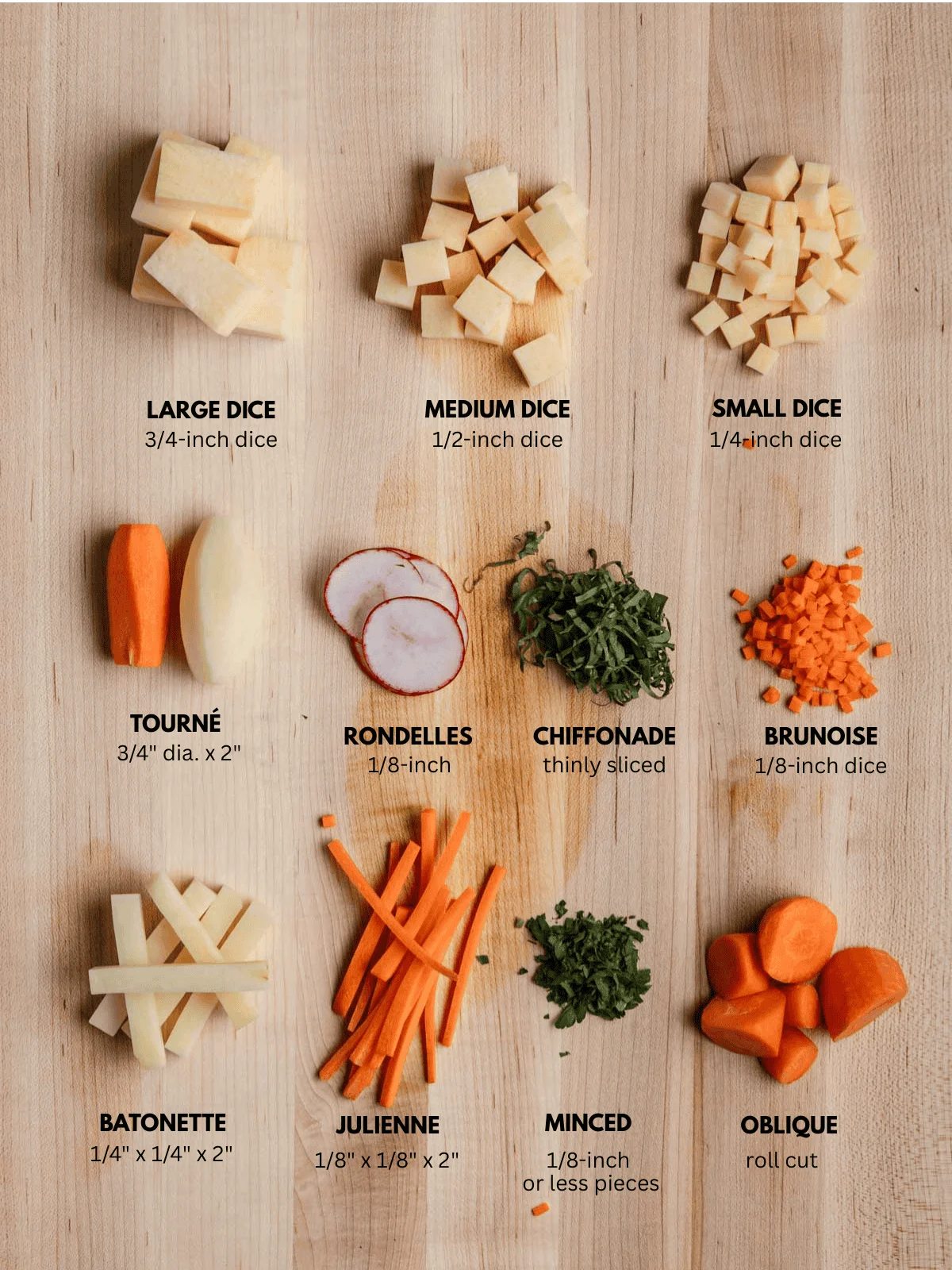
Basic knife cuts
Pastry making principles
Do not knead the pastry; overworking will create a heavy texture,
Preheat the oven: If you put shortcrust in an oven that’s too cool, then the pastry will shrink.
Cook pastry in a hot oven: as above
Keep ingredients cool: if you don’t keep things cool, the mixture will become greasy or
heavy; the texture is not the fine, ‘short’ (or crumbly) texture you want.
Rest pastry before baking: this allows gluten to relax, so that when it's rolled it out, they’re
not being overworked and the dough will stretch easily. If the dough is not
allowed to relax, the dough will shrink in the oven.
Function of eggs in cooking
Binding: Proteins coagulate with heat to hold food mixtures together
Leavening: Whisked whites trap air to make baked goods rise
Emulsifying: Lecithin in the yolk blends oil and water
Thickening: Heated proteins set to thicken liquids
Coating: Sticky raw egg holds crumbs on food before frying
Structure of eggs

Australian Dietary Guidelines
GUIDELINE 1 | To achieve and maintain a healthy weight, be physically active and choose amounts of nutritious food and drinks to meet your energy needs. |
GUIDELINE 2 | Enjoy a wide variety of nutritious foods from the five groups every day and drink plenty of water. |
GUIDELINE 3 | Limit intake of foods containing saturated fat, added salt, added sugars and alcohol. |
GUIDELINE 4 | Encourage, support and promote breastfeeding. |
GUIDELINE 5 | Care for your food; prepare and store it safely. |
What the 5 main food groups AGHE direct people to consume
grain
vegetables
fruit
dairy
protein/meat
What are the ways aeration can occur
Biological ingredients - yeast
Chemical ingredients—baking powder, bicarbonate of soda
Mechanical actions—sifting, creaming, whisking, beating, folding in ingredients, rubbing in ingredients.
Physical aeration; Uses steam from boiling water or lamination layers of fat and oil
egg white
Egg whites are high in protein with minimal fat. When you beat whites, they form a foam,
creating lightness and airiness in a product. Egg whites have a subtle or neutral flavour
egg yolks
Yolks are rich in fats and emulsifiers, with a richer flavour. Yolks act as a thickening agent
and give sauces and custards