7.2 SUICIDE RISK
 Call Kai
 Learn
 Practice Test
 Spaced Repetition
 Match
 Flashcards
 Knowt Play
1/30

Earn XP
Description and Tags
SUICIDE RISK
31 Terms
SUICIDE RISK nine steps
risk factors
suicidal ideation
how concrete & specific
hopelessness & plans for the future
ideas & feelings of guilt
real & perceived social support
values, beliefs & protective factors
questionnaires & standardised scales
assessment of the level of risk & decision making
Risk factors increase concern, but
they do not predict what a person will do
they tell you where to look

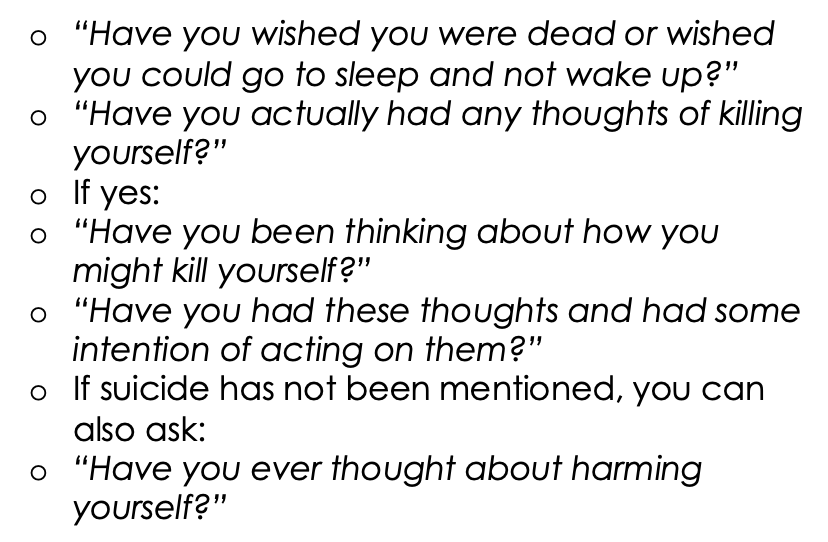
if suicidal ideation present
ask directly
the C-SSRS provides a simple structure
asking directly does not put the idea into someones head → it makes suicidal thinking easier to identify
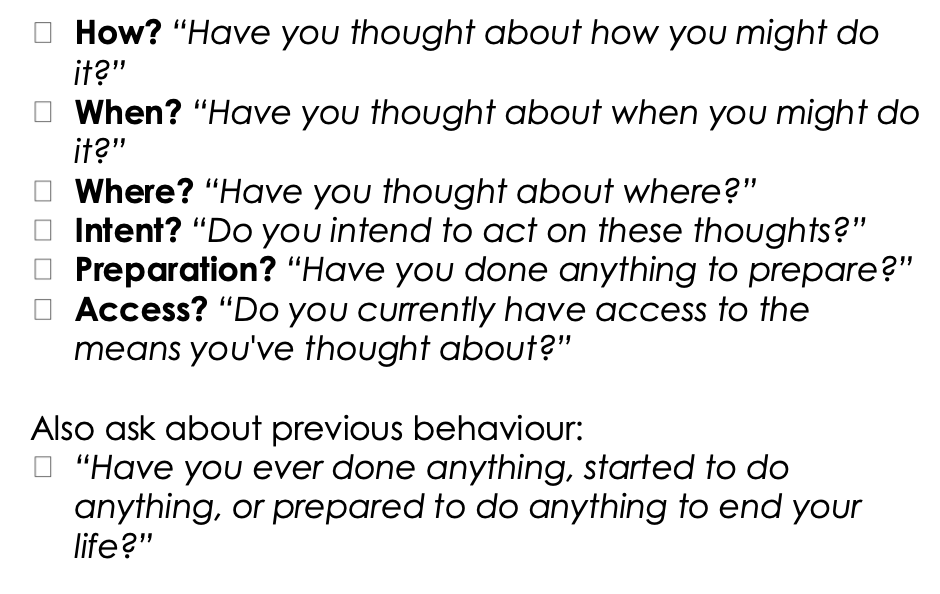
How concrete & specific is it?
If suicidal ideation is present assess method, plan, intent & preparation
thoughts alone, thoughts with intent & a specific plan with access & preparation represent very different levels of concerns
Hopelessness & plans for the future → what to do
explore whether the person sees any possibility of change
hopelessness can increase risk, but do not reinforce it by agreeing that the situation is hopeless.

Ideas & feelings of guilt → what to explore
explore guilt & perceived burdensomeness
listen for the meaning behind the guilt, rather than trying to reassure the person immediately

Real & perceived social support → what to do
assess both who is available & whether the person feels able to use that support
a support network is protective only if the person can actually access it when they need it

Values, beliefs & protective factors → what to explore
explore what keeps the person connected to life
protective factors are not

Questionnaires & standardised scales → what to do
Standardised measures complement the interview; they do not replace it
a score does not determine risk → it tells you where to explore further
Suicidal ideation & behaviour → scales
C-SSRS → suicidal ideation & suicidal behaviour
Suicidal Intent Scale (SIS) → suicidal intent
Associated factors → scales
Beck Hopelessness Scale (BHS) → hopelessness
Beck Depression Inventory (BDI) → depressive symptoms
Reasons for Living Inventory → protective beliefs & reasons for living
Assess the level of risk & decide what to do → consider
acute risk
vulnerability
protective factors
acute risk
Current suicidal ideation
Intent
Specific plan
Access to means
Preparation
Recent suicidal behaviour
Increasing intensity or frequency
Vulnerability
Previous attempts
Mental or physical illness
Substance use
Trauma or significant losses
Isolation
Protective factors
Relationships & support
Reasons for living
Future goals
Values & responsibilities
Willingness to accept help
How imminent is the risk?
What needs to happen now to keep this person safe?
if risk is acute
if risk is not acute
risk assessment is not about predicting the future with certainty → it is about identifying what is happening now & deciding what needs to happen next
If risk is acute
do not leave the person alone
follow the service's emergency protocol
involve appropriate support
reduce access to lethal means
document the assessment & decision-making.
If risk is not acute
agree on the next steps
strengthen protective factors & support,
consider developing a safety plan with the person
you own emotions → What are you going to feel
Fear of making it worse
Fear of being responsible
The urge to fix it
Wanting it to end
And afterwards: rumination
Fear of making it worse
Of asking about suicide & planting the idea.
Of naming violence & precipitating something.
Fear of being responsible
For a decision that is not yours to make, & for an outcome you cannot control.
The urge to fix it.
To tell her to leave
To make him promise.
To fill the silence after bad news with a plan.
Wanting it to end
The relief when the hour is up, & the guilt that follows the relief
And afterwards: rumination
Going over what you said, at night, for days.
all five are
ordinary & information
none of them is evidence that you have chosen the wrong profession
What to do with these emotions
Self-knowledge
Self-regulation, in the session.
Self-knowledge connected with the
four horsemen:
anxiety
urgency
pessimism
excess of responsibility
Self-regulation, in the session
A pause before you respond.
"Give me a moment to think about what you've told me."
Your own breathing.
Calmness is contagious and so is urgency
afterwards
Talk to someone the same day. Not to be reassured → to be heard.
Supervision, & a team
Know your limits & say it before you reach out
Vital experience
Your own history is in the room with you.
→ If something here is yours, that is not a reason to leave the profession —it is a reason to know it, & to have somewhere to take it.
A therapist who is frightened
A therapist who is frightened & knows it is safe
A therapist who is frightened & does not know it will either avoid the question or rush the answer