L9: Molecular Absorption Spectroscopy
 Call Kai
 Learn
Learn Practice Test
 Spaced Repetition
 Match
Match Flashcards
 Knowt Play
1/11

There's no tags or description
Looks like no tags are added yet.
Name | Mastery | Learn | Test | Matching | Spaced | Call with Kai | Chat |
|---|
No analytics yet
Send a link to your students to track their progress
12 Terms
Absorption v. Fluorescence v. Phosphorescence

Beer’s Law and Absorption Measurements
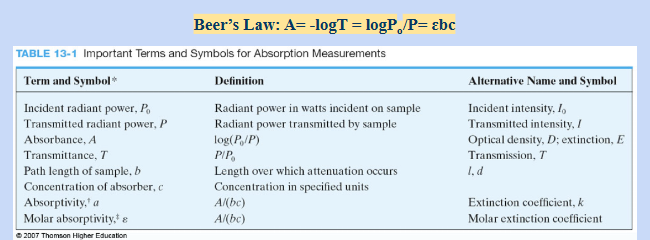
Molecular Absorption Spectroscopy Losses
reduce the intensity of transmitted radiation, which cause attenuation of the light beam
To prevent this: the power of radiation transmitted through the analyte is compared to the power transmitter through only the solvent
The difference is attributed to absorption by the analyte

Limitations of Beer’s Law
the direct proportionality between absorbance and concentration may occur only for relatively low analyte concentration
ɛ is dependent on the refractive index
while applied for polychromatic radiation, beer’s law only applies to monochromatic radiation
If the analyte molecules dissociate/associate/react with the solvent deviations occur if they cause a different absorption spectrum
Components for UV/VIS/NIR Spectroscopy
source, wavelength selector, sample, radiation transduce, signal processor
Light sources:
Deuterium and hydrogen lamps (most common light source)
D2 + Ee → D2* → D‘ + D“ + hν
Ee=ED‘ +ED“ +hν
Tungsten filament lamps: most common for VIS and NIR; Energy distribution similar to black body
Xenon Arc lamps: Passage of current through a xenon atmosphere
Sample container: Cuvette, Quartz, fused silica, silicate glasses
Single Beam Instruments

Tungsten/deuterium lamp
Measure the intensity of light before and after it passes through the sample, thus avoids
using a reference beam

Probe-type single beam instruments
Use optical fibers to deliver and collect light directly from the sample.
A mirror reflects light back through the sample to increase the effective path length.
Adjustable path lengths (1 mm–10 cm) allow analysis of samples with different concentrations

Double Beam Imstrument
Beam Splitter divides collimated light in beam into equal halves

Separtion of Beams in the double beam instrument separation
Rotating sector mirror divides the entire beam to reference cell and sample cell
Pulses of radiation combined by another sector mirror

Diode Array Instruments
Single beam instrument with a diode array transducer, fixed grating and linear array of several hundreds of photodiodes
Output onto each diode corresponds to a different wavelength

NanoDrop Spectrometer
