Bio Topic 5 -> Photosynthesis
 Call Kai
 Learn
Learn Practice Test
 Spaced Repetition
 Match
Match Flashcards
 Knowt Play
1/23

There's no tags or description
Looks like no tags are added yet.
Name | Mastery | Learn | Test | Matching | Spaced | Call with Kai | Chat |
|---|
No analytics yet
Send a link to your students to track their progress
24 Terms
Describe the light dependent reactions of photosynthesis(5)
Light excites a pair of electrons in the chlorophyll which leave the photosystem
The electrons are used in the Electron Transport Chain
Generating energy for photophosphorylation of ADP → ATP
Photolysis of water: H2O → 2H+ + ½ O2 + 2e-
NADP- is reduced to NADPH
Give 2 reasons why a cold solution containing sucrose and a buffer is used for the Hill Reaction(2)
Cold solution slows enzyme activity
Buffered solution prevents enzyme denaturation
Sucrose prevents water from osmosing out of the chloroplasts
Give a reason why a tube in the dark is used in the Hill reaction(1)
As a control, to ensure the DCPIP doesnt decolourise on its own

C

What enzyme fixates CO2?
Rubisco
Explain the relationship between structure and functions of a granum in photosynthesis(3)
Stacks of thylakoids
Increases SA
Thylakoid membranes contain chlorophyll to absorb light
Contians ATP synthase
In which part of the chloroplast does the reduction of NADP take place(1)
Stroma
Describe the role of Rubisco in the production of GALP in the light independent reaction(4)
Enzyme that bonds CO2 to RuBP to form GP in the Calvin Cycle
GP is converted to GALP
using ATP and hydrogen ion from NADPH
Describe how the membranes inside the chloroplast are involved in photosynthesis(3)
Separates the thylakoid space from the stroma
Thylakoid membrane is where the light dependent reaction occurs
maintains a high conc grad of H+ ions
Contains ATP synthase
Contains the Electron Transport Chain
Where do light independent reactions occur(1)
Stroma
Describe the roles of the products of the light dependent reactions
ATP and NADPH
ATP provides the energy required for the conversion of GP to GALP
NADPH is used to convert GP to GALP

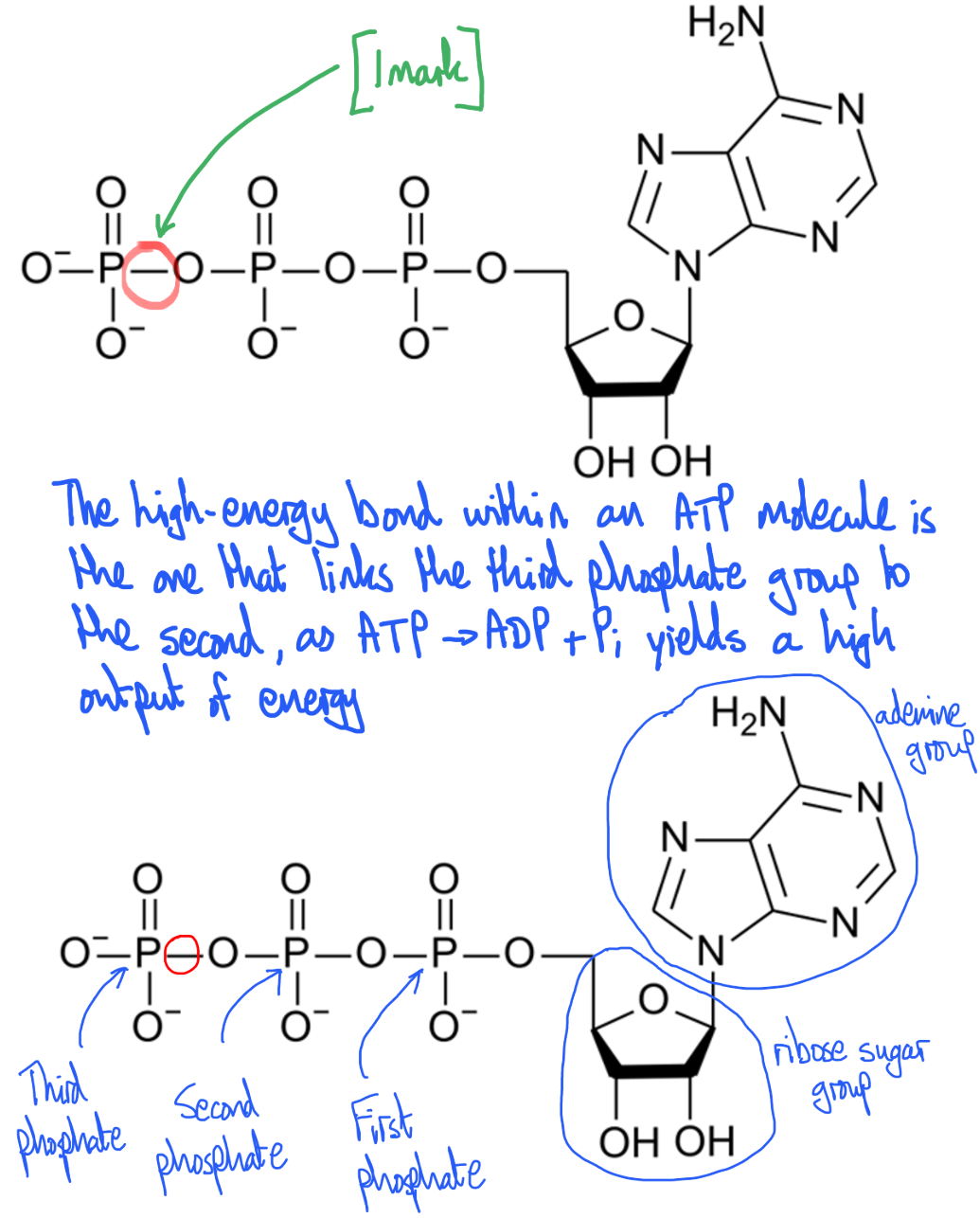
A decrease in the activity of Rubisco limits the rate of photosynthesis. Why? (2)
Less CO2 fixed in the Calvin Cycle
Less GP produced
Less GP converted to GALP so less hexose sugars produced
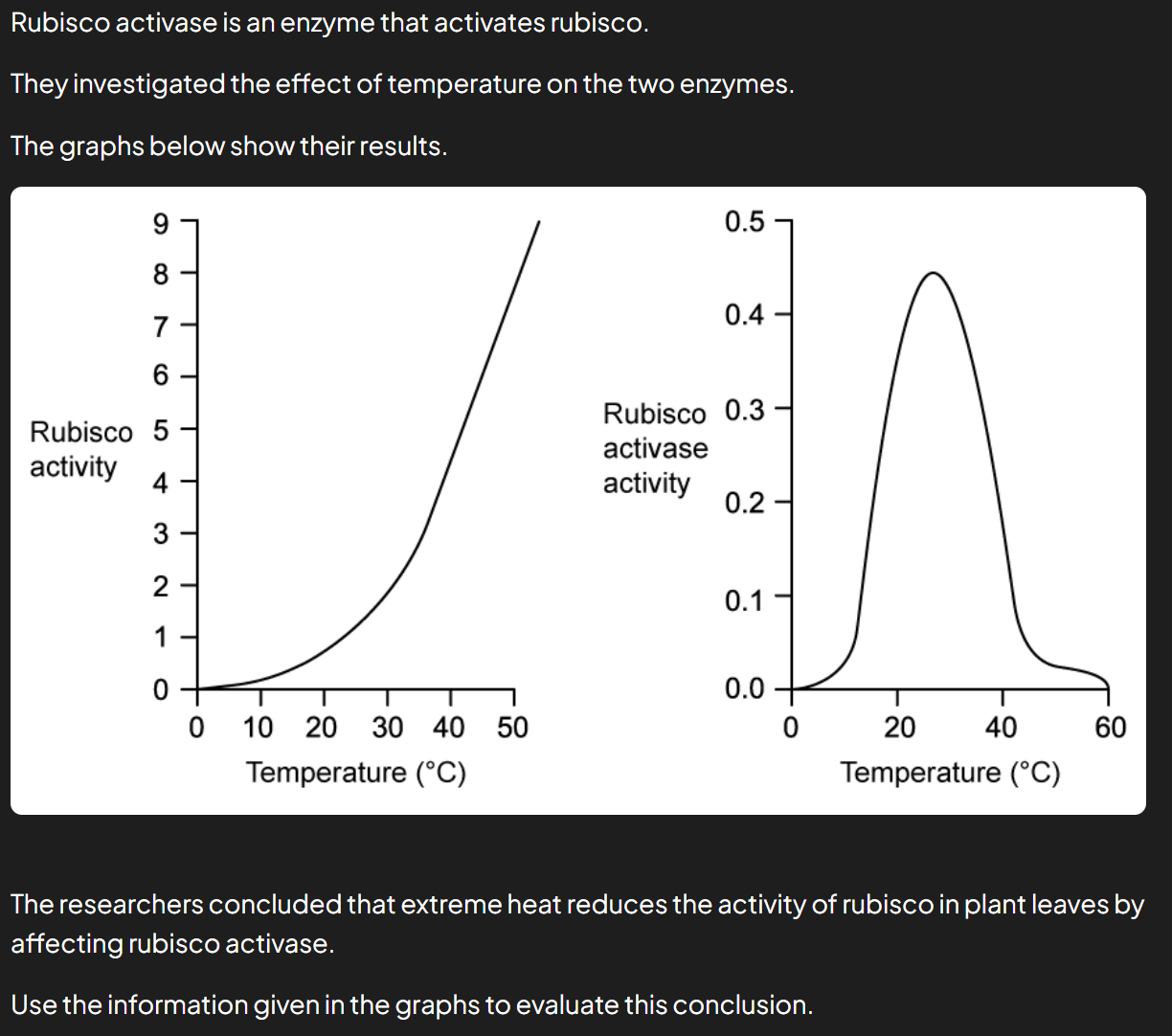
As temp increases, Rubisco activity increases
As temp increases past 30 degrees, Rubisco activase activity decreases
So Rubisco activity and Rubisco activase activity are not linked
Only one species is used in the experiment
How does CO2 reach inside a palisade mesophyll cell from the external atmosphere(2)
CO2 enters via the stomata
Passes between spongy mesophyll cells
What does fixation mean (2)
Carbon from CO2 is converted into a biological molecule
catalysed by the Rubisco enzyme
Compare and Contrast the cyclic and non cyclic nature of photophosphorylation in the light dependent stage of photosynthesis (4)
Similarities:
Both photophosphorylate ADP to ATP
Both use electrons in the Electron Transport Chain
Both use photolysis to split H20 → 2H+ + ½ O2 + 2e- to provide the electrons
Differences:
Cyclic only produces ATP whereas non - cyclic produces both ATP and NADPH
Describe the role of the electrons in the light dependent reaction of photosynthesis(4)
Replace electrons lost by the photosystem
Be used by the Electron Transport Chain
to release energy to phosphorylate ADP into ATP
Electrons and H+ ions help NADP - to convert to NADPH
Describe and explain how the products of the light dependent reaction are involved in the production of GALP(3)
ATP and NADPH
ATP provides the energy for the reduction of GP to GALP
NADPH provides H+ ions for GP to be reduced to GALP
Explain how GALP is used following its production(2)
5/6 is used to regenerate RuBP
1/6 is used to produce hexose sugars
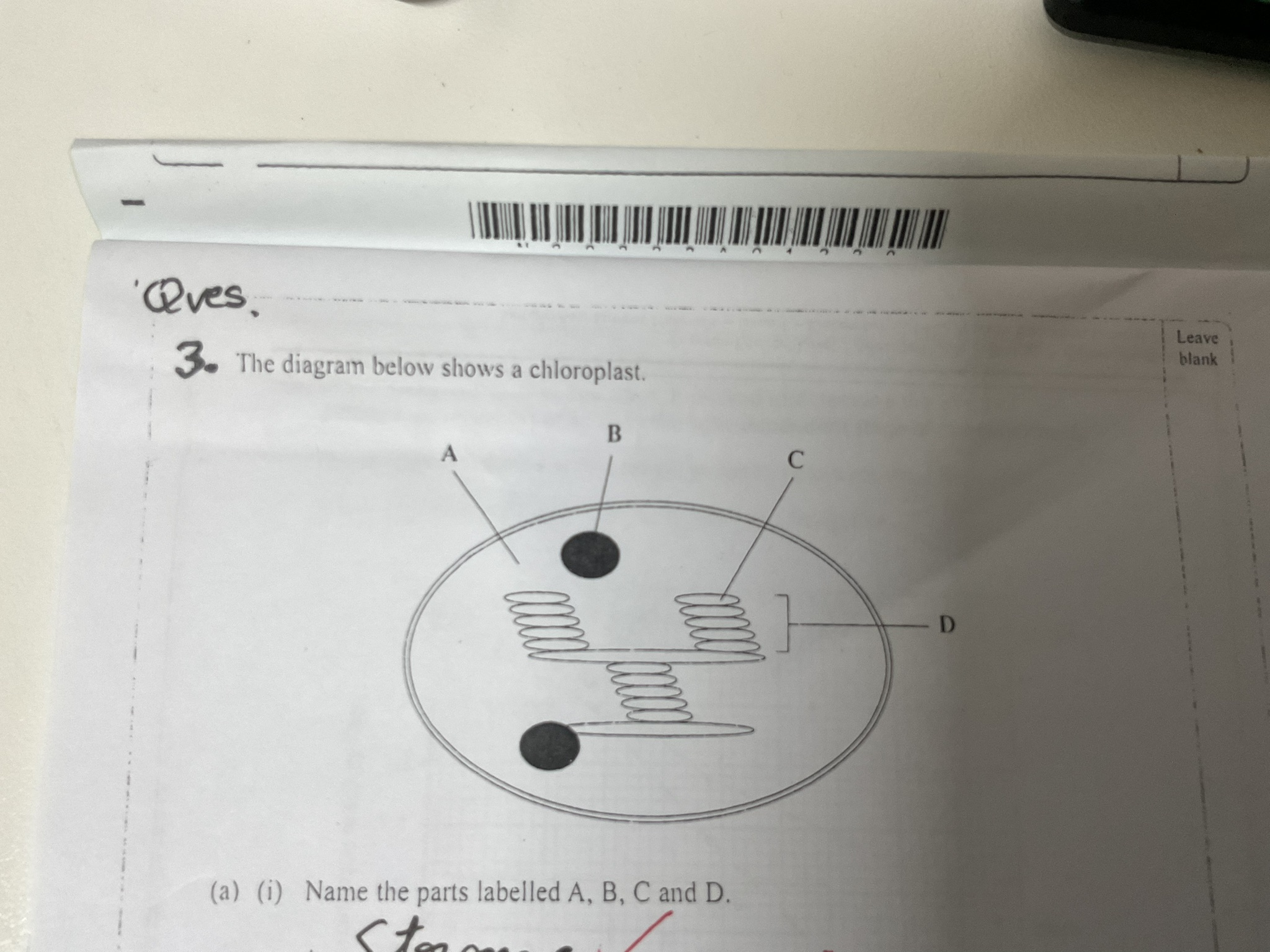
A - Stroma
B - Lipid droplet
C - Thylakoid space
D - Grana

Where in the diagram is oxygen produced(1)
Photolysis occurs in the thylakoid space
Explain how oxygen is produced in chloroplasts during photosynthesis(3)
Photolysis of water
using light energy
H20 → 2H+ + ½ O2 + 2e-
Oxygen inhibits the enzyme that catalyses the fixing of CO2. High conc of oxygen, within a chloroplast, can reduce the rate of photosynthesis. Describe and explain the effect of high concs of oxygen on the rate of carbohydrate production in a chloroplast. (3)
Less CO2 is bonded to RuBP by Rubisco
Less GP is produced
Less GP is reduced to GALP
Less GALP is converted to carbohydrates
So carbohydrate production will be reduced