Nucliec Acids
 Call Kai
 Learn
Learn Practice Test
 Spaced Repetition
 Match
Match Flashcards
 Knowt Play
1/17

There's no tags or description
Looks like no tags are added yet.
Name | Mastery | Learn | Test | Matching | Spaced | Call with Kai | Chat |
|---|
No analytics yet
Send a link to your students to track their progress
18 Terms
Polymer
-Polynucleotides or Nucliec Acids (DNA or RNA)
Monomers
Nucleotides
Bond
Covalent: Phosphodiester Bond
3 subcomponents of a Nucleic Acid Monomer:
-Pentose Sugar (2 types)
-Nitrogenous Base (5 Types)
-Phosphate Group (at least 1)
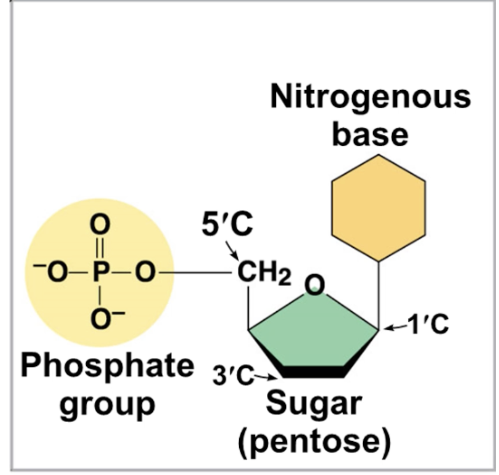
Pentose
-A term given to monosaccharide with 5 carbons: 4 will be carbons and 1 will be an oxygen
-2 types: Ribose and Deoxyribose
Ribose: Has a OH group on the 2’C - found in RNA
Deoxyribose: Only has H on the 2’C - found in DNA

Nitrogenous Base
-Nitrogenous Base = nitrogen rich
-Cystosin (C), Thymine (T), Uracil (U), Adenine (A), Guanine (C)
-2 Different Group: Pyrimidine and Purines
-Purines = 2 rings with 9 atoms
-Pyrimidines = 1 ring with 6 atoms
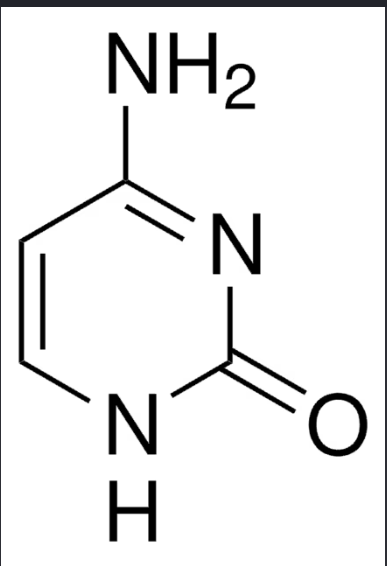
Cytosine
-Pyrimidine
-Has an Amino Group
-Found in both DNA and RNA
-No methyl group
-Double bounded N within ring
Thymine
-Pyrimidine
-Two Carbonyl Groups
-Methyl Group
-Found in DNA

Uracil
-Pyrimidine
-Two carbonyls
-Lacks methyl group
-Found in RNA

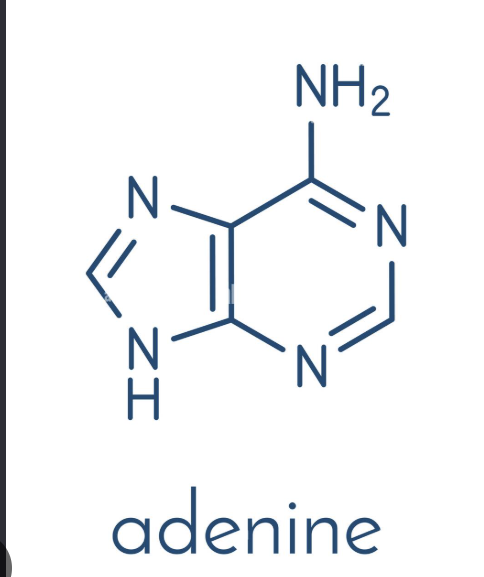
Adenine
-Purine
-Have an amino group
-Has a total of 3 N double bonds
-Found in DNA and RNA
Guanine
-Purine
-Carbonyl group
-Amino Group
-Found in DNA and RNA

Nucleotide Nomenclature
Nitrogenous Base = 1,2,3,4,5,
Carbons of Pentose Sugar = 1’,2’, 3’. 4’, 5’
Nitrogenous Base is attached to 1’ Carbon
Phosphate group is attached to 5’C
-Linkage between phosphate and carbon is a covalent bond
Name = nitrogenous base, sugar, and how many phosphates
Nitrogenous Base = Adenine
Sugar = Ribose
3 Phosphates (TRI)
Nucleoside
Sugar and Nitrogenous Base only
Directional Synthesis in Nucleic Acid
When nucliec acids are synthesized in cells, new nucleotides are always going to be added to the 3’ Hydroxyl Group of the pentose
3’ has a free hydroxyl group to react w/carbons so that the hydroxyl group get kicked out
5’ has a free phosphate group
3’ carbon is where the phosphate of another nucleotide ends up attaching, the phosphate is attached to the 5’ carbon of that nucleotide, so the phosphodiester bond is between 3’ and 5’ carbon of 2 different nucleotides
DNA Structure
Double helix
Sides of the ladder are made of the sugar-phosphate backbone (deoxyribose and phosphate group)
rungs of the ladder are made up of nitrogenous base pairs (held together through HYDROGEN BONDS: a purine with a pyrimidine
Double Helix is antiparallel: goes from: 5’ to 3’ and 3’ to 5’

DNA Base Pairing
Adenine (A) ↔ Thymine (T) → 2 hydrogen bonds
Guanine (G) ↔ Cytosine (C) → 3 hydrogen bonds
RNA Base Pairing
Adenine (A) ↔ Uracil (U) → 2 hydrogen bonds
Guanine (G) ↔ Cytosine (C) → 3 hydrogen bonds
Directional Synthesis
-The additional nucleotide must be added to the growing polypeptide at a specific carbon (specific position on the nucleotide)
-The 3’ carbon of one nucleotide holds a hydroxyl which is kicked out by a phosphate group of another nucleotide
-Since the new groups are always added to this 3’ position, the polynucleotide is said to be built in the 5’ —> 3’ direction