AP PSYCH: Unit 2
 Call Kai
 Learn
Learn Practice Test
 Spaced Repetition
 Match
Match Flashcards
 Knowt Play
1/124

There's no tags or description
Looks like no tags are added yet.
Name | Mastery | Learn | Test | Matching | Spaced | Call with Kai | Chat |
|---|
No analytics yet
Send a link to your students to track their progress
125 Terms
Nature vs. Nurture
Biology makes us who we are vs. surrounding environment
Maturation
Process of following genetic plan
Twin Studies
A research design in which hereditary influence is assessed by comparing the resemblance of identical twins and fraternal twins with respect to a trait.
Adoption Studies
assess hereditary influence by examining the resemblance between adopted children and both their biological and their adoptive parents
Neuron
a specialized cell transmitting nerve impulses; a nerve cell.
Dendrite
the bushy, branching extensions of a neuron that receive messages and conduct impulses toward the cell body
Soma
Body/Cell
Axon
the extension of a neuron, ending in branching terminal fibers, through which messages pass to other neurons or to muscles or glands
Terminal Branches
form junctions with other cells, breaks off at end of axon
terminal buttons
Small knobs at the end of axons that secrete chemicals called neurotransmitters
myelin sheath
covers the axon of some neurons and helps speed neural impulses
action potential
firing of a neuron by sending an electrical charge down the axon
threshold
the level of stimulation required to trigger a neural impulse
refractory period
a period of inactivity after a neuron has fired
neural communication
The body's information system is built from billions of interconnected cells called neurons.
synapse
the junction between the axon tip of the sending neuron and the dendrite or cell body of the receiving neuron
- tiny gap between neurons
- protoplasmic kiss
reuptake
process by which neurotransmitters are taken back into the synaptic vesicles
Neurotransmitters
chemical messengers that cross the synaptic gaps between neurons
acetylcholine
A neurotransmitter that enables learning and memory and also triggers muscle contraction (alzheimers)
endorphins
natural, opiate-like neurotransmitters linked to pain control and to pleasure (feel good after workout)
dopamine
influences movement, learning, attention, and emotion (parkinson's disease, schizophrenia)
serotonin
Affects mood, hunger, sleep, and arousal (too little leads to depression)
Norepinephrine
helps control alertness and arousal (adrenaline)
agonists
drugs that increase the action of a neurotransmitter
Antagonist
drugs that block/inhibit activity
depressants
drugs that reduce neural activity and slow body functions (alcohol, opiates, barbiturates)
stimulants
drugs that excite neural activity and speed up body functions (caffine, cocaine, nicotine)
hallucinogens
psychedelic ("mind-manifesting") drugs, such as LSD, that distort perceptions and evoke sensory images in the absence of sensory input
Nervous System
the body's speedy, electrochemical communication network, consisting of all the nerve cells of the peripheral and central nervous systems
central nervous system (CNS)
brain and spinal cord
peripheral nervous system (PNS)
the sensory and motor neurons that connect the central nervous system to the rest of the body
skeletal/somatic nervous system
the division of the peripheral nervous system that controls the body's skeletal muscles
autonomic nervous system (ANS)
a set of nerves that carries involuntary and automatic commands that control blood vessels, body organs, and glands
Sympathetic Nervous System (SNS)
The component of the autonomic nervous system that responds to stressful situations by initiating the fight-or-flight response.
parasympathetic nervous system
the division of the autonomic nervous system that calms the body, conserving its energy
sensory neurons (afferent)
neurons that carry incoming information from the sensory receptors to the brain and spinal cord (CNS)
Interneurons (association neurons)
found in neural pathways in the CNS, connect sensory and motor neurons
motor neurons (efferent)
neurons that carry outgoing information from the brain and spinal cord to the muscles and glands
nerves
bundled axons that form neural "cables" connecting the central nervous system with muscles, glands, and sense organs
reflexes
specific patterns of motor response that are triggered by specific patterns of sensory stimulation
neural networks
interconnected neural cells
endocrine system
the body's "slow" chemical communication system; a set of glands that secrete hormones into the bloodstream
hormones
chemical messengers that are manufactured by the endocrine glands, travel through the bloodstream, and affect other tissues
adrenal glands
a pair of endocrine glands that sit just above the kidneys and secrete hormones (epinephrine and norepinephrine) that help arouse the body in times of stress.
pineal gland
secretes melatonin
thyroid
regulates metabolism
pituitary gland
The endocrine system's most influential gland. Under the influence of the hypothalamus, the pituitary regulates growth and controls other endocrine glands.
lesion
tissue destruction. A brain lesion is a naturally or experimentally caused destruction of brain tissue
Electroencephalogram (EEG)
record of the electrical activity of the brain
Computerized Axial Tomography (CAT)
Uses multiple X-Rays to create a 3D model of the brain. Only shows structure, not function
Positron Emission Tomography (PET)
a method of brain imaging that assesses metabolic activity by using a radioactive substance injected into the bloodstream
magnetic resonance imaging (MRI)
brain-imaging method using radio waves and magnetic fields of the body to produce MOST detailed images of the brain
- atoms spin, giant magnet of MRI lines them up
functional magnetic resonance imaging (fMRI)
MRI that shows changes in metabolic activity over time
brainstem
the oldest part and central core of the brain, beginning where the spinal cord swells as it enters the skull; the brainstem is responsible for automatic survival functions
medulla
the base of the brainstem; controls heartbeat and breathing
pons
where the spinal cord swells a lot
- helps coordinate movement (bridge to the cerebellum)
- bladder control, sleep paralysis
thalamus
the brain's sensory switchboard, located on top of the brainstem; it directs messages to the sensory receiving areas in the cortex and transmits replies to the cerebellum and medulla
Cerebellum (little brain)
A large structure of the hindbrain that controls fine motor skills.
limbic system
neural system located below the cerebral hemispheres; associated with emotions and drives
amygdala
A limbic system structure involved in memory and emotion, particularly fear and aggression.
Hypothalamus
A neural structure lying below the thalamus; it directs several maintenance activities (eating, drinking, body temperature), helps govern the endocrine system via the pituitary gland, and is linked to emotion and reward.
Hippocampus
A neural center located in the limbic system that helps process explicit memories for storage.
reticular formation
a nerve network that travels through the brainstem and thalamus and plays an important role in controlling arousal
corpus callosum
the large band of neural fibers connecting the two brain hemispheres and carrying messages between them
cerebral cortex
The intricate fabric of interconnected neural cells covering the cerebral hemispheres; the body's ultimate control and information-processing center.
glial cells
cells in the nervous system that support, nourish, and protect neurons
Frontal Lobes (Prefrontal Cortex)
most frontal region of the frontal lobe; involved in higher-order cognitive processes (planning, decision making, emotional control)
motor cortex
an area at the rear of the frontal lobes that controls voluntary movements
parietal lobes
portion of the cerebral cortex lying at the top of the head and toward the rear; receives sensory input for touch and body position
somatosensory cortex
area at the front of the parietal lobes that registers and processes body touch and movement sensations
occipital lobes
portion of the cerebral cortex lying at the back of the head; includes areas that receive information from the visual fields
visual cortex
The visual processing areas of cortex in the occipital and temporal lobes.
temporal lobes
portion of the cerebral cortex lying roughly above the ears; includes the auditory areas, each receiving information primarily from the opposite ear
auditory cortex
the area of the temporal lobe responsible for processing sound information
association areas
areas of the cerebral cortex that are not involved in primary motor or sensory functions; rather, they are involved in higher mental functions such as learning, remembering, thinking, and speaking
Aphasia
impairment of language, usually caused by left hemisphere damage either to Broca's area (impairing speaking) or to Wernicke's area (impairing understanding).
broca's area
Controls language expression - an area of the frontal lobe, usually in the left hemisphere, that directs the muscle movements involved in speech.
Wernicke's area
controls language reception - a brain area involved in language comprehension and expression; usually in the left temporal lobe
Angular Gyrus
transforms visual representations into an auditory code
brain plasticity
The capacity for the brain to alter its structure and function.
neurogenesis
the formation of new neurons
left hemisphere of brain
The left hemisphere of the brain is responsible for control of the right side of the body, and is the more academic and logical side of the brain.
right hemisphere of brain
The right hemisphere of the brain is responsible for control of the left side of the body, and is the more artistic and creative side of the brain.
split brain
a condition resulting from surgery that isolates the brain's two hemispheres by cutting the fibers (mainly those of the corpus callosum) connecting them
consciousness
our awareness of ourselves and our environment
Freud's Iceberg Theory
The mind is like an iceberg. It is mostly hidden, and below the surface lies the unconscious mind. The preconscious stores temporary memories.
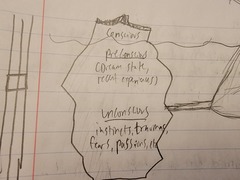
subconscious/unconscious
not fully aware; occurring below your level of thinking and awareness
circadian rhythm
the biological clock; regular bodily rhythms that occur on a 24-hour cycle
automatic processing
unconscious encoding of incidental information, such as space, time, and frequency, and of well-learned information, such as word meanings
parallel processing
the processing of many aspects of a problem simultaneously; the brain's natural mode of information processing for many functions, including vision. Contrasts with the step-by-step (serial) processing of most computers and of conscious problem solving.
suprachiasmatic nucleus
a pair of cell clusters in the hypothalamus that controls circadian rhythm
-controlled by light to slow production of melatonin (hormone) from pineal gland
Melatonin
A hormone manufactured by the pineal gland that produces sleepiness.
sleep cycle
passage through the four stages of NREM sleep (I, II, III, IV), then reversal (IV, III, II), and finally, instead of reentering stage I and awakening, entering REM sleep and returning to stage II
- as night goes on deep sleep/stage 4/NREM-3 gets shorter
- REM gets longer
why we sleep
- brain repair, reorganization, readiness
- memory
- conserve energy
- physical health: immune system strengthens and fights during sleep
- growth: pituitary gland releases growth hormone during deep sleep, can impact strength/performance/recovery physically and/or athletically
alpha waves
the relatively slow brain waves of a relaxed, awake state
Stage 1 NREM-1
2-5 minutes of light sleep
- brainwaves, breathing, slow
- hallucinations (false sensory experiences) may occur
- dreamlike sensations (see yourself doing something)
- hypnic jerk often occurs (sleep quake)
Stage 2 NREM-2
20 minutes long, clearly asleep
- happens on the way down to deep sleep and the way back up
- sleep spindles: bursts of brain activity
- may lead to sleep talking, this stage is where most sleep talking occurs
Stage 3 NREM-3
30 minutes long
- short transition period
Stage 4 NREM-4
deep sleep
- process some stimuli, ignore most
- may sleep walk, wet the bed
delta waves
the large, slow brain waves associated with deep sleep