ACER Lecture #23: Reaction Mechanisms and Rate-Determining Step
 Call Kai
 Learn
 Practice Test
 Spaced Repetition
 Match
 Flashcards
 Knowt Play
1/17

There's no tags or description
Looks like no tags are added yet.
18 Terms
What is an elementary reaction?
a reaction that proceeds in a single step, through simultaneous collision of reactants and direct formation of products
How do you determine the reaction order for an elementary reaction?
It can be determined directly from reaction stoichiometry (unlike overall reactions where reaction order must be determined experimentally).
Compare unimolecular, bimolecular, and termolecular elementary reactions.
An unimolecular elementary reaction only involves one reactant molecule.
A bimolecular elementary reaction involves two reactant molecules.
A termolecular elementary reaction involves the simultaneous collision of three reactant molecules, which is not very likely to occur.
Most reactions are unimolecular or bimolecular.
An asterisk next to a chemical in a reaction formula indicates…
that that chemical is energized
Are solvents included in elementary reactions or rate expressions? Explain.
Though present, solvents usually remain at a constant concentration and thus are not included in the elementary reaction or rate expression.
What is an intermediate?
any chemical in the reaction mechanism that isn’t in the overall reaction
Why is it difficult to identify intermediates?
They are often very short-lived and hard to detect.
What is the principle of detailed balance?
What is a formula that can represent this?
At equilibrium, the rate of each elementary process is equal to the rate of its reverse process.
k1 = k-1 (or k1’)
How can you use the rates of elementary steps of a reaction to determine the overall equilibrium constant?
K1 = k1/k-1 so Keq = K1K2K3 … = (k1k2k3 … )/(k-1k-2k-3 … )
What is the rate-determining step?
Why is it important?
The elementary step in a reaction that is significantly slower than all the other steps
The rate law of the rate-determining step, adjusted to not included any intermediates, is the rate law of the overall reaction.
When do you use pre-equilibrium approximation?
the rate determining step is preceded by a fast equilibrium step (reversible)
Pre-equilibrium approximation assumes that…
elementary reactions before the rate-determining step are in equilibrium
What are the steps to use pre-equilibrium approximation?
Include a formula.
Write an equation representing the preceding (fast equilibrium) reaction at equilibrium. It is in the form of K1 = k1/k-1 = [products]/[reactants].
Isolate the intermediate on one side.
Substitute it into the rate law of the rate-determining step, to get a rate law expression for the overall reaction without any intermediates.
When is steady state approximation (SSA) used?
When you do not have information about the rates of the individual steps, and do not know which step is the rate-determining step
Steady state approximation assumes that…
concentrations of reactive intermediates remain approximately constant and low throughout most of the reaction
Why is pre-equilibrium approximation and steady state approximation used?
to remove the intermediates (consumed before the rate-determining step) from the rate law of the overall reaction
What are the steps to use steady state approximation?
Include the formula(s).
As an example, use this general equation: A + B (reactants) ⇌ Intermediate → Product
Assume/set the net rate of change of the intermediate to zero. d[Intermediate]/dt ≈ 0
Because the net rate is zero, the rate of production (sum of all steps producing it) is the same as the rate of consumption (sum of all steps consuming it). Thus, you can write:
k1[A][B] = k-1[I] + k2[I]Rearrange this net rate law equation to isolate the intermediate. [I] = k1[A][B] / (k-1 + k2)
Plug this expression into the rate of product formation, rate = k2[I], to get the overall rate law with no more intermediates remaining.
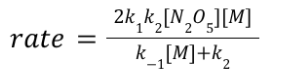
Take the overall rate law for the energization of N2O5:
How may changes in pressure affect the rate law and the overall reaction order?
Low pressure: When [M] is small, k2 >> k1’ [M] so we can basically ignore k’[M] and get:
rate ∝ k1[N2O5][M]
The overall reaction order is two.
High pressure: When [M] is large, k–1[M] >> k2 so we can basically ignore k2 and get:
rate ∝ k1k2[N2O5]/k-1
The overall reaction order is one.