Physics U6
 Call Kai
 Learn
 Practice Test
 Spaced Repetition
 Match
 Flashcards
 Knowt Play
1/29

There's no tags or description
Looks like no tags are added yet.
30 Terms
State the reason for using a small displacement in oscillations? (3 reasons)
To ensure the conditions for SHM (Simple harmonic motion)
To ensure angle is small
To ensure time period is independent of amplitude

Velocity is at a maximum
(So) uncertainty in time is reduced
This is the (only) fixed point (in the oscillation)
Whereas amplitude may vary (because of damping)
Why may a value be inaccurate? On a curved graph.
No repeats shown.
Best fit line is uncertain because it’s a curve
Not enough readings around the maximum value.
State one reason for using the thickness of the folded sheet rather than an unfolded sheet?
Larger distance reduces the percentage uncertainty
Explain one other technique she should use to ensure that the measurement of the thickness of the folded sheet is accurate. (2)
1)
Repeat at different places and calculate a mean
to reduce (the effect of) random errors
2)
Check for zero error (on the micrometer)
to eliminate systematic error
3)
Take measurements away from the folded edge
as the fold will be thicker Or to reduce (the effect of) random errors
State what is meant by damping?
Energy is (permanently) removed/dissipated (from the system) Or energy is lost from the system
Resulting in a decrease in amplitude
The student modified the experiment by using a data logger attached to a position sensor. Explain how this may lead to a more accurate value for A. (2)
High sampling rate near the maximum displacement
Parallax error at the maximum displacement is eliminated
What is a systemic error?
An error that adds a constant amount to the measurement
Repeat readings for diameter
To reduce the effects of random error
Or as ball may not be uniform
Or as difficult to measure a sphere using vernier calipers
Or to (identify and) remove anomalous readings
What is resonence?
Driving frequency is at natural frequency and the amplitude is maximum


6 MARKER


After plotting the graph, the student modified his prediction.
He suggested that the relationship between T and I is
T = kI ^n
where k is a constant. Justify this suggestion. (4)

Techniques to use?
Check for zero error to eliminate systemic error.
Take repeat readings (AND at different places/orientations in a circles/spheres) to reduce the effect of random errors.
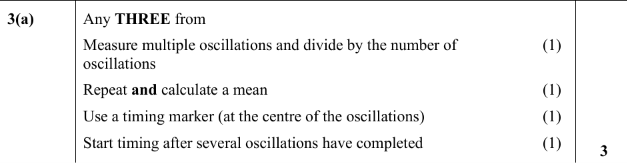
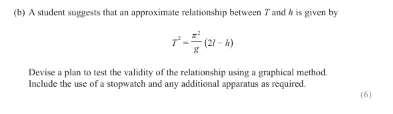
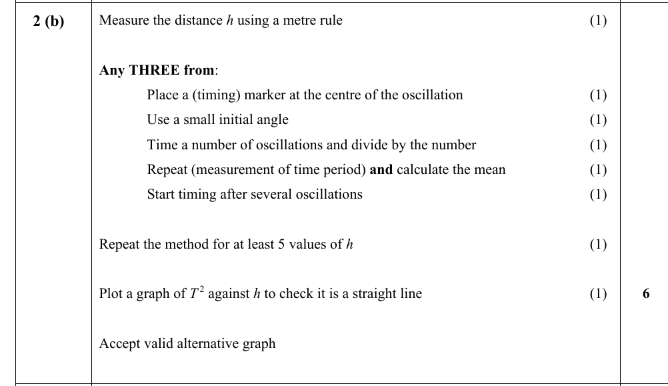
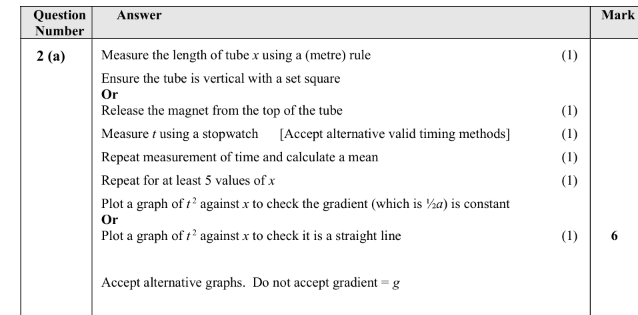
Describe how the time period of the oscillations should be measured to make the readings as accurate as possible. (3)

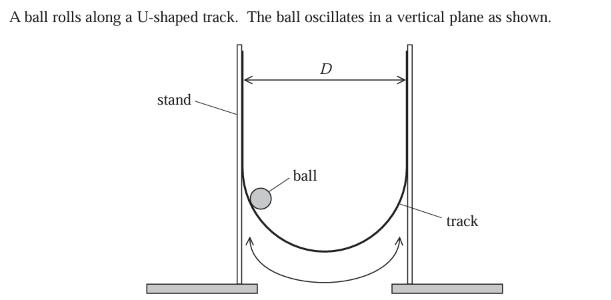
Describe how a single measure of D should be made accurately. (2)
Use a metre rule and set square (to ensure metre rule is horizontal) (1)
View metre rule perpendicularly (to avoid parallax error) (1)
State one safety precaution the student should take during a capacitor investigation
Ensure working p.d is not exceeded and capacitor is fully discharged.

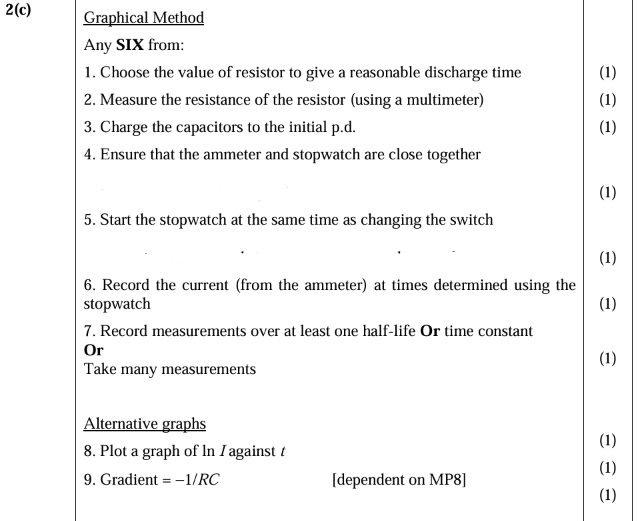
The student had a stopwatch. Describe how the student should determine an accurate value for the total capacitance of the capacitors. (6) 6 MARKER
To state mathamatical relationships what do we do?
Find values of constant and state relationship (original, not linearized)


One significant source of error in this experiment is the uncertainty in the mass reading due to the water moving as it boils. Explain how another significant source of error affects the value of L. (3)



Identify two other control variables for this investigation. (2)
Explain one improvement the student could make to reduce the uncertainty in the measurement of ∆θ for each value of I. (2)
1) volume (of water)
Time
distance between resistor and thermometer
2) Insulate the beaker Or cover the beaker To reduce the amount of energy transfer to the environment
Stir the water Or ensure thermometer is close to the resistor To ensure the water is at the same temperature as the resistor


The capillary tube was attached to a 30 cm ruler and placed in a beaker of water at room temperature. The water was heated gradually and θ was measured using a thermometer. (i) State two techniques that should be used to ensure the measurement of θ is as accurate as possible. (2)
Stir the water Place the thermometer close to the capillary tube

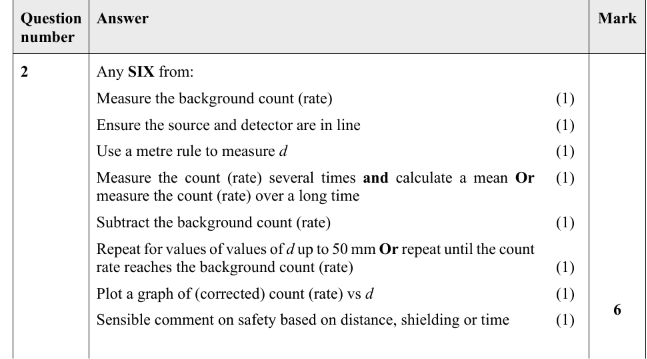
A radioactive source emits beta radiation and gamma radiation. (a) State two precautions that should be taken when using this source. (2)


