Module 9 - Energy and Metabolism
 Call Kai
 Learn
 Practice Test
 Spaced Repetition
 Match
 Flashcards
 Knowt Play
1/24

Earn XP
Description and Tags
included on exam 3
25 Terms

free energy
energy that can be converted to do work
if negative, a reaction is spontaneous (increases disorder of the universe)
reflects the degree to which a reaction creates a more disordered state of the universe
second law of thermodynamics
the universe tends toward disorder
e.g. increasing order in a cell generates heat → that heat dissipates and increases disorder outside the cell
overall, even though the cell is more ordered, disorder (entropy) of the entire universe overall increases
also applies to chemical reactions
energy
the capacity to perform work
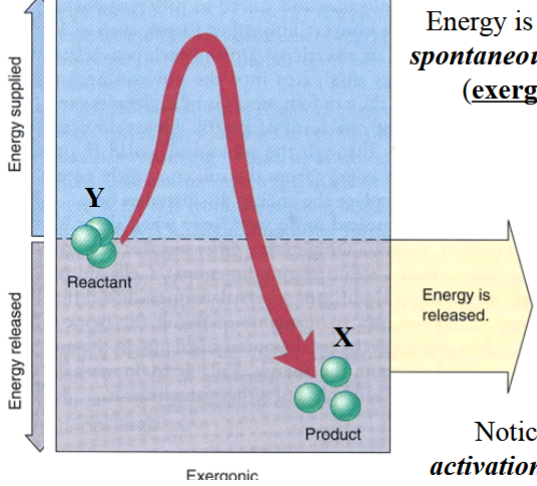
exergonic
spontaneous, as a reaction
energy is released
notice: energy of the product is less than energy of the reactant
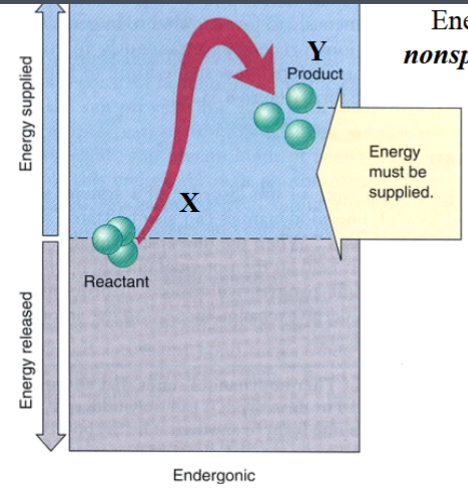
endergonic
nonspontaneous, as a reaction
energy is consumed
notice: energy of the product is greater than energy of the reactant
the second law of thermodynamics applying to chemical reactions
building a more complex/ordered molecule decreases entropy in a cell → is energetically unfavorable (e.g. condensation)
breaking bonds in a molecule increases energy in a cell → is energetically favorable (e.g. hydrolysis)
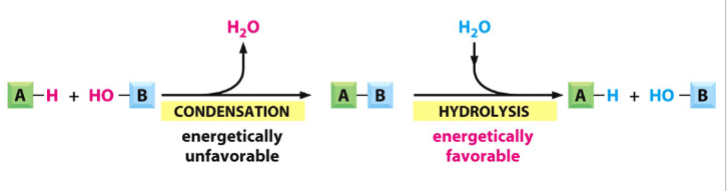
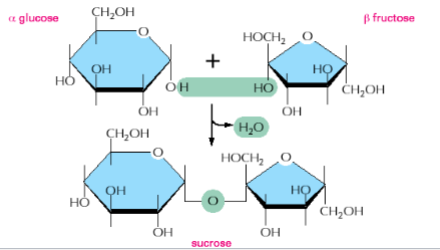
dehydration synthesis
a non-spontaneous that produces a water (H from one molecule, OH from another)
e.g. disaccharide synthesis
results in an increase in molecular order → requires energy
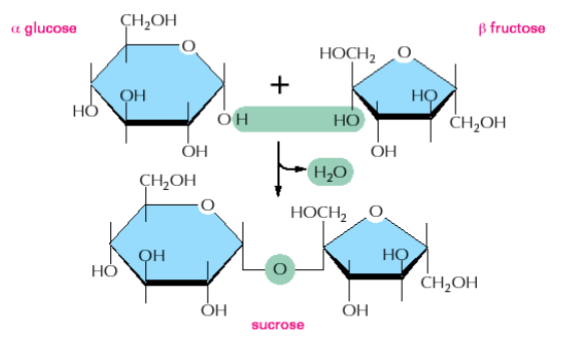
hydrolysis
a spontaneous reaction that consumes a water (H goes to one molecule, OH goes to another)
e.g. breaking down of a disaccharide into monosaccharides
results in a decrease in molecular order → more favorable
equilibrium
the state during which both directions of a reaction occur with the same frequency
eg. X→Y = Y→X
note: does NOT mean amount of X = amount of Y
DOES mean that no net change in the amount of reactant and product occurs
metabolism
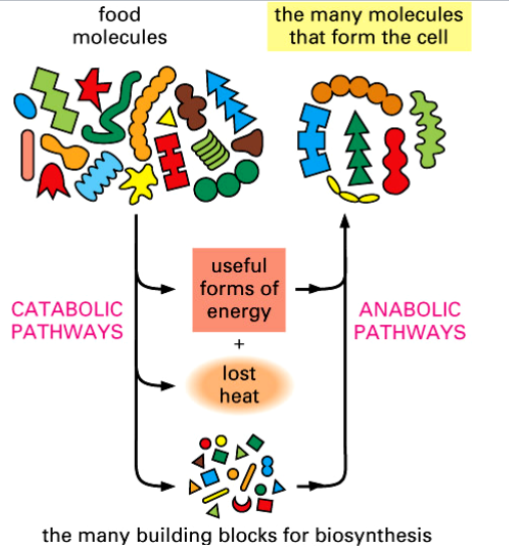
the web of continuous and sequential chemical reactions that harvest energy and make cell components
very complex
in living cells: the end products are consumed (energy is spent) → metabolic reactions occur mostly in the forward direction
consists of catabolic and anabolic reactions
all reactions in a living organism cannot reach equilibrium, because then necessary gradients and differences would not keep the organism functioning
spontaneity vs speed
spontaneity does not mean a reaction will happen quickly
sometimes activation energy is so great that it hinders a reaction
enzymes are needed to speed up these reactions by lowering activation energy
e.g. breakdown of sucrose → glucose and fructose; glycosidase speeds it up vastly
enzymes
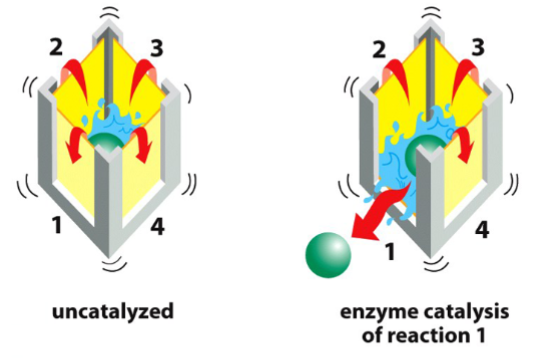
proteins that act as biological catalysts by accelerating specific chemical reactions
cause specific transformations to be favored
lower activation energy
different ones can be employed by the cell to catalyze different reactions in a pathway, to ensure that pathways proceed in the correct sequence
note: they DO NOT change the equilibrium point, only the rate at which reactions go toward equilibrium
forcing endergonic reactions
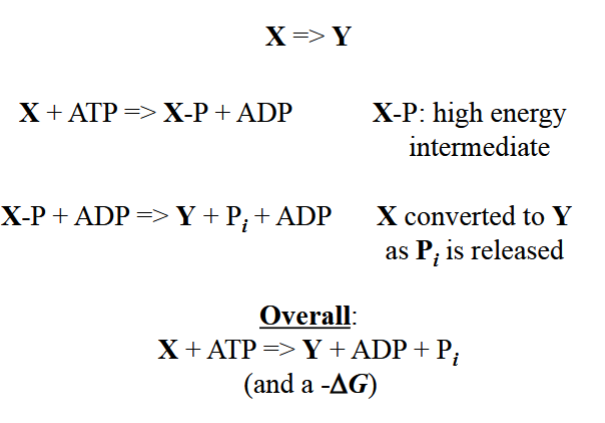
enzymes can catalyze a nonspontaneous reaction, but need an energy source, e.g. ATP
unfavorable reactions can be coupled with favorable reactions to make the overall multistep process favorable
e.g. conversion of Glu to Gln (condensation) is coupled with ATP hydrolysis (high-energy intermediate is made in the process) (see slide 37 for illustration)
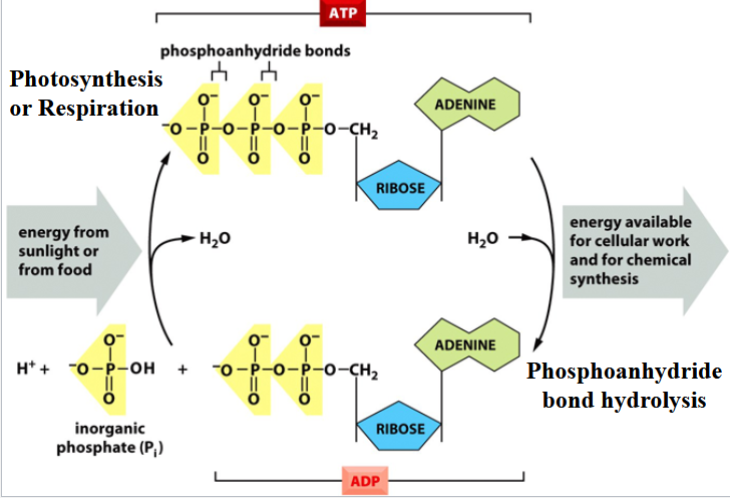
ATP
adenosine triphosphate
a ribonucleotide
energy carrier: source of useful available energy, because of high-energy phosphoanhydride bonds
hydrolysis (ATP → ADP + Pi) is energetically favored
energy released from hydrolysis can be used to drive other (nonspontaneous) reactions
released Pis can make higher-energy bonds with many proteins and metabolic intermediates
respiration
the harvesting of the energy stored in macromolecules, e.g. sugars and macromolecules
energy from macromolecules is transferred to smaller carrier molecules (useful)
consumes oxygen
releases CO2 and water
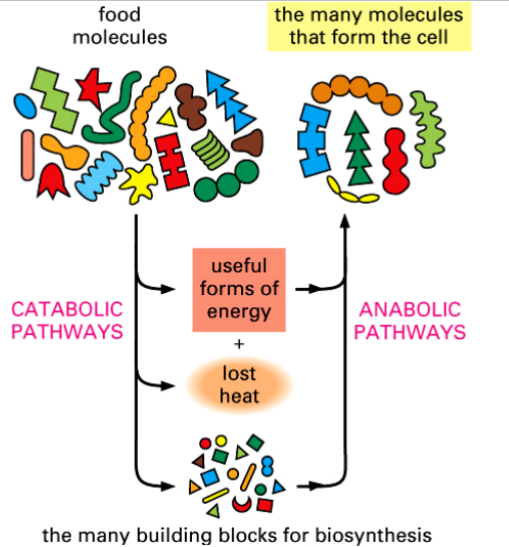
catabolic reactions
the respiration side of metabolism
breakdown of food molecules into basic components
energy is released from food molecules and transferred to carrier molecules
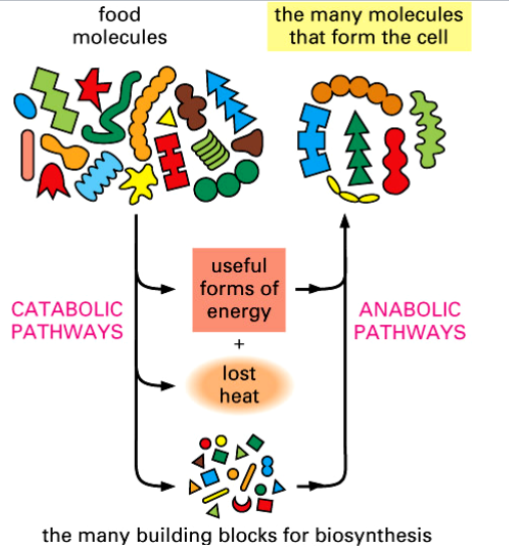
anabolic reactions
the biosynthesis side of metabolism
products of food breakdown are used as building blocks for synthesis of macromolecules (cell constituents)
require energy from energy carriers
photosynthesis
how energy enters living organisms
energy from sunlight is used to build sugars
C is obtained from atmospheric CO2
water is consumed
oxygen is released
energy stores are generated as sugars, which can then be harvested by all organisms (via respiration)
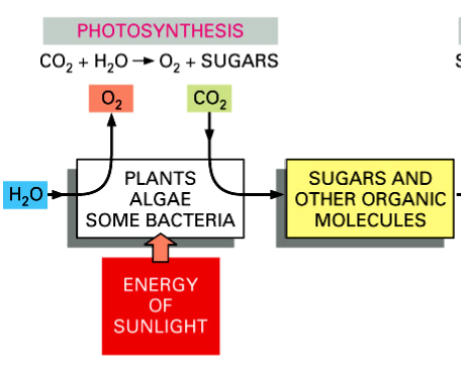
relation between photosynthesis and aerobic respiration
reverse reactions of each other
products of photosynthesis are needed by respiration
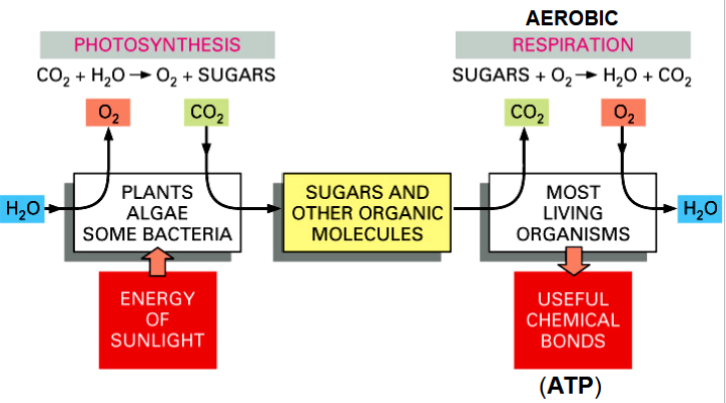
how cells harvest energy from sugars
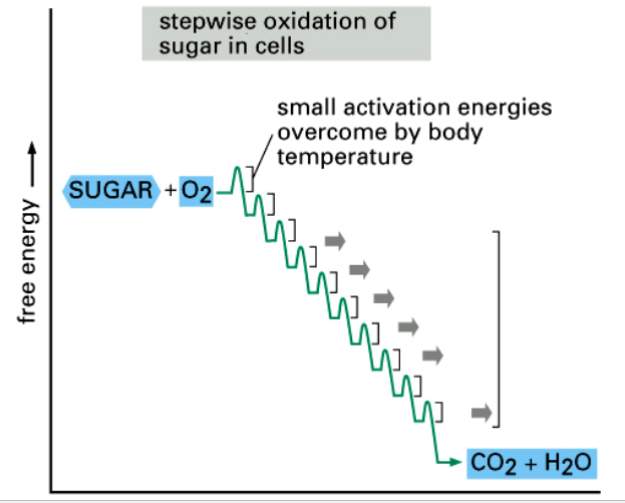
single-step process cannot be used, because all energy would be released in that one reaction and most would be wasted as dissipated heat
instead: "slow burning” occurs, gradually releasing small energy pockets
activation energies are lowered by enzymes, overcome by body temperature
small energy pockets can be stored in energy carrier molecules while minimizing energy lost as dissipated heat
oxidation
a reaction in which a molecule or atom loses electrons
energetically favored
always coupled with reduction
common molecules that get oxidized: NADH, NADPH, FADH2
reduction
a reaction in which a molecule or atom gains electrons
energetically unfavorable
always coupled with oxidation
e.g. intermediates that receive electrons and protons from oxidized NADH, NADPH, or FADH2
examples of high-energy molecules/carriers
ATP and GTP: phosphoanhydride bonds store energy pockets, can be used by cell to drive unfavorable reactions when hydrolyzed
NADH, NADPH, FADH2: can be oxidized; electrons and protons can be transferred to metabolic intermediates → intermediates get reduced
acetyl coA: intermediate of aerobic respiration; has a thioester bond that releases a lot of energy when hydrolyzed
NADH vs NADPH
difference: NADH is the electron carrier in cellular respiration, NADPH is the electron carrier in photosynthesis
similarities: both are electron carriers; both accept 2 electrons and 1 proton to become reduced from NAD+/NADP+ to NADH/NADPH (result in a new high-energy C-H bond)
note: reduction occurs to oxidize another target molecule
note: the reverse is also true: NADH/NADPH can be oxidized to NAD+/NADP+ in order to reduce another molecule
FAD/FADH2
FAD (oxidized form) can accept 2 electrons and 2 protons to be reduced to FADH2
vice versa also occurs