Pre-Calc Unit 4 Test Review
 Call Kai
 Learn
Learn Practice Test
 Spaced Repetition
 Match
Match Flashcards
 Knowt Play
1/28

There's no tags or description
Looks like no tags are added yet.
Name | Mastery | Learn | Test | Matching | Spaced | Call with Kai | Chat |
|---|
No analytics yet
Send a link to your students to track their progress
29 Terms
Vertex
(h,k)
+a = …. , -a = …
+a = up, -a = down
a = slope
rise/run
Inside(…)
x-coordinates change, do opposite
Outside(…)
y-coordinates change
y = -f(x)
reflection across the x-axis, y-values change/flip sign
y = f(-x)
reflection across the y-axis, x-values change/flip signs
y = a * f(x)
vertical stretch or compression
y = f(bx)
horizontal stretch or compression (USE RECIPROCAL)
What is the domain and range if an exponent is odd?
all real numbers (-inf,+inf)
What is the domain and range if exponent is even?
only domain is all real numbers (-inf,+inf)
What is the symmetry and end behaviors for an odd exponent/function?
opposite end behaviors and origin symmetry
What is the symmetry and end behaviors for an even exponent/function?
equal end behaviors and y-axis symmetry
Identify what “k” and “a” are in the following formula: k * x^a
k is the constant of variation, and a is the power
When rewriting a square root into a power, where does the INDEX go and where does the RADICAND’S exponent go?
number on index (outside/on top of the perch) goes in the denominator and the number above the radicand (what the inside number is being taken power to) goes in the numerator
What cannot be a power function?
x (e.g. 3^x power is not a power function!)
f(x) = k * x
direct variation
f(x) = k/x
inverse variation
varies, is
=
k is always on ____.
top

x³

x²

1/x

squareroot x

x^-2

\sqrt[3]{x}

x^-4

x^8
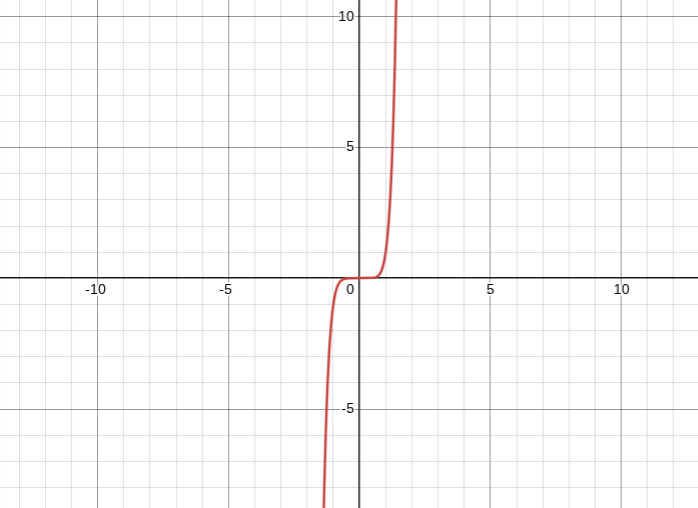
x^7