Scott Dollinger CS3377 Exam 2
 Call Kai
 Learn
 Practice Test
 Spaced Repetition
 Match
 Flashcards
 Knowt Play
1/49

There's no tags or description
Looks like no tags are added yet.
50 Terms
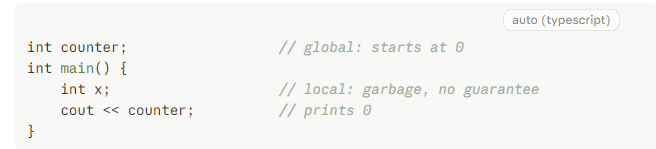
Globals are automatically initialized to zero
True

BSS is where static variables are located
True

Name the four segments of the memory model:
Text (code), static/data (incl. BSS), heap, stack

Segment holding machine instructions?
Text (code)

Where dynamic allocation happens
Heap

Segment saving return address and arguments on each call:
Stack

Segment whose items last until the program deletes them or ends
Heap

Postfix i++ on a variable used elsewhere in the same expression:
Undefined behavior

Standard file descriptors open at start
stdin, stdout, stderr

fopen(filename, mode)
Opens the file in the given mode ("r", "w", "a", plus "+" variants) and returns NULL on failure

Differences between parent and child:
Different PIDs, different fork return value, separate copies of memory
fork's return value in the child:
0
fork's return value on failure:
-1
Processes after one fork
2

if (fork()) cout...
Prints 1 time
Displays a zero getpid() after a fork
False (getpid never returns 0)

Loop for (i = 1; i < n; i++) fork()
2^(n−1) processes
Which is NOT true about forks
Pick the choice claiming shared memory or the same PID
Example: "the child shares the parent's variables" is false because the child gets a copy. "The child has the same PID" is also false.
True statements: the child inherits open file descriptors and a copy of memory.
Parent's PID is always zero after a fork
False

if (fork()) fork(); fork(); if (fork()) fork()
18 processes
What dup does:
Duplicates a file descriptor, returning the lowest unused one
Three forks in a row, how many processes?
8 processes

Index to read from a pipe
0

Index to write to a pipe
1
Which is NOT true about pipes
Pick the choice claiming pipes are bidirectional or connect unrelated processes
Example: "a pipe carries data both ways" is false because it is one-way. “
“Any two unrelated processes can share a pipe" is false because the pipe must be created before fork so the child inherits both ends.

Named-pipe open blocks until the other side opens
True

Client and server must use a known named pipe:
True

Order of named-pipe operations
Create the name string, mkfifo, chmod, open
execvp creates a new process mirroring the caller
False (it replaces the current process image)
What two sockets must agree on
Protocol/type, IP address, and port

Correct client socket order:
socket, connect, read/write, close
API not used in client code:
bind, listen, or accept

IPC mechanisms that work across a network
Sockets

Item not related to sockets
Pick the pipe, shared-memory, or fork-related choice
Example: socket, bind, htons, and sockaddr_in are socket-related. pipe() and mkfifo() are not.
Sockets cannot be used on the same machine
False

Server-side order
socket, bind, listen, accept, read/write
SOCK_STREAM
Reliable, connection-oriented byte stream (TCP)
Loopback IP address:
127.0.0.1
pthread_create start routine takes only one argument:
True (a single void *)
A pthread_start command is needed to start the thread
False
A process has one thread by default:
True
Building requires pthread.h and -pthread on the g++ line:
True
Segment not shared between threads:
Stack
Threads help because they can run longer than the process's allotted time
False

Critical code section
Code touching shared data that only one thread may run at a time

Lock/unlock device:
Mutex

Call that waits for a thread to finish
pthread_join
Is cout thread safe:
False
Linux is:
Preemptive and time-shared
PaaS means Programming as a Service:
False