Chapter 4: PSY-432 (1267-11239) PSYCHOPHYSIOLOGY DRUGS AND BEHVR (Fall 2026 M16) 002
 Call Kai
 Learn
 Practice Test
 Spaced Repetition
 Match
 Flashcards
 Knowt Play
1/19

There's no tags or description
Looks like no tags are added yet.
20 Terms
_______ is an example of an ionotropic receptor.
Dopamine
Anandamide
GABA
Opioids
GABA
The blood–brain barrier (BBB) is the strongest in the
area postrema.
posterior pituitary gland.
frontal lobe.
hypothalamus.
frontal lobe.
The first-pass effect occurs with which of the following routes of administration?
Inhalation
Transdermal
Oral
IV
Oral
__________ is the most important organ for metabolism of drugs.
Bladder
Esophagus
Kidney
Liver
Liver
Intravenous injection gets the drug to the brain fastest.
False
True
False
Which is true about first-order kinetics?
The rate of metabolism is independent of the concentration of the drug.
Alcohol is metabolized by first-order kinetics.
The metabolism rate is directly proportional to the concentration of a drug.
Drugs metabolized by the liver undergo first-order kinetics; drugs metabolized by the kidney undergo zero-order kinetics.
The metabolism rate is directly proportional to the concentration of a drug.
An antagonist is a drug that
makes you sleep.
binds to a receptor and produces an excitatory response.
binds to a receptor without producing an effect except to block other substances from the receptor.
increases the reuptake of the neurotransmitter into the presynaptic neuron.
binds to a receptor without producing an effect except to block other substances from the receptor.
_______ is most subject to the first-pass effect.
Oral ingestion (pills)
Vaping
Patches
Sublingual
Oral ingestion (pills)
A substance that binds to a receptor and initiates a response opposite to that of the agonist is called a(n)
opponent.
negative allosteric modulator.
antagonist.
inverse agonist.
inverse agonist.
An agonist binds to a receptor without producing an effect except to block other substances from the receptor.
True
False
False
If two drugs are taken concurrently and are both metabolized by the CYP450 enzyme system, large amounts of drug A will increase the metabolism of drug B.
False
True
False
Which of the following is an example of behavioral tolerance?
When a chronic, heavy drinker is tolerant to Xanax, even though they've never taken Xanax before
When a chronic, heavy drinker produces more liver enzymes that metabolize alcohol
When a person who smokes marijuana regularly can handle themselves high better than they could the first time they got high
When someone who regularly uses morphine has a decrease in the number of opioid receptors
When a person who smokes marijuana regularly can handle themselves high better than they could the first time they got high
Which is true about cellular tolerance?
Tolerance that occurs when the body metabolizes a drug faster by increasing production of liver enzymes
There is no such thing as cellular tonerance
Tolerance that occurs when a person learns to handle themselves while on a drug
Tolerance that develops when the neurons adapt to the presence of a drug by changing the receptor density
Tolerance that develops when the neurons adapt to the presence of a drug by changing the receptor density
Which of the following is not a drug depot?
Muscle
The brain
Fat
Plasma proteins
The brain
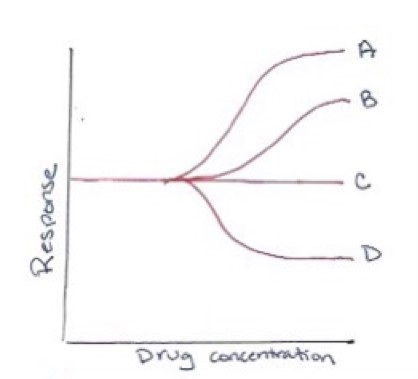
What does line A represent?
Full agonist
Inverse agonist
Neutral antagonist
Partial agonist
Full agonist
Which route of administration transports a drug to the brain the fastest?
Rectal
Oral
Transdermal
Inhalation
Inhalation
Which of the following affects drug absorption?
All answers are true
The pH of the drug
The drug's route of administration
Whether it is fat soluble or water soluble
All answers are true
Which of the following does not affect the metabolism of drugs?
Age
Mood or expectations
Other drugs or foods taken at the same time
Genetic factors
Mood or expectations

Which lettered line represents a neutral antagonist?
B
D
C
A
C
What is the route of administration for the birth control patch?
IV
Oral
Inhalation
Transdermal
Transdermal